

U.S. Drafts Ultimatum for Allies Joining China’s AI Bloc
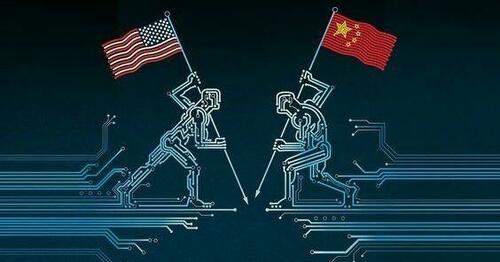
The United States is preparing to tell 35 countries they cannot belong to both the American and Chinese artificial intelligence coalitions, and that joining Beijing’s framework will cost them their place in Washington’s, according to an undated State Department draft letter reviewed by Reuters and a U.S. official who spoke on condition of anonymity.
The letter is addressed to the signatories of an “AI Opportunity Statement” the United States circulated in June, a group that includes members of Pax Silica, the non-binding framework Washington launched last year to secure supply chains for critical minerals, semiconductors and AI models, Reuters reported.
“To be part of everything is to be part of nothing. Signature of the Pax Silica Declaration is not merely a membership subscription, but a commitment.”
The letter urges signatories to choose deliberately and does not name China. The U.S. official said the document was drafted to make clear that countries “can’t have it both ways,” speaking on condition of anonymity because internal discussions are continuing.
The letter has not been sent. Reuters reported it could not determine when the State Department intends to deliver it, or whether the wording will be revised first, and said the draft carried no date. The department declined to comment on what it called “purportedly leaked internal documents.”
Kazakhstan was likely the trigger – as the only country known to have joined both frameworks. Reuters described it as a potentially important source of the critical minerals the American strategy is built to secure.
Xi Jinping launched the rival World Artificial Intelligence Cooperation Organization in July, promoting Chinese open-weight models – systems whose weights can be downloaded, modified and run on local hardware – as a challenge to U.S. influence over the sector.
China’s embassy in Washington said Beijing opposes politicizing trade and technology, and that such moves “will only stifle global AI advances and serve no one’s interests.” The Kazakh embassy did not respond to a request for comment.
Roughly two dozen countries have joined Pax Silica, among them Japan, Australia and South Korea. The framework pushes signatories toward joint projects and coordinated export controls and away from depending on adversaries for AI inputs. Membership is non-binding.
Chinese open-weight models have closed much of the gap with the proprietary systems built by U.S. firms including OpenAI and Anthropic, a shift that has given Beijing’s coalition more to offer than it had a year ago.
China has used the renewed tariff fight to demonstrate the leverage of its dominance in critical mineral processing, and Washington has moved to secure alternative domestic and allied supplies.
Pax Silica has announced accessions individually and has never published a full roster. The identities of most of the 35 countries being asked to choose are not publicly known.
Tyler Durden
Mon, 08/17/2026 – 04:15

