

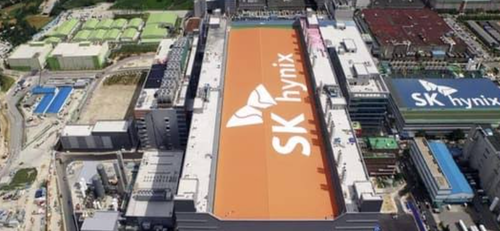
SK Hynix Unleashes South Korea’s Biggest-Ever ‘Buyback Bazooka’ To Halt Stock Rout
Asian equities fell sharply overnight as the regional semiconductor rout intensified following another downdraft in US chipmakers on Tuesday (read morning wrap). Japan, South Korea, and Taiwan led the regional declines, while Chinese stocks also weakened despite the blockbuster IPO of humanoid robotics maker Unitree.
Against that bearish backdrop, SK Hynix announced the largest share buyback in South Korean history, a highly aggressive attempt to arrest a six-week selloff that has erased roughly half of its market value. The scale of the buyback shows just how concerned management is that the drawdown has become disconnected from the company’s fundamentals and underscores its desire to put a floor under the stock.
Nikkei Asia reports that SK Hynix’s stock buyback program totals a staggering 40 trillion won, or $28.6 billion, and will involve purchasing 24.1 million treasury shares in the open market from Thursday through Nov. 19 to improve shareholder value.
“The decision stems from the assessment that the company’s intrinsic value — underpinned by its business competitiveness, robust cash generation capability, and mid-to-long-term growth potential — is not fully reflected in its current stock price,” SK Hynix said in a statement. The company noted that progress toward its financial health targets remains on track, affirming its “commitment to maintaining a stable financial structure while delivering sustained shareholder value.”
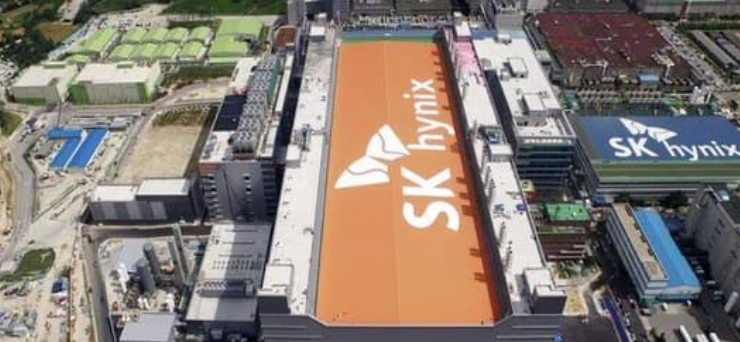
SK Hynix’s announcement followed a nearly 10% drop in the stock during overnight trading in South Korea, as rising bond yields, persistent inflation, and the deepening US-Iran crisis sparked a broader move out of semi stocks. Samsung Electronics also tumbled nearly 8%, while South Korea’s main equity index, the Kospi, fell 5.8%.
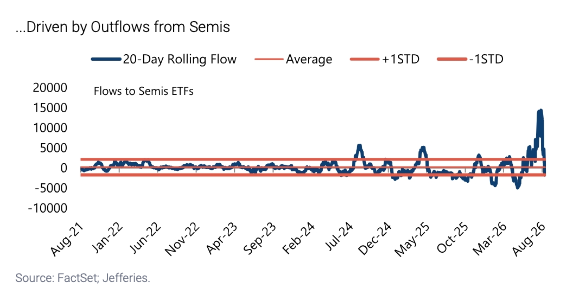
Jefferies analyst Lloyd Byrne warned clients on Monday that rising energy prices and an elevated rate environment, especially in the US, have sparked a rotation out of semiconductor stocks and into high-quality energy and materials stocks (read report).
Here’s more color on SK Hynix’s buyback program from the Japanese outlet:
SK Hynix said the buyback program marks the largest treasury share cancellation ever conducted by a South Korean-listed company. The Lee Jae Myung government encouraged listed companies to buy back and cancel treasury shares to address the so-called Korea discount, in which investors have historically undervalued the country’s stocks due to poor corporate governance and low shareholder return.
Macquarie analyst Daniel Kim provided clients this morning with why the buyback program is very important:
Why it matters
- More to come. Won40tr might be short of the market’s high and hasty expectations. However, we still think that this is just the beginning. We calculate the remainder to be returned to shareholders to be Won243tr in case of 50% FCF and Won358tr in case of 70% FCF. This is equivalent to 22% and 33% of its market cap, respectively.
- Optimal capital structure. We estimate its net cash position to mushroom from Won69tr in 2Q26 to Won192tr in 2026-end and to Won523tr (50% of its market cap) in 2027. This would be way higher than the level of cash on hand the company wants to keep to cover 2 years’ capex, or over Won120tr.
- Additional ADR issuance. Assuming SK Hynix issues the same 24.07mn shares, or 240.7mn ADR (10 ADR to 1 underlying), the company can bring in Won59tr proceeds due to a 47% ADR price premium, resulting in even higher net cash balance. In other words, its cash balance should continue to swell, and we think its war chest should be strong enough to return even 100% of FCF like its US peers.
- Likely a big increase in cash dividend. We expect Hynix to increase cash dividend substantially from 2026. This should be positive for SK Square (402340 KS, Outperform), which owns 20% stake in SK Hynix. Hynix increased capital surplus by Won4tr in 1Q26, which could be paid as tax-free cash dividend for 2026. Thanks to ADR issuance, Hynix now has more room to raise capital surplus and accordingly is able to increase tax-free 2027 cash dividend.
- Upside to 50% of FCF. Management alludes the upside to the current 50% FCF rule and the mix of capital return could be skewed to share buybacks versus cash dividend. Different from its local peer, SK Hynix will not count the spending on M&A in FCF calculation.
What now
- SK Hynix, in our view, is in oversold territory, considering strong earnings momentum, continued shareholder value enhancement. Outperform.
SK Hynix’s shares in Korea are down 45% on the year. US ADRs are up 6% in early trading.
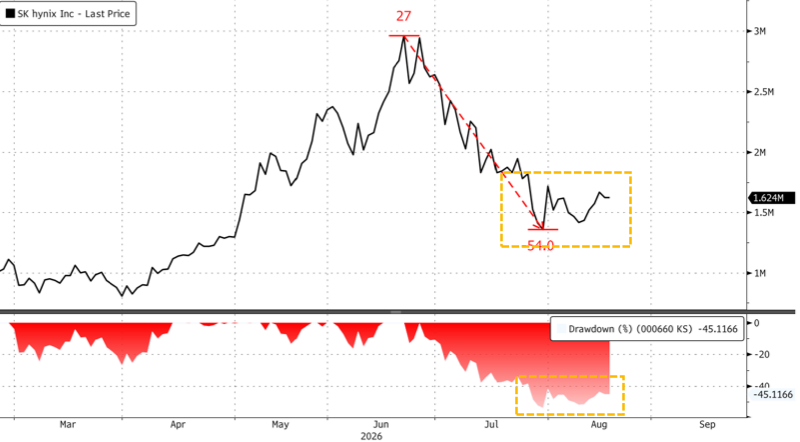
SK Hynix accounted for 21.43% of the Kospi’s market capitalization at Tuesday’s close, making it the index’s second-largest constituent, behind Samsung Electronics at 27.71%.
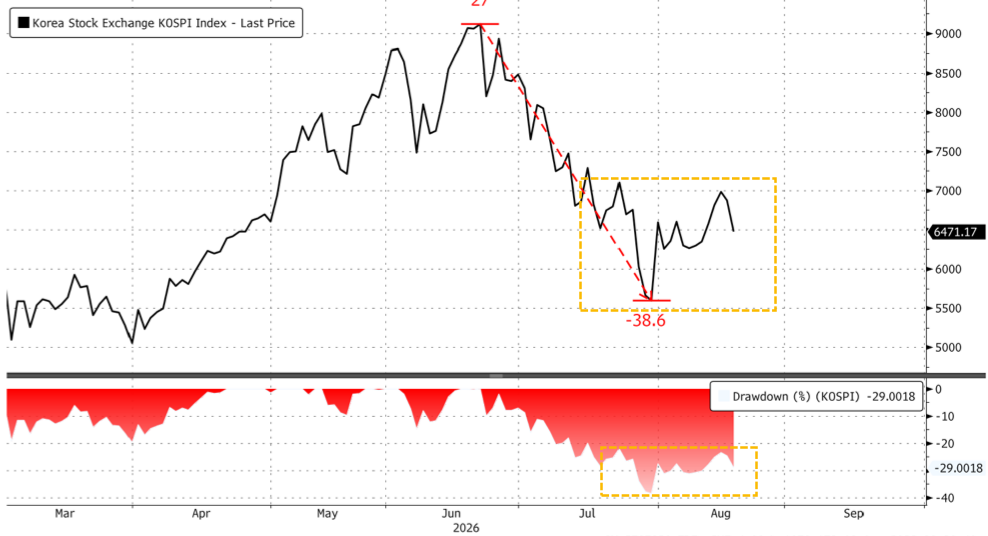
Any reversal in SK Hynix could help stabilize the broader equity index…
… and are about to blow up all over again https://t.co/vU9i4jXYXk
— zerohedge (@zerohedge) August 19, 2026
Tyler Durden
Wed, 08/19/2026 – 10:00

