

Markets Now Face Two Wars And Two Economic Wars
By Michael Every of Rabobank
Two wars and two economic wars
Friday’s Jackson Hole speech from Fed Chair Warsh would traditionally be the big event this week but that’s arguably no longer true: the action is not with central banks but elsewhere. I don’t mean the ECB’s Lagarde going to work for the WEF. Rather, markets now face two wars and two economic wars.
Dawn in the US will see what Treasury Secretary Bessent calls ‘Economic D-Day’ designed “to sever every economic lifeline that sustains the tyrannical regime until Tehran stands alone.” Until the regime collapses – and everyone must either stand with the US or against them. Iran has likewise stated that any country joining new US sanctions would be “considered an enemy.” Yes, Iran’s (powerless) president said the US MoU is still the best path out of this mess, as Pakistan’s army chief is to visit Tehran again today; then again, Iran also claims Saudi Arabia, Turkey, and Pakistan invited it to join their new defence pact, which just failed to defend the Saudis from attacks by the Houthis instigated by Iran.
Indeed, as the Iranian parliament advances plans for Hormuz ‘service fees’ and the US says it’s shuttling more oil through Hormuz, the risk is Tehran opts to attack the GCC and US bases in Europe. Greece is moving a Patriot missile system to Crete. The UK is having to face that Iranian hackers just shut down one of its power plants for four days. As if that were not enough, worrying signals about Turkey-Israel clashes in Syria have prompted deescalation efforts, yet regional tensions remain very high. Towards the western edge of the MENA region, Spain has rejected Morocco’s calls for talks on Ceuta and Melilla sovereignty.
Today marks Ukraine’s Independence Day, with EU officials in Kyiv to celebrate. With Russia testing its readiness for military mobilisation, France is promising help with missile interceptors for Ukraine, Germany a €12bn missile program, and the UK has handed over its Storm Shadow missile blueprints alongside plans to build them there. The Kremlin has warned there will be consequences for these actions and is allegedly already sabotaging weapons factories across Europe. Putin also says Ukraine opened a ‘Pandora’s box’ with its strikes vs. economic targets, and Zelenskyy says Russia refused a Black Sea shipping truce, ensuring more destruction to trade.
Canadian PM Carney stated his country is now in an “economic war” with the US after USMCA negotiations collapsed. He will be matching US tariffs dollar for dollar from 8 September. The alleged list of US demands made on Canada include scared cows like dairy and parts of the auto industry, weakened domestic cultural protections, and binding defence commitments, but also tougher trade rules of origin and restrictions on Canada’s sovereignty to sign trade or investment agreements with other nations.
Canada presumed this was just an FTA discussion. The US — as was abundantly clear — is only interested in forging a tight-knit Fortress North America bloc as part of its Grand Macro Strategy. Against that backdrop, what is Canada’s Grand Macro Strategy?
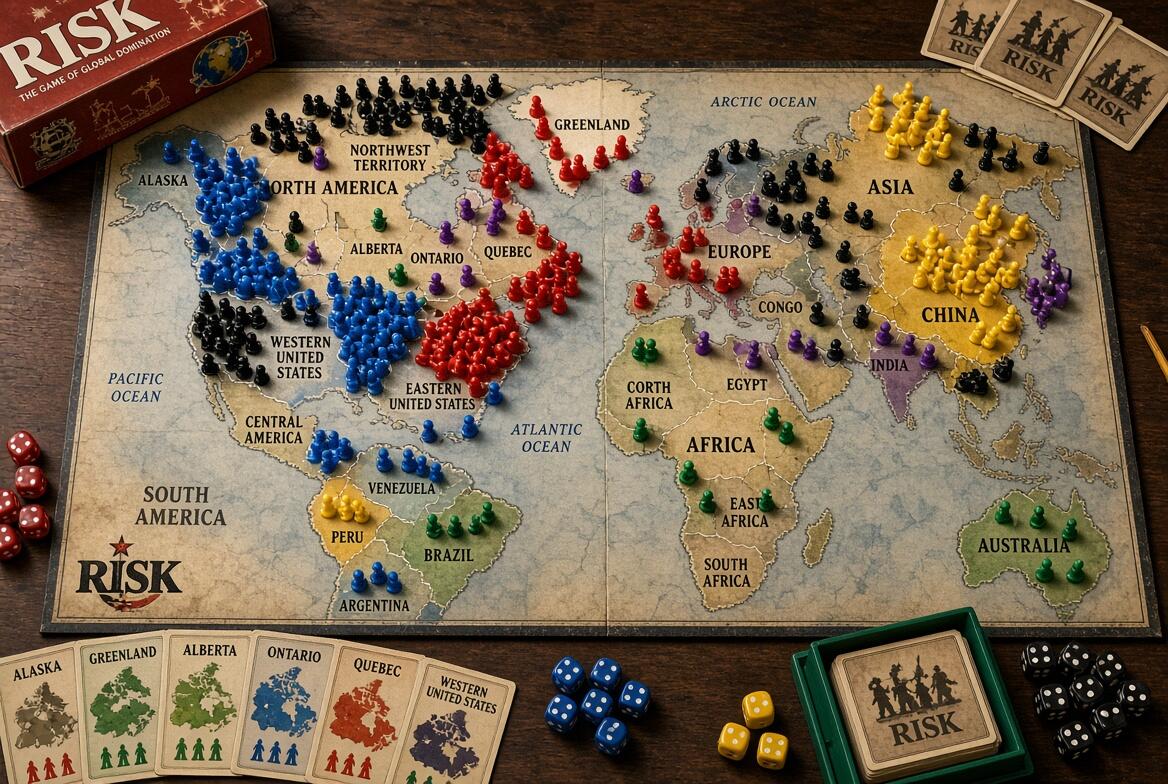
Canada is 1/10 the size of the US economy. 90% of its population sits two hours drive from the US border. It’s deeply integrated into the US economy. It runs mostly north-south, not east-west trade, with internal tariffs. As KPMG notes, “Canadian manufacturers are shifting production toward the US, and the movement is material.” It’s rich in resources. It has a separatist issue in Quebec and might soon have one in oil-rich Alberta. It has a lot of privately held guns but a weak military with a very large territory to patrol. It has long relied on a US defensive shield. It also now has a pivotal geostrategic location that’s becoming vulnerable as the Arctic transforms into a playground for the Great Powers, which matters hugely to the US for *its* national security. So:
It could do more internally, but enough to mitigate being choked by the US? It’s a trading nation and can’t just go solo.
It could side with China… unleashing a FAR stronger US reaction across the spectrum, just as The Economist notes China’s “Leninist” neomercantilist model deindustrialises others. How many cars or planes will Canada sell to it vs. raw materials?
It could, but won’t, join Russia as an Arctic power – and see a US *and* EU pushback.
It can’t join the EU as it’s *not in Europe* but could ‘do a Norway’ of sorts … then Europe would insist on the same control of its external trade, as Europe is moving closer to ‘buy local’ schemes and confronting China like the US.
It could work with the UK and Australia: but both lack a Grand Macro Strategy and are too small, too reliant on the US, and too far away. In Asia, Japan and South Korea are locked into the US camp, and ASEAN are mostly net exporters trying to balance the US and China.
In short: give in and accept the liberal world order is truly over, as is Canadian sovereignty; fight an economic war when heavily outgunned (…in the hope of a better deal or outcome from the US midterms, which is just a tactic?); or encourage the liberal world order to shrink further by choosing China, which will also imply a loss of sovereignty over time along with fears of more worrisome US actions. If that sounds like a Melian dialogue to some degree, it sadly is.
While the direct impact of the US-Canada fight on world markets is small, symbolically it matters hugely. Middle Powers, and China and Russia, will be watching to see who wins, just as they are with the US-Iran. Markets will move on that.
On which, as the financial press notes ‘Warsh seeks to soothe investors’ nerves’, yet ‘Bessent Has No Easy Fix for What’s Really Driving Yields Up’, and hears from ‘US economist Barry Eichengreen on reality of de-dollarisation and next currency reshuffle’, and as Bitcoin nears $80,000 in its biggest weekly rally in three years, something else Trump just said about rising bond yields and Bessent’s Special Military Operation Twist is worth focusing on: “The ultimate intervention is our military, and if we have to use that we will.”
Yes, folks – physical power sits behind global markets. They only exist in their current form because US power won WW2 and the Cold War, and it then used that legacy to allow markets to think they get to decide everything. Now they don’t, as Trump is making painfully clear to Canada and other Middle Powers in terms of physical markets. And he’s not the only one playing that game. That in turn flows up to financial markets.
If you want to push bond yields down… raise taxes; cut spending; cut rates; do Operation Twist; QE; or YCC. Or boost the supply side with subsidies themselves subsidized with export earnings. Or use your military to take control of upstream commodity supply chains to redirect supply where you want it, ‘encouraging’ others to strike deals with you on your terms. Yes, *such wars can be lost*, but the underlying principle should be obvious. And it’s not, “because markets.”
Ironically, those joking about what Trump said, accept ongoing BOJ JGB buying or the ECB’s APP and TPI schemes, the latter allowing unlimited bond buying to supress price discovery in peripheral Eurozone bond markets, precisely “because markets” and technobabble. Drawing an analogy, they are like those enjoying a nice chicken sandwich at the desk for lunch while preferring not to think about the existence of slaughterhouses that allow them to be served.
Bessent and Trump are saying they are willing to do ‘Whatever It Takes’. Warsh, Lagarde, PM Carney, and all of us are going to have to adapt to that awkward fact – and the equally awkward geopolitical and market movements that come alongside it whether the US wins or loses.
Tyler Durden
Tue, 08/25/2026 – 08:20

