

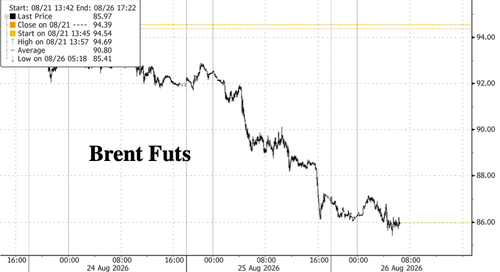
Oil Dumps As Iran, Oman Push To Reopen Hormuz; Satellite Image Shows Gulf Producers Ramping Up
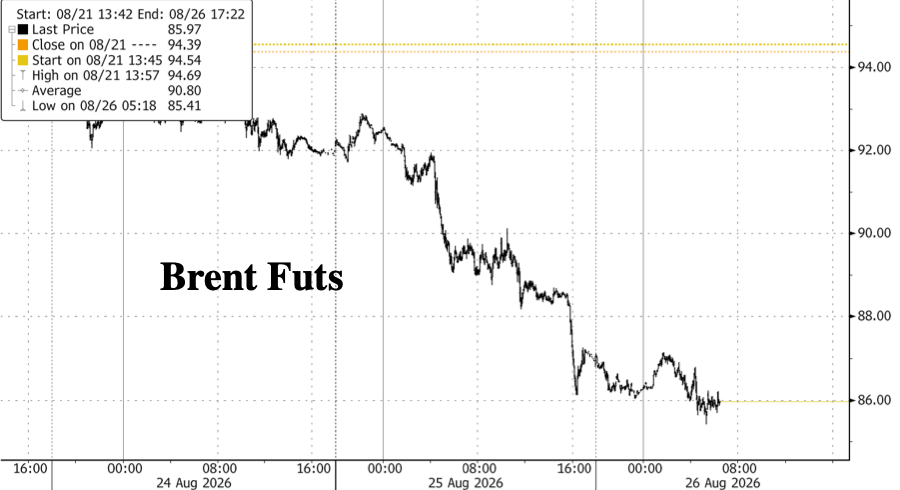
Brent crude futures dropped for a third session as Iran and Oman advanced plans for a temporary maritime corridor through the Strait of Hormuz.
Brent tumbled to $85 a barrel early Wednesday, down more than 9% for the week, while West Texas Intermediate traded around $80. Crude remains up more than 41% this year following the US-Iran conflict and ongoing disruptions at the Hormuz chokepoint.
Earlier, Oman’s state news agency reported that Iranian Foreign Minister Abbas Araghchi and Omani Foreign Minister Badr Albusaidi discussed an “interim framework” establishing a temporary joint shipping corridor.
Iranian Deputy Foreign Minister Kazem Gharibabadi said both countries agreed on a temporary route and intend to negotiate a permanent corridor within 30 to 60 days, according to Tasnim. No timeline has been given for when the temporary deal to reopen the critical waterway would begin.
Talk of an interim deal comes as oil loadings from Iraq’s Persian Gulf export terminals surged at the beginning of the week, offering one of the clearest signals yet that regional Gulf producers expect Hormuz tensions to dissipate.
Satellite imagery showed seven tankers collecting Iraqi cargoes, with a combined carrying capacity of roughly 13 million barrels, according to Bloomberg.
Maritime research firm TankerTrackers also reported on X, saying, “A busy day in the Gulf of Oman, where there are at least fifteen sets of STS transfer sessions taking place. We count 25 million barrels of crude oil; plus some refined products. The oil originates from almost every country in the region, minus Iran.”
A busy day in the Gulf of Oman, where there are at least fifteen sets of STS transfer sessions taking place. We count 25 million barrels of crude oil; plus some refined products. The oil originates from almost every country in the region, minus Iran.#OOTT #IranWar #Tankers pic.twitter.com/TAba26mJiW
— TankerTrackers.com, Inc. (@TankerTrackers) August 25, 2026
“It seems crude is now beginning to price in a sooner rather than later peace deal,” said Dennis Kissler, senior vice president for trading at BOK Financial Securities, who Bloomberg quoted.
Kissler noted, “With some oil still getting through the strait, Iran and the US are more likely to be in a newer state of de-escalation as both sides are looking for an off-ramp.”
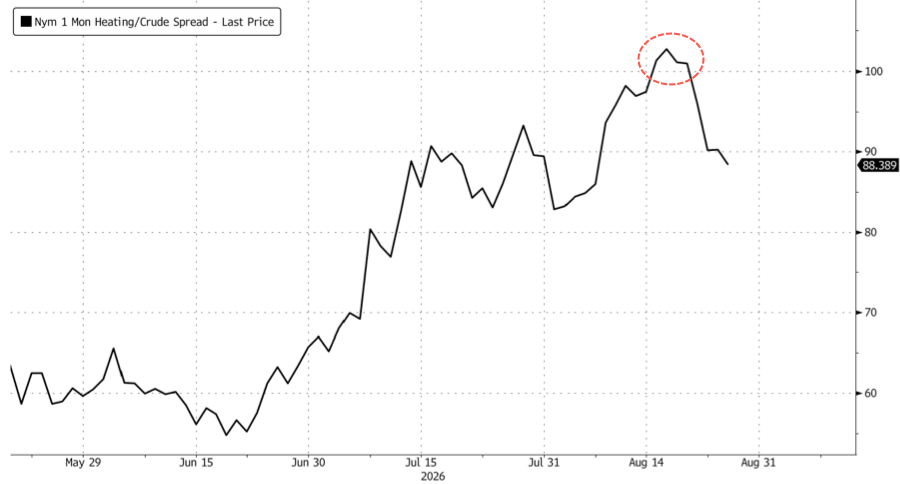
By now, readers know that the energy crisis is not necessarily about crude, but rather refined products, as diesel crack spreads in the US topped $100 a barrel. The good news is that, by midweek, the spread was trading around $88.
Related:
Last week, veteran commodities strategist Jeff Currie detailed on X that the next commodities bull market was poised for another leg higher (read note).
The latest developments in the Gulf are promising signals, but an interim framework should not be mistaken for a durable normalization of regional tanker transits through the maritime chokepoint. Previous de-escalation efforts have repeatedly broken down, often returning the region to drone attacks on tankers and short-lived military tit-for-tat bombing campaigns. Until a permanent and enforceable shipping deal is set in stone, the Hormuz risk premium is likely to remain embedded across crude and refined-product markets.
Tyler Durden
Wed, 08/26/2026 – 06:55

