

Druckenmiller Warning: The Bond Market Already Priced It
Authored by Lance Roberts via RealInvestmentAdvice.com,
Recently, Stanley Druckenmiller wrote an opinion piece for the Wall Street Journal. The “Druckenmiller warning” hit on August 24, and within a day, the financial press turned it into a soap opera. Some of the headlines were “Mentor scolds protégé,” and “Billionaire slams the Treasury Secretary.” Then, the revelation that he wrote it with the help of AI somehow became its own headline.
However, while the media was busy making headlines, the argument was lost. Stanley Druckenmiller did not forecast a debt crisis, nor pitch a trade. What he said was something difficult to fit in a headline, and it was something the bond market has already said for him.
What Actually Happened On August 19
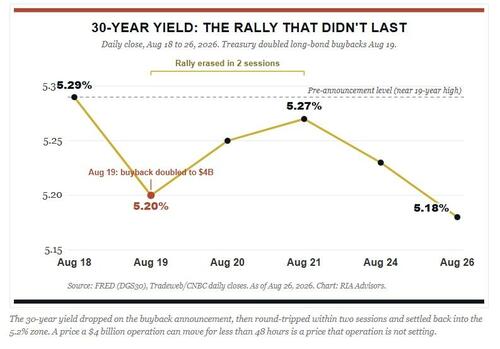
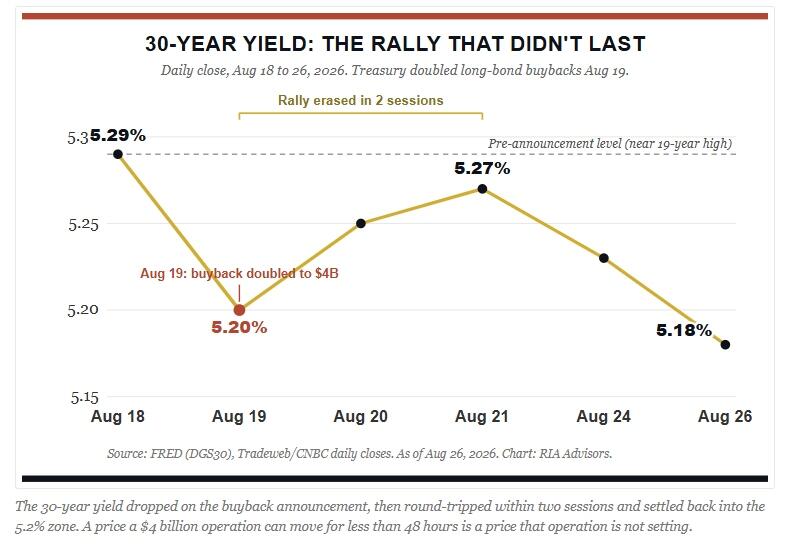
On August 19th, the Treasury said it would double the size of its long-dated buyback operations to at least $4 billion. That operation will run from September 9 through November 4 (it hasn’t started yet) and is aimed at the long end of the curve. The timing of the announcement was the tell, and the heart of the Druckenmiller warning, as the move came right after yields hit their highest level in about 19 years. Yields dropped on the news, but by the next trading day, the bond rally was reversed. The long bond has hovered in the 5.2% range since then.
Treasury Secretary Scott Bessent then told CNBC the operations could run bigger than $4 billion. Days later, senior officials floated the idea of using the department’s nearly $950 billion cash account to help fund the purchases. What is crucial to understand is that these actions are a very different conversation from “liquidity support.”
You do not need to support a market you yourself describe as having strong, consistent sponsorship, and that strong sponsorship is the definition of a healthy market. However, the Treasury intervened anyway right after yields peaked, which is why the market read it as “price management” and shrugged.
What The Druckenmiller Warning Actually Says
I posted the link to Druckenmiller’s warning above, and encourage you to read the piece closely. When you do, you will realize that the popular summary falls apart.
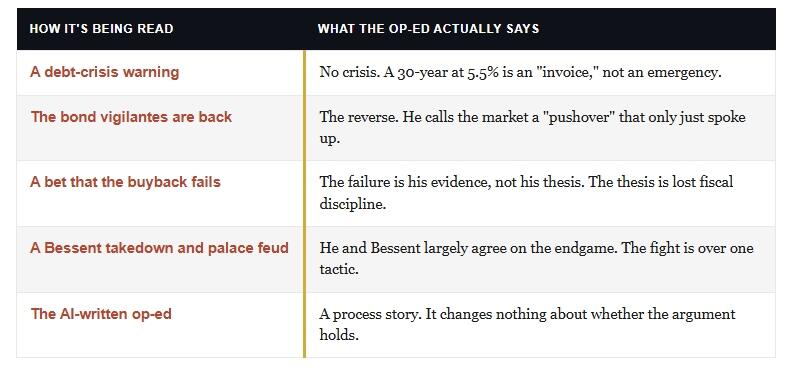
Most notably, the article was not a claim that yields are about to spiral. What Druckenmiller suggests is that a 30-year bond at 5.5% is an “invoice,” not a “crisis,” nor was it a claim that the “bond vigilantes” have finally arrived. He actually described the opposite: a market he called “a pushover that had finally begun to clear its throat,” and the bond market has been too calm, rather than too violent.
However, Druckenmiller’s real target is structural. To wit: the long bond, in his framing, is “the only fiscal disciplinarian the U.S. has left.” He states that if you suppress that signal, you subsidize the one thing Washington does reliably well: “delay.”
While many currently point fingers at the Republicans, particularly as we approach the mid-term elections, the reality is that neither party has the will to touch entitlements with the market applying pressure. But more importantly, without that pressure, neither party has shown the will to touch them either. Such is why entitlements are called the “third rail of politics,” because if you touch them, your political career is toast.
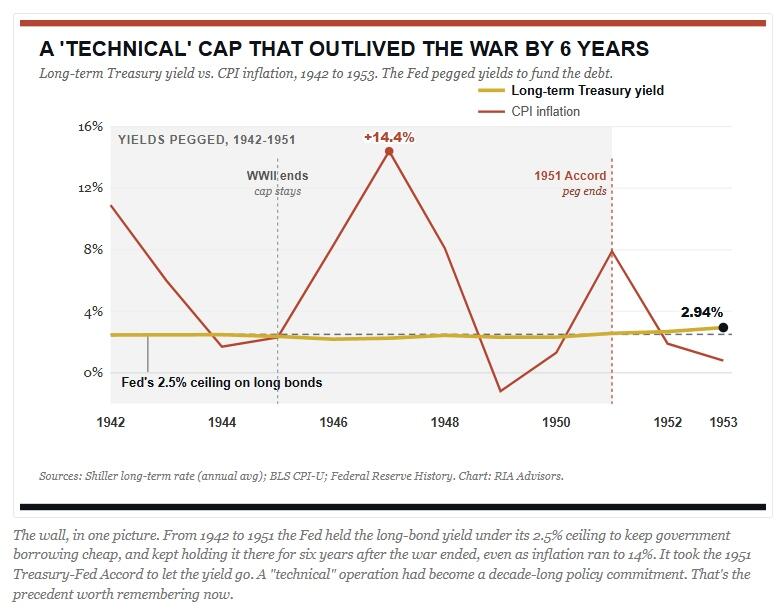
There’s a second layer that most of the media coverage skipped. Historically, yield management has always started as a technical operation. However, as with most things in Government, it tends to end as a more permanent policy commitment. From 1942 to 1951, the Fed capped long Treasury yields to finance the war. Naturally, that cap outlived the war by years before the Treasury-Fed Accord finally killed it. The wall between managing the debt and managing bond prices was built on purpose. Unfortunately, that “wall” gets blurred by this intervention.
The last time this happened, it looked like this.
The gap at the center of the Druckenmiller warning is the space between what he wrote and how it’s being read. That gap is wide enough to matter. The table lays it out.
The Strongest Case Against The Druckenmiller Warning
To be fair, the bond bears have a valid point. Someone will wave the whole thing off as $4 billion against a market north of $30 trillion, a rounding error. So, what is all the fuss about? They are correct about the arithmetic. Four billion dollars cannot set the long end, and the recent round-trip in yields proves it. However, that also exposes the risk in the argument. You can’t call an operation both impotent and dangerous in the same breath without saying which one it is.
(The chart below shows the history and magnitude of previous buybacks. This is not unprecedented by any measure.)
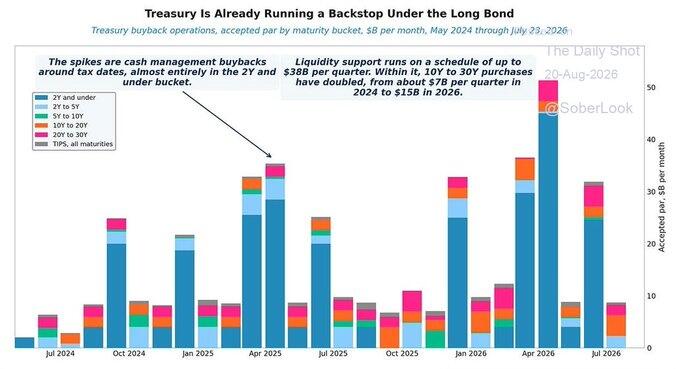
There is a much better version of the pushback, and it comes from people like Jon Hilsenrath. He noted that a move in long yields isn’t purely fiscal information but also reflects dealer balance sheets, hedging flows, and the financing of levered positions. The March 2020 and 2022 gilt crises both showed that liquidity can seize up even when the fundamentals look fine. Furthermore, Bessent’s stated case is that the Treasury sees something about market functioning that outsiders don’t. That probably isn’t as crazy as it sounds on its face.
So where does that leave the Druckenmiller warning? In our opinion, it is much stronger than its critics allow, for one reason. The danger was never the four billion dollars. The mistake is the precedent: the signal that the Treasury will now step in to defend a price. Once the market believes that, every selloff becomes a test of official resolve, and the tests only get bigger. This is the very definition of “moral hazard” that we discussed previously. More notably, the bond market has already ruled on this point.
Bessent’s actions run counter to Kevin Warsh’s recent mandate to remove the “Fed Signal” from the market. For investors, this means we will need to watch the next moves from both Bessent and Warsh.
What The Druckenmiller Warning Means For Bond Investors
The future is currently uncertain. What will happen with oil prices, tariffs, and political policy? The mid-term elections are coming quickly, and there are signs of both economic weaknesses and strengths. The Fed is signaling it is backing away from market support, but the Treasury says it is still there. It’s all confusing, but for investors managing their own portfolio, it suggests several changes to both strategy and holdings.
-
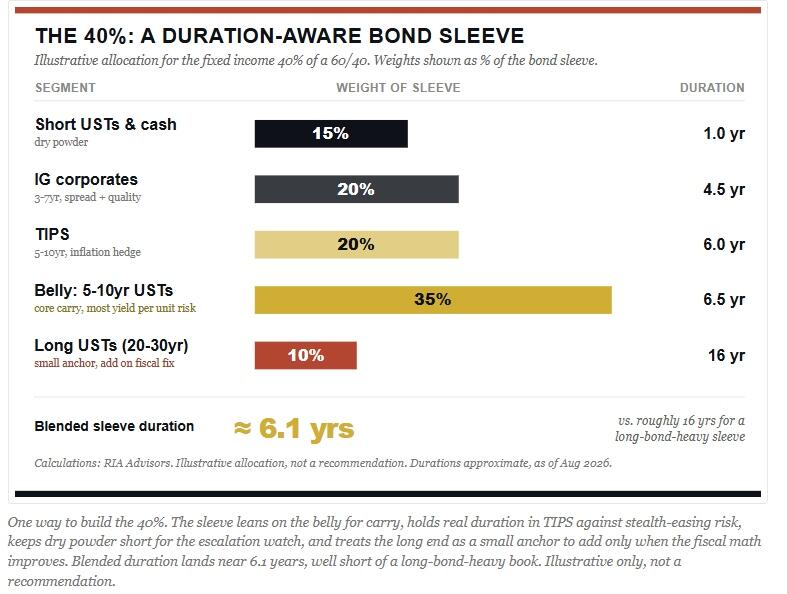
Do not buy the long bond for the buyback bid. A $4 billion operation is a backstop, not a floor under prices. Supply at the long end is getting heavier as deficits run near 6% of GDP. Furthermore, corporate issuance is competing for the same buyers. The 20- to 30-year part of the curve is now a political football. Political footballs trade with extra volatility.
-
Own the belly of the curve, the 5- to 10-year part. That is where you capture most of the yield with far less duration risk. You also reduce exposure risk to whatever “policy commitment” the long end gets dragged into. At a 10-year near 4.7%, the coupon does real work as you are paid to wait. Just take that interest rate “carry” where the duration risk is SMALL.
-
Lastly, it could pay to keep some inflation protection in the mix. If the Treasury escalates its interventions and funds long-bond purchases with bills or its cash account, that’s a quiet form of easing. However, that is occurring while inflation still runs above the Fed’s 2% target. In that environment, TIPS will earn their place in portfolios. But the risk is that you cap your returns if the term premium keeps grinding higher on increasing supply.
Here is an example of the 40% allocation in a 60/40 equity/bond portfolio.
So, here is the question worth asking.
“If there’s no crisis, why not just own the long bond and clip the coupon?”
The answer is the escalation path, so you will want to watch the Treasury General Account. If Treasury actually deploys the $950 billion to defend a yield level, Druckenmiller’s “technical tool becomes policy commitment” line stops being theory, and the trade shifts toward steeper curves, more inflation protection, and shorter nominal duration.
The one thing that would push me to extend into the long end with conviction is the opposite of intervention. A credible plan on the deficit would do more for the long bond than any buyback. This is the real point of the “Druckenmiller Warning,” and it’s mine too. I’ve argued before that the debt problem is a crisis without a calendar. However, that is what the waiting looks like.
Tyler Durden
Sun, 08/30/2026 – 11:40

