

Starbase Louisiana 101: A Look At Elon’s New Space City
Following the Starbase Louisiana announcement last week, questions have swirled over Musk’s motivation for choosing this location. In response, Deutsche Bank analyst Edison Yu takes a closer and identifies four main reasons including i) orbital trajectory (optimizing for ODCs), ii) geography, iii) regulation, and iv) propellant (bringing processing/production onsite).
New Starbase
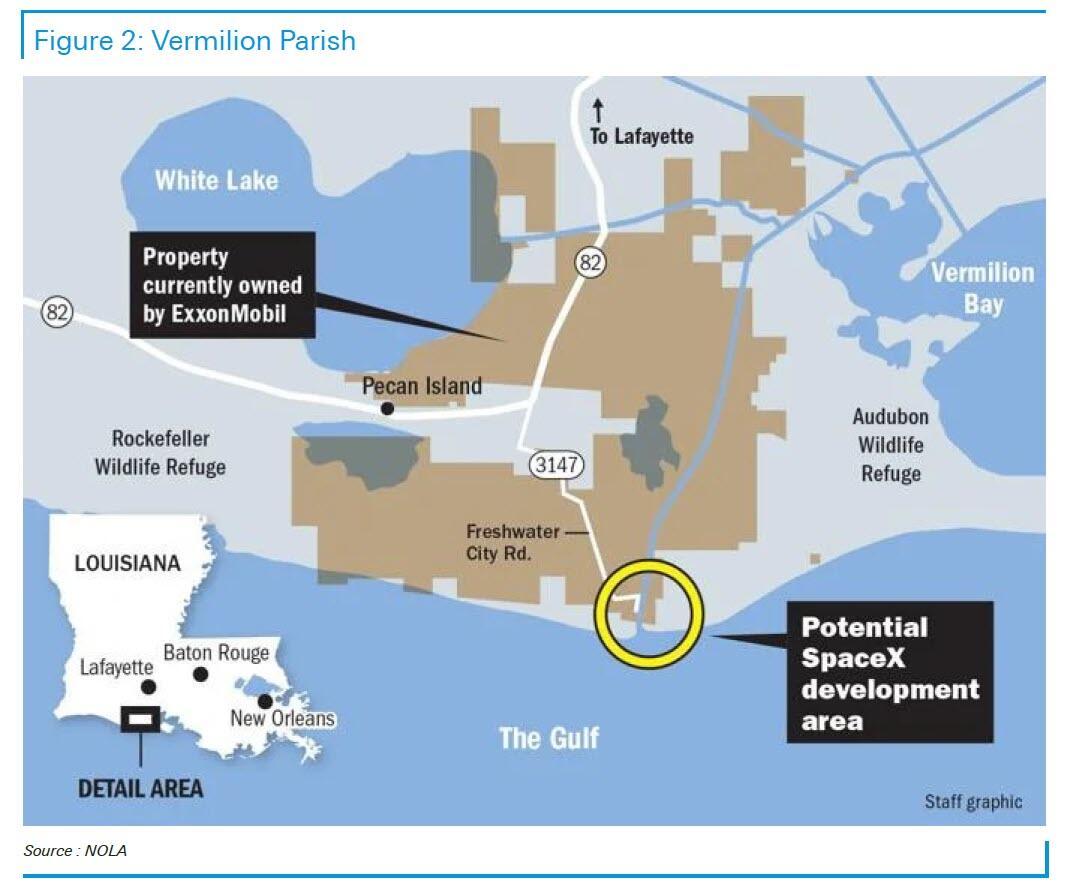
SpaceX announced a new $100 billion Starship launch site in Louisiana last week with initial plans to build five two-pad complexes or ten towers. Longer term, Elon Musk commented there could be over twelve towers capable of launching more than 30 flights daily. The site is expected to be materially larger than Starbase Texas and essentially be a “space city” with on-site fuel processing/production, dedicated power generation, deep-water port, employee housing, and potentially an airport; Starship manufacturing however will seemingly not occur here. Construction is slated to begin next year with first launch slated for no earlier than in 2029 (2030 is more realistic). Headline investment amount is $100bn although this could span over a decade. The exact location will be an area called Pecan Island (~125k acres), located in the Vermilion Parish which is on the Gulf of America coast. The site was formerly owned by ExxonMobil and was transferred to the state following settlement of a coastal environmental lawsuit. SpaceX expects to create about 10,000 jobs with 60-80% being locally hired.
Rationale #1 – Orbital trajectory
To establish some basic principles: the Earth’s spin is fastest at the equator. Therefore, a rocket launching eastward starts with that speed already in hand. The further from the equator a launch site sits, the less benefit from that free push. Inclination is the angle an orbit makes with the equator. For example, a satellite in a 0° orbit circles above the equator; one in a 90° orbit passes over both poles. The rule is essentially a rocket can most efficiently reach any orbit whose inclination is at least the latitude of its launch site. Reaching a lower inclination requires an expensive mid-flight turn, burning fuel that could otherwise have carried payload. Azimuth is the compass direction the rocket flies after liftoff. Rockets shed spent stages and occasionally fail, so regulators only permit trajectories where debris would fall over open ocean water or empty land.
As discussed in our Data Centers in Space series, SpaceX is seeking to deploy a large number of orbital data centers. The ideal position for these satellites is a type a sun-synchronous orbit (SSO) running along the day-night boundary (“dusk-dawn orbit”), to maximize continuous sunlight. To launch to SSO, the rocket needs to fly nearly due north or due south. That means a launch site with open water or empty land in that direction is optimal. SpaceX’s existing Starship site at Boca Chica sits at the southern tip of Texas, on the Mexican border. It launches east over the Gulf of America because southerly trajectories run into Mexican territory almost immediately. So while it is a decent site for the orbits Starship has been testing into, it is not ideal for high volume SSO launches. In comparison, a site on the central Louisiana coast sits further from the Mexican coastline and opens a long southerly corridor over open water.
Rationale #2 – Geography
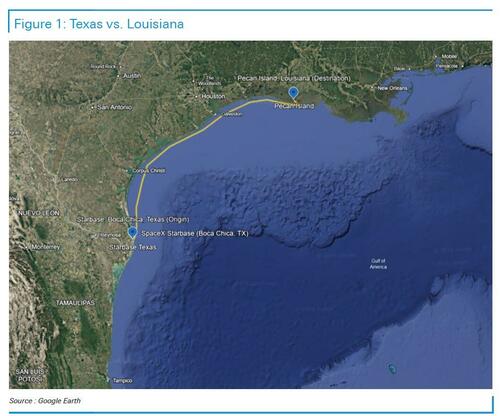
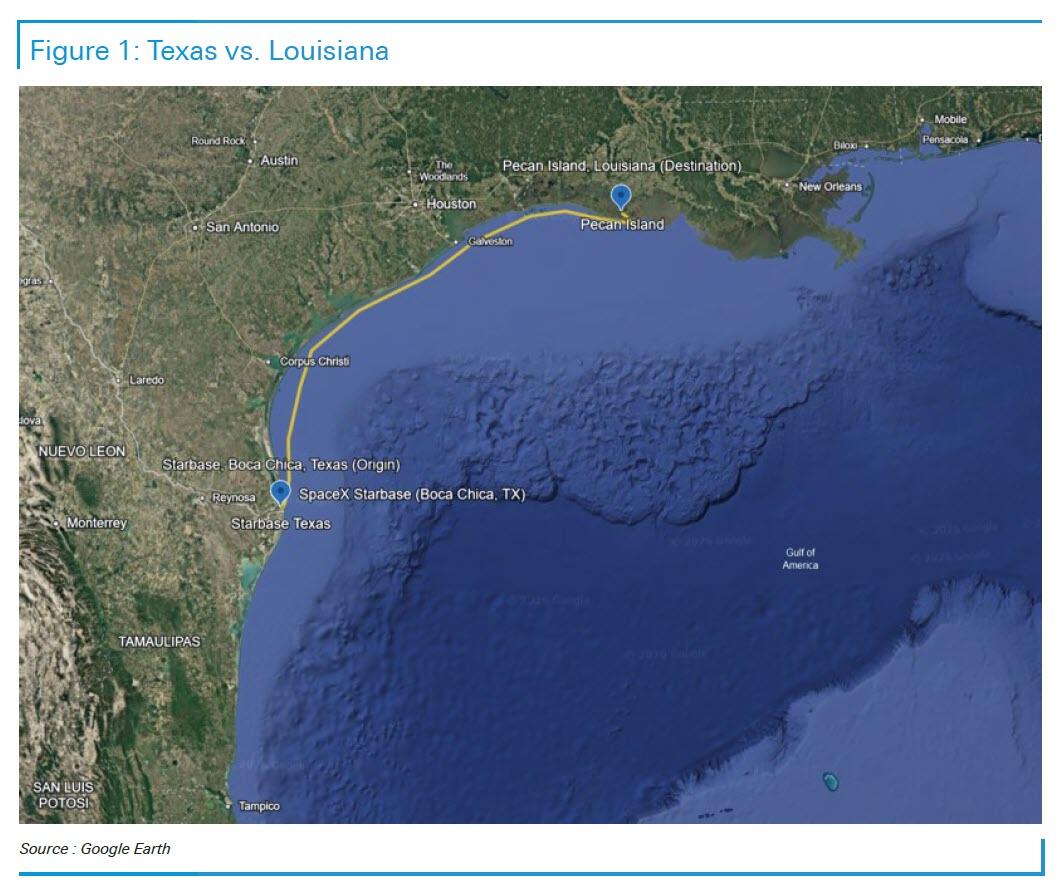
Due to Starship’s enormous size, it’s impractical to use truck or rail for transport. Instead, the rocket will be moved by barge on water and be relatively accessible from the production site in Texas. Pecan Island is an 18-mile strip with a deep-water bayou off the Gulf of America which can serve as a port. Moreover, there’s also the sheer size of the area (125k acres), allowing for the build out of towers, propellant farms, power generation, etc… Other locations are either too small or crowded (e.g., multiple entities launch from Florida now). For context, the total scope of area in Texas owned or controlled by SpaceX covers <10k acres even after factoring in potential annexations.
In relation, the LA location is ideal for methane supply. Henry Hub is in Vermilion Parish and sets the US natural gas benchmark pricing (nearly 10% of US production is in Louisiana). Around a dozen interstate and intrastate pipelines interconnect here. The Louisiana Gulf Coast is also home to a very dense concentration of gas liquefaction expertise built up around the LNG export terminals over the years.
Rationale #3 – Regulation
SpaceX indicated it has been looking for a high-rate launch site for about seven years and discussions began with state officials (Project Osprey) in early 2026. DB’s original view was that Texas could scale up to 4-5 launch pads and the regulatory regime would gradually adapt. With the Louisiana location, this should help de-risk longer-term capacity constraints by shifting traffic to a different corridor although certain details still need to be worked out (launch licenses, wildlife, airspace, etc…). Currently, the FAA has capped Starbase Texas at 25 launches annually (up from initial 5) and could scale up further to >100; a bottleneck would emerge at some point even factoring in an additional 120 licensed flights out of Florida, where SpaceX is planning to have three pads. Ultimately, Florida will be mainly used for NASA/govt missions and Vandenberg will continue launching Falcon 9 for the foreseeable future, leaving Texas and Louisiana to be workhorse sites for Starship-captive missions (Starlink, Starmind).
Rationale #4 – Propellant
Beyond launch operations and regulation, the next structural bottleneck appears to be propellant, which the Louisiana set-up can potentially address. For background, Starship’s Raptor engines run on liquid methane or LCH4 and liquid oxygen or LOX (known together as methalox). A fully fueled stack weighs roughly 5,000 metric tons at liftoff, of which about 4,600 metric tons is propellant. The engines burn the two in a ratio of ~3.6 parts oxygen to 1 part methane.
At small scale, propellant can be transported via trucks. To illustrate, a typical LOX trailer holds about 20 metric tons, implying 180 trucks per flight. However, this is not scalable once Starship reaches hundreds of flights annually, let alone thousands. It is therefore likely that LOX will be made onsite and then piped to tank farms near the pad. LOX is made out of air, using electricity by compressing, cooling, and then distilling. To do this requires large cryogenic air separation units (ASUs). Similarly, methane is also trucked in now but will be processed onsite and piped. In fact, SpaceX already is building Starpipe in Texas (8-mile, 16-inch natural gas pipeline from Brownsville) along with its own liquefier and air-separation unit. Long term, assuming a launch cadence in the thousands, this type of architecture will be required and could drive large cost savings.
More in the full DB report available to pro subs.
Tyler Durden
Fri, 09/04/2026 – 22:48

