

FICO Crashes As Trump Housing Chief Pulte Cracks Mortgage-Score Monopoly
“Equifax, Experian, and TransUnion have been overcharging Americans for far too long,” Federal Housing Finance Agency Director Bill Pulte wrote on X late Thursday.
The Trump administration’s campaign against the cost of credit scores and reports used in the mortgage industry sent shares of Fair Isaac, the company behind FICO scores, as well as Equifax and TransUnion, tumbling on Friday morning.
Pulte continued: “This will end soon. We are seriously considering bi-merge, and stronger solutions (SAFER and SOUNDER). We will not allow companies to take advantage of American consumers. No more.”
Equifax, Experian, and TransUnion have been overcharging Americans for far too long. This will end soon. We are seriously considering bi-merge, and stronger solutions (SAFER and SOUNDER). We will not allow companies to take advantage of American consumers. No more.
— Pulte (@pulte) September 4, 2026
Pulte’s warning was accompanied by a Reuters report that mortgage giants Fannie Mae and Freddie Mac will allow all lenders to use VantageScore, a competing credit-scoring model, expanding a rollout across 50 lenders.
The move to lower costs for homebuyers and boost competition in the mortgage credit-scoring market, which FICO dominates, is seen by the market as a direct challenge to FICO’s long-standing dominance.
Ashish Sabadra, an equity-research analyst at RBC Capital Markets, provided clients on Friday morning with more details about the industry implications following Pulte’s X post:
Assessing the Impact on Credit Bureaus (EFX/TRU/EXPN) and FICO
Our view: Tweet from FHFA Director Bill Pulte suggests the agency is seriously considering permitting bi-merge credit reports for conforming loans. If fully adopted across the mortgage market, this shift could negatively impact up to one-third of mortgage inquiries. Beyond volume loss, the move would also introduce greater competition in mortgage credit reporting, a dynamic we will monitor closely for signs of pricing pressure.
Regarding bureau-level impact, EFX carries the greatest mortgage exposure given its mortgage solutions and income and employment verification businesses, though these same assets also present meaningful bundling opportunities. However, with the remaining third-party resellers estimated to control 75%+ of the market, these players may preferentially gravitate toward TRU and EXPN. EXPN has the least mortgage exposure among the three bureaus and would likely face the smallest revenue headwind from this potential regulatory change.
Separately, Bill Pulte also tweeted that, effective immediately, he is instructing Fannie Mae and Freddie Mac to approve all lenders to use VantageScore. VantageScore adoption has already gained meaningful traction, with VS4 market share reaching approximately 25% at UWM and ~34% at Rocket through August 25th. However, while 50 lenders participated in the pilot program, Fannie Mae data indicates that only four mortgage lenders were actively issuing VantageScore loans. Pulte’s directive to open adoption to all lenders would therefore represent a significant broadening of the program.
Mortgage exposure: In 2025, Mortgages represented ~21% of EFX’s revenues, with mortgage credit reports and mortgage solutions collectively accounting for ~11% of total revenues, or 32% of USIS revenues. For TRU, mortgage exposure stood at ~13% of total revenues, representing ~35% of US Financial Services revenues. EXPN has comparatively limited exposure at ~4% of total revenues.
Background. FHFA Director Bill Pulte announced last night that effective immediately, Fannie Mae and Freddie Mac have been instructed to approve all lenders to use VantageScore as an eligible credit scoring system. The directive follows a successful initial rollout in which 50 lenders delivered loans using VantageScore under the program.
In a separate post, Pulte stated that EFX, TRU, and EXPN are overcharging American consumers and that he is seriously considering a bi-merge credit pull requirement for conforming loans, as well as structural reforms.
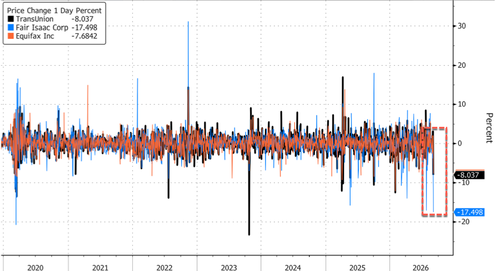
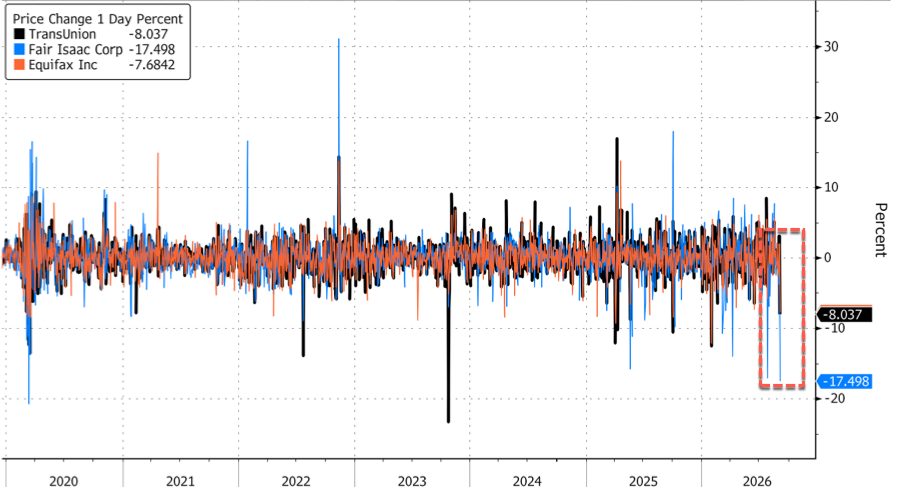
Fair Isaac crashed as much as 21%, its sharpest intraday decline since March 2020 if losses sustain through close. Equifax and TransUnion each tumbled as much as 11%.
Separately, TD Cowen analyst Jaret Seiberg told clients that Pulte’s attack on mortgage-related costs could support the administration’s affordability message ahead of the midterm elections this fall.
Tyler Durden
Sat, 09/05/2026 – 14:35

