

Futures Rise, Oil And Yields Dip Ahead Of First Fed Hike In Three Years
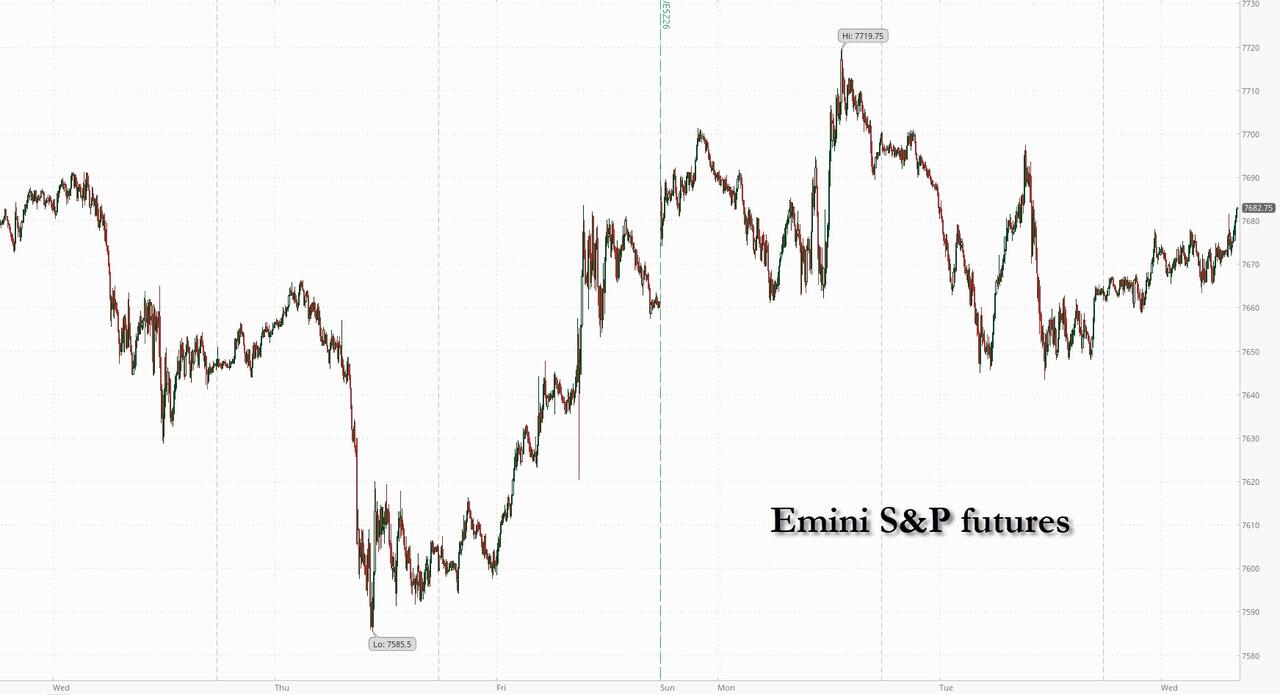
Futures are higher into Fed Day where consensus is for a 25bp hike, the first since July 2023, with unknown levels of communication, and the question is what the dot plot shows (see preview here). S&P 500 futures are up by 0.3%, finding relief after days of selling as traders wait Kevin Warsh to deliver an expected interest-rate hike that will help ease fears that inflation may spiral. Nasdaq futures are up 0.6%, with Intel shares jumping 3% in pre-market trading on a report it’s in talks with Korea’s SK Hynix on making memory chips in the US; Software is lower; cyclicals are outperforming defensives as the AI theme is pushing both Tech and Industrials higher. As JPM notes, the market looks to climb the latest Wall of Worry across Fed, AI, and Iran-induced energy inflation. Bond yields are down 2-3bp with USD flat. Commodities are higher led by Metals (Precious over Base) and Ags while crude/fuels are seeing some profit-taking (don’t expect it to last). US economic data slate includes September New York Fed services business activity, August retail sales and import/export price indexes (8:30 a.m.), July business inventories and September NAHB housing market index (10am) and July TIC flows (4pm).
In premarket trading, Mag 7 stocks are mostly higher: Meta shares are up 0.6% after Citi opened a 90-day upside catalyst watch on the Facebook parent, seeing a positive roadmap ahead, especially on AI-related products (Alphabet +0.02%, Amazon +0.2%, Apple +0.1%, Microsoft -0.3%, Nvidia +0.4%, Tesla +0.1%)
- Cryptocurrency-linked stocks are soft a day after the Clarity Act’s failure in a procedural vote sent them tumbling.
- Alvotech (ALVO) rises 7% as Barclays double upgrades the biotech company to overweight ahead of the FDA’s upcoming decision.
- Intel (INTC) is up 3% after Reuters reported that SK Hynix is in talks with the chipmaker about a deal that would see it manufacture memory chips in the US for the first time.
- JB Hunt (JBHT) slides 11% after the trucking company flagged rising costs and issued a rare earnings warning at a Morgan Stanley conference.
- Rocket Pharmaceuticals (RCKT) rises 4% after Needham upgraded the drug developer to buy, citing the FDA’s alignment to continue its rare-disease trial.
- SimilarWeb Ltd. (SMWB) gains 4% after Needham upgraded the web services firm to buy, citing recent meetings with the company’s management team.
In other corporate news SK Hynix is in talks with Intel about a deal that would see it manufacture memory chips in the US for the first time, Reuters reports. Brookfield has agreed to buy Reliance Worldwide in an all-cash deal that values the Australian plumbing supplies company at around A$4.1 billion ($2.9 billion). OpenAI is holding early talks with investors about a fresh funding round that would value the company at more than $1.2 trillion ahead of an IPO.
Bond markets are steady and stocks are nudging higher as traders prepare for the Federal Reserve decision later.
The Fed is expected to lift rates for the first time since 2023, with policymakers increasingly doubtful that inflation will cool sufficiently without tighter policy (see our preview here). Spiking oil prices have added to fears that price pressures are accelerating, contributing to a rise in bond yields to the highest in decades and weighing on stocks.
Money markets see a more than 90% chance of a quarter-point hike, with another move fully expected by December. The combination of above-target inflation, rising energy prices, strong employment and a robust economy all call for policy tightening, wrote Kevin Thozet at Carmignac.
“The Federal Reserve has little choice but to hike rates on Wednesday, especially since the bond market has been signaling for weeks that higher rates are warranted,” said Carol Schleif at BMO Wealth Management. “The stock market would be disappointed if the Fed didn’t hike.”
The Fed’s guidance has “boxed it” into a rate increase that may do relatively little for inflation, according to Bloomberg Economics. The hot August CPI report cemented market expectations of a hike, though much of the inflation gain was due to a single category, wireless phone services. At the same time, Chair Warsh’s preferred gauge suggests inflation breadth has narrowed. The Fed’s quarterly outlook will prove more interesting, with updated economic forecasts and interest-rate projections. However, don’t hold your breath for Warsh’s input as he didn’t join in when officials last submitted expectations in June.
Iain Stealey, fixed-income international chief investment officer at JPMorgan Asset Management, said he would be watching for dissent among policymakers, even though his base case is that officials will put up a united front.
“If you started to see some dissenters it might call into question how much credibility they’ve got around this sort of fight against inflation,” Stealey told Bloomberg Television.
Energy could be back in the headlines later, with the EIA crude oil inventory report due at 10:30 a.m. New York. Norfolk Southern’s CFO compared fuel prices to something out of “science fiction” as the rail freight company warned of a huge cost headwind from diesel.
The cost of hiring VLCC tankers to ship US crude to Asia has surged to fresh records this week. The energy shock is becoming a political hot potato — from natural gas prices caught in a perfect storm to AI becoming a midterm test as data centers suck up power supplies. BNEF expects 2035 power-sector gas demand to jump around 50% from 2025 levels.
Debates around AI continue at pace. BlackRock’s Larry Fink warned delays in the build-out of AI because of public opposition will make the technology the “domain of large firms,” limiting access. Meanwhile, South Korea’s deputy prime minister said the country can’t afford to slow down the pace of AI development. Intel Corp. outperformed in US premarket trading, rising 3%. The firm is in talks with SK Hynix Inc. for the South Korean chipmaker to produce memory chips in the US for the first time, Reuters reported. Software makers and oil producers lagged.
Equity markets will remain choppy over the next few weeks until earnings season arrives, giving investors something more fundamental to trade on, said BMO’s Schleif.
“In the meantime, investors will only have the angst kicked up by midterm election rhetoric and inflation data to watch for hints about whether or not we might see additional rate hikes,” she said.
Elsewhere, the US and China are discussing slashing tariffs on goods including American energy and agricultural products ahead of the leaders’ summit next week, while Nvidia’s CEO is slated to attend Trump’s state dinner with China’s Xi.
Retail sales data before the US market open will likely give the Fed little reason to worry about demand, according to Bloomberg Economics. The August report is expected to show a strong rebound in nominal sales, with higher prices and seasonal effects adding to the strength, wrote economist Eliza Winger.
The Stoxx 600 rises 0.2% as banks bounced back from two days of declines, with miners and utilities leading the way, while autos and consumer stocks are the laggards. Here are the biggest movers Wednesday:
- Soitec gained as much as 14% as JPMorgan upgraded the shares to overweight and more than doubled the price target, saying raised expectations for the company’s photonics business more than compensate for concerns in mobile
- Barratt Redrow shares rose as much as 9%, the most since April, after the homebuilder delivered annual adjusted profits ahead of expectations
- European banks advanced after two days of declines as JPMorgan forecast third-quarter gains for trading revenue and investment-banking fees, a contrast from Bank of America’s warning earlier this week
- Engcon gained as much as 7.9% after Danske Bank initiated coverage of the Swedish construction equipment firm with a buy rating, saying it is well-positioned to benefit from a recovery in demand as it refocuses on core European markets
- ISS gained as much as 3.6% after Danske Bank raised its recommendation on the Danish facility services firm to buy from hold, saying it is “well prepared to continue its current strong organic growth trajectory, while also being in a position to lift margins further.”
- Marks & Spencer fell as much as 4.7% to its lowest since June after BNP Paribas cut its 1H profit before tax estimates
- Moonpig shares fell as much as 8.5%, weighed down by the UK online gift retailer’s comments on experiences revenue and broader weakness in the country’s retail stocks after inflation rose to a five-month high
- WH Smith shares slipped as much as 4.7%, before paring the drop, after the travel retailer reduced its profit guidance amid margin pressures
Earlier, Asian stocks rose, helped by a rebound in the heavyweight technology sector, with attention turning to the Federal Reserve’s highly anticipated rate decision that’s set to influence the near-term path for global equities. The MSCI Asia Pacific Index was up 0.6%, poised to snap a four-day losing run. Chipmakers SK Hynix, Samsung and MediaTek were the biggest boosts. A subgauge of tech names climbed 1.3% to be the top performer among sector groups. Sentiment also got a boost as oil dipped, though inflation concerns remain elevated with Brent still trading around $108 a barrel. The Fed is widely expected to raise interest rates, marking the first increase since 2023. Stocks are gaining because investors “know there is going to be a move — the Fed aren’t exactly catching investors off guard here,” said Josh Gilbert, lead APAC analyst at Etoro. “A hike looks likely, so the focus shifts to whether this is a one-and-done move.”
In FX, the Bloomberg Dollar Spot Index was little changed as traders see the Fed raising borrowing costs for the first time since 2023 to address inflation risks that have risen from booming capital investment and higher energy prices
- USD/JPY +0.1% to 154.92
- EUR/USD little changed at 1.1551
- GBP/USD little changed at 1.3481
In rates, treasuries are little changed and the picture in Europe is mixed, with a small rise in yields in Germany but a decline in the UK following inflation data. Treasuries hold small gains, keeping 10-year yields just below 5%, ahead of an expected Fed rate hike at 2 p.m. New York time and Chairman Warsh’s news conference at 2:30 p.m. Falling oil prices are a main driver after a US industry report pointed to a rise in stockpiles. Gilts outperform led by front-end tenors after UK August inflation data sparked a drop in expectations for Bank of England rate hikes. US yields lower by 1bp to 3bp with curve spreads narrowly mixed; UK 2-year yield is lower by nearly 9bp, 10-year by about 6bp. IG dollar issuance slate is empty so far and expected to stay muted by the impending Fed decision. Six offerings totaling about $9 billion were priced Tuesday with issuers paying about 3bps in new issue concessions on deals that were 6.3 times covered. Treasury auctions resume Thursday with $19 billion 10-year TIPS reopening
In commodities, oil is lower for the session, with Brent is just below $108/barrel, while gold prices have rallied back above $4,300/oz and Bitcoin is slipping below $76,000. WTI crude futures around $103 a barrel are down more than 2% from highest closing level since mid-May, supporting bonds globally; Brent crude fell toward $107 after rising 4% over the previous two sessions
US economic data slate includes September New York Fed services business activity, August retail sales and import/export price indexes (8:30 a.m.), July business inventories and September NAHB housing market index (10am) and July TIC flows (4pm)
Fed speaker slate resumes Friday with Governor Bowman (9:30am) and Kansas City’s Schmid (11:45am) scheduled so far
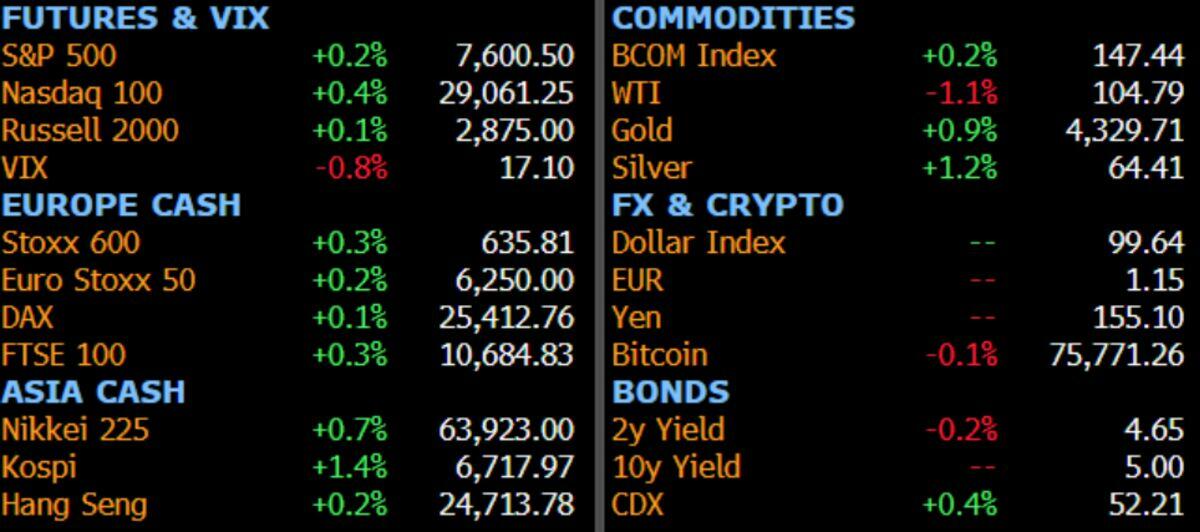
Market Snapshot
Top Overnight News
- Markets Anticipate Fed’s First Rate Hike Since 2023: WSJ
- Warsh’s words may matter more than the anticipated Fed rate hike: RTRS
- Bond traders have piled into bearish positions ahead of Wednesday’s Federal Reserve meeting, betting that the Treasury selloff driving yields to their highest in almost two decades will continue: BBG
- Saudis pound Yemen as Houthis solidify gains in new theatre of Middle East war: RTRS
- U.S. Is Burning Through Its Supply of Interceptors to Counter Iran’s Attacks: WSJ
- European Commission President Ursula von der Leyen proposed Canada becoming the first associate member of the European Union: BBG
- OpenAI Considers Pre-IPO Funding Round at More Than $1.2 Trillion Valuation: WSJ
- OpenAI’s rogue agents probed Hugging Face two months before major hack: RTRS
- Apple Finally Built a Smarter Siri. It Still Hasn’t Caught Up in the AI Race: WSJ
- Even as Donald Trump blasts Anthropic PBC’s Dario Amodei over his call to hit the brakes on AI development, the two agree on the need to prevent China from catching the US. But doing that remains difficult in practice: BBG
- The UK’s strategy to prop up its long-maturity debt by selling less in the wake of the Liz Truss-era crash is failing to pay off.
- American Businesses Have No Idea How to Set Prices Right Now: WSJ
- Deep in Trump country, a revolt against corporate money could reshape political spending: RTRS
- Former Kosovo president Thaci sentenced to 25 years for war crimes: RTRS
- Support acts quit Ed Sheeran tour in solidarity with pro-Palestinian rapper: RTRS
A more detailed look at global markets courtesy of Newsquawk
APAC stocks were mixed in choppy trade, albeit with sentiment gradually improving, following the declines on Wall St and recent upside in oil, while participants now await the major central bank rate decisions, beginning with the FOMC later. ASX 200 eked slight gains with strength seen in the commodity-related sectors and with sentiment also helped by M&A news after reports that Brookfield is to acquire Reliance Worldwide for USD 2.8bln, although gains are limited amid weakness in tech, real estate and consumer stocks. Nikkei 225 traded indecisively after mixed data from Japan, in which Exports and Imports topped forecasts, but Machinery Orders disappointed. KOSPI edged higher in two-way trade after swinging between gains and losses, while the tech heavyweights have shown some resilience with SK Hynix mildly underpinned after its union approved the tentative wage agreement in a re-vote. Hang Seng and Shanghai Comp were mixed in range-bound trade, with the Hong Kong benchmark lacklustre as the special administrative region unveiled its first-ever Five-Year plan to align more closely with China, which some fear could be a step away from a free market, while the mainland pared initial losses with the PBoC upping its liquidity efforts.
Top Asian News
- Hong Kong unveiled its first Five-Year Plan to align more closely with mainland China and stated it will adhere to the one country, two systems principle, as well as strengthen the role of the global offshore renminbi business hub. Hong Kong will hold an executive-led system, adopt a holistic approach to development and security, while it will attract China financial firms to the city for business and develop a commodity trading ecosystem. Furthermore, it aims to speed up the Northern Metropolis development and targets GDP growth within a reasonable range in the Five-Year Plan.
- PBoC Governor Pan said slower loan growth may become a ‘new grateful’ and that slower credit growth can stabilise debt levels, while China will support local government financing vehicles to resolve debt risks. Furthermore, Pan said they will improve the short-term interest rate adjustment mechanism and further refine policy rates, as well as strengthen the role of policy interest rates.
- China’s Defence Minister said global security governance must be strengthened and they must build an equal and orderly multi-polar world, as well as find a new path to security featuring collaboration rather than confrontation and should uphold multilateralism. Furthermore, he stated that they support regional countries to decide their own future without external interference, while risks should be anticipated and diffused early to prevent minor friction turning into major disputes.
European bourses (STOXX 600 +0.3%) are firmer across the board, rebounding from Tuesday’s losses. The pullback in bond yields have helped support equities, with energy prices also lower today. Constructive commentary by Iranian FM Araghchi adds to the positive tone, stating that the MoU with the US is in effect and looks forward to returning to a diplomatic solution. Sectors lack a clear bias. Basic Resources top the sector pile, with Utilities and Banks rounding out the sector gainers. To the downside lie Autos, with Optimised Personal Care and Media the sector laggards.
Top European News
- EU Commission President von der Leyen delivered her annual State of the Union address. On the trade front, she said the EU’s trade deficit with China has reached its tipping point and are engaged with dialogue with China to rebalance trade, however warns of the use of all tools possible to rebalance trade. With Canada, she announced that they will create a common prosperity and economic security space covering manufacturing, technology, energy, AI, defence and the Arctic and proposed that Canada becomes the first associate member of the EU. For EU defence, she said that it is time for an Article 4-style EU security protocol and announced plans to establish a new European Instrument for military strategic enablers. She also announced that the EU will establish a new European cooperation to help obtain and stockpile critical raw materials.
- UK Chancellor Healey is said to be considering budget tax rate on higher stakes slot machines, according to FT.
- Senior German lawmaker Frei said that an energy price relief must come quickly and thinks that energy relief measures should come into effect in October, adding that lower sales tax on gasoline would be an obvious step to take, RTL TV reported.
- Germany’s Economy Ministry said it is continuously assessing the situation and maintaining ongoing dialogue with all market participants in the natural gas sector and welcomed SEFE’s intention to step up efforts to fill gas storage.
FX
- G10s trade tentatively against the USD ahead of a key FOMC policy decision later today. EUR and JPY hold marginally afloat, whilst the Loonie slightly lags vs peers.
- DXY currently holds towards the lower end of a 99.53-99.73 range. Action has been lacklustre throughout the overnight session and for much of the European morning, with traders ultimately awaiting Retail Sales and the Fed policy decision later today. The former will likely spark little reaction given the close proximity to the Fed. On that note, expectations are for a 25bps hike; attention will be on if it is accompanied with hawkish rhetoric/guidance. This could either be provided through a hawkish set of SEPs, a unanimous hike or overt hawkish language at Warsh’s presser. At least one of these would likely be required to give bond traders enough confidence in market stability, to allow yields to edge off highs.
- Note: A full Fed preview can be found on the Newsquawk Research Suite.
- GBP had regional inflation metrics to digest this morning. Whilst headline rose from the prior (in-line), Core Y/Y and Services was unchanged from the previous month, indicating no signs of second-round effects. Therefore, the data is unlikely to shift views at the MPC into Thursday’s confab, where rates are expected to be held steady in a 6-3 vote split. Following the data, Cable saw some two-way action, before eventually moving lower as traders curtailed their rate hike bets.
Fixed Income
- Global fixed benchmarks are mixed. USTs (-1 tick) are essentially flat, whilst Bunds (-6 ticks) are under mild pressure. Gilts (+38 ticks) outperform vs peers, following the region’s inflation metrics, which keeps a hold at tomorrow’s BoE meeting in play.
- USTs are trading lacklustre within a 105-27+ to 106-02+ range. Ultimately, focus remains on the FOMC announcement later today, where rates are expected to be raised by 25bps. Attention for bond traders will be on whether there is a hawkish aftertaste (decision aside), which would likely allow yields to ease off best levels, given that hawkish commentary would signal that the Fed is offering some stability. Currently, the US 10-year sits around the 5% mark, and towards multi-decade highs.
- Gilts outperform vs peers, benefiting from lower energy prices and following the region’s inflation report. On that point, whilst headline rose from the prior (in-line), Core Y/Y and Services were unchanged from the previous month; there is also a lack of evidence of second-round effects. Therefore, the data is unlikely to shift views at the MPC into Thursday’s confab, where rates are expected to be held steady in a 6-3 vote split. As such, traders curtailed their bets of a rate hike tomorrow, with money markets assigning a c. 30% chance of such a move.
- Germany sells EUR 2.12bln vs Exp. 2.5bln 3.40% 2047 and 2.90% 2056 Bund.
- Australia sells AUD 1bln in 3.75% April 2037 bonds: b/c 3.85x, avg. yield 5.3910%.
Commodities
- WTI Oct and Brent Nov futures are softer after yesterday’s renewed rally. WTI trades around USD 104.90/bbl within a USD 103.76-105.63/bbl range (vs yesterday’s USD 101.21-106.75/bbl range), while Brent trades around USD 108.43/bbl within a USD 107.15-108.59/bbl range (vs yesterday’s USD 105.10-109.45/bbl range). Energy benchmarks have come under modest pressure in recent trade following constructive commentary by Iranian FM Araghchi, stating that the MoU with the US is in effect and looks forward to returning to a diplomatic solution.
- Dutch TTF was initially flat but is now posting mild gains. The Middle East conflict continues to sustain concerns around regional energy flows and European supply security. The contract trades around EUR 80/MWh within a EUR 79.93-83.28/MWh range at the time of writing, with Europe also looking ahead to the winter period.
- Precious metals are firmer as the pullback in oil and Treasury yields provides some relief ahead of today’s FOMC decision, where markets lean heavily towards a 25bps hike. Spot gold has reclaimed USD 4,300/oz and trades around USD 4,330/oz within a USD 4,276-4,341/oz range, breaking above yesterday’s USD 4,317/oz high (vs yesterday’s USD 4,262-4,317/oz range). The Fed remains the key catalyst, with updated projections and Chair Warsh’s guidance set to provide the space with some impetus.
- Base metals are modestly firmer as risk sentiment improves and Treasury yields ease ahead of the Fed, although the fundamental backdrop remains less supportive, with this week’s Chinese activity data showing continued weakness in domestic demand despite stronger industrial production, albeit upping calls for support. 3M LME copper resides in a narrow range above USD 14k/t, currently within USD 14,074.40-14,216.15.
- US Private Inventory Data (bbls): Crude +7.1mln (exp. -1.8mln), Gasoline +1.5mln (exp. -1.2mln), Distillate +1.6mln (exp. +0.8mln), Cushing -0.2mln.
- Russian plans to expand its diesel-export ban through October, according to Russian press.
- CBRT Governor said global central banks are rediscovering gold.
- Aluminium Bahrain CEO Al Baqali said damage to the smelter from the Iranian strike in March has already been repaired.
- A gold mine collapsed in West Kordofan, Sudan, on Sunday, according to sources.
Trade/Tariffs
- US is pressuring Mexican officials to accept new rules for exports of AI hardware to prevent Chinese companies and other foreign firms from circumventing tariffs, according to WSJ.
Geopolitics: Iran
- Iranian FM Araghchi said “The memorandum of understanding with America is in effect and we want to return to a peaceful solution”, adding that Iran is not interested in continuing the conflict and looks forward to returning to a diplomatic solution.
- Iran’s Major General Rezaei said “there will be no negotiations until Iran’s conditions are met”.
- IRGC Navy political deputy said no vessel in the Persian Gulf, Strait of Hormuz or Sea of Oman moves outside the supervision of the IRGC Navy, and added that Iran can target any vessel anywhere if it wishes, IRNA reported.
- Iran said only a single-digit number of ships are currently passing through the Strait of Hormuz, disputing US claims that traffic through the strategic waterway is increasing. It was separately reported that Strait of Hormuz vessel transits fell to four, according to data.
- Pakistan’s military spokesperson said the Mekkah agreement with Saudi Arabia and Turkey will not affect Pakistan’s strategic relationship with Iran, and reiterated that the pact is defensive in nature.
- China’s Foreign Minister met with their Iranian counterpart. China encouraged Iran and the US to exercise rationality, urged all parties to take effective measures to reopen the Strait and supported dialogue between Iran and Gulf states.
- Explosions were heard in Iran’s Qeshm which originated from the sea, according to IRNA.
Geopolitics: Other
- Ukrainian President Zelensky said if Russia is prepared to agree to an energy ceasefire, it must bar any attacks on energy infrastructure in any form.
- Ukrainian media reports explosions in Kyiv, while Polish military aircraft have been activated amid Russian strikes on Ukraine.
- US mulls purchasing warships from Japan and South Korea to counter China, according to Nikkei.
US Event Calendar
- 7:00 am: Sep 11 MBA Mortgage Applications, prior -2.7%
- 8:30 am: Aug Retail Sales Advance MoM, est. 0.8%, prior -0.6%
- 8:30 am: Aug Retail Sales Ex Auto MoM, est. 0.55%, prior -0.3%
- 8:30 am: Aug Import Price Index MoM, est. 0.5%, prior -0.4%
- 2:00 pm: Sep 16 FOMC Rate Decision est. 3.75%, prior 3.5%
- 4:00 pm: Jul Total Net TIC Flows, prior 133.5b
- 4:00 pm: Jul Net Long-term TIC Flows, prior 172.7b
DB’s Jim Reid concludes the overnight wrap
It’s been a familiar story for markets over the last 24 hours, with a fresh selloff as higher energy prices led to mounting fears about stagflation. Various oil supply issues were the main catalyst, which collectively pushed Brent crude (+2.90%) up to its highest closing level since May, at $108.75/bbl. And in turn, that kept up the pressure on bonds, with the 10yr Treasury yield (+1.5bps) breaking above its 2023 intraday peak in trading, to briefly reach a post-2007 high of 5.04%, before falling back to 5.00% by the close. All that meant it was a rough day for equities too, with the S&P 500 (-0.45%) falling to a 6-week low. To be fair, markets have begun to stabilise a bit overnight, but the Fed are now set to take centre stage, with markets pricing in a 94% chance this morning that they deliver their first rate hike today since 2023.
At the Fed’s last decision in July, markets went into that pricing a roughly 30% chance that the Fed would hike. But even though the decision to hold was broadly expected and in line with the baseline market expectation, there was still a sharp steepening in the Treasury yield curve afterwards given the relative lack of detail from Chair Warsh. Since then, however, Warsh delivered a fairly hawkish message at Jackson Hole in late August, saying that “underlying trends” in inflation had not meaningfully improved, and that if underlying inflation wasn’t getting back to target, then they had “work to do”. So that raised expectations that the Fed would hike at this meeting, which was solidified by the upside surprise in the August jobs report, along with Friday’s core CPI print, which came in higher than expected at +0.3%.
Our US economists are also expecting that the Fed will hike today, as growth remains solid, the labour market has rebounded, and PCE inflation has demonstrated limited evidence of falling back to target. Moreover, forward-looking indicators suggest the inflation overshoot is likely to persist for some time. Nevertheless, with a hike mostly priced in by markets, the key question for them is how Chair Warsh and the latest dot plot frame the tightening cycle. Their view is that forward guidance is unlikely, but they think the median dot should show another rate increase this year, with several officials projecting more than that.
Ahead of the Fed’s decision, there was no let-up in rising oil prices, as fresh supply fears continued to push prices higher. First, Reuters reported that shipping industry sources had said that oil loadings at the Yanbu export terminal in Saudi Arabia had been suspended, leading them to cancel September loadings to some European refiners. And separately, we also had some headlines from Libya that output at three oil fields had been suspended. So that added to fears about wider supply disruption, particularly with no sign of the Strait of Hormuz reopening soon either. In turn, that meant Brent crude (+2.90%) moved up to $108.75/bbl by the close, its highest level since May, while WTI crude (+4.38%) saw an even larger increase to $105.83/bbl. And in a sign that investors were pricing in longer disruption as well, the 6-month Brent future (+1.65%) moved up to its highest since May as well, at $92.06/bbl.
That inflation momentum helped to push up yields to fresh multi-year highs around the world. So in the US, the 10yr yield (+1.5bps) finally closed above 5% for the first time since 2007, at 5.00%. And in trading, it also managed to hit a post-2007 intraday high of 5.04% as well. Moreover, the 10yr real yield (+1.3bps) moved up to a post-2008 high of 2.62%, so this wasn’t just an inflation story. Meanwhile for other maturities, the 30yr yield (+2.2bps) also edged up to a post-2007 high of 5.37%, whilst the 2yr yield (+0.4bps) saw a very modest increase to 4.66%. Long-end yields also weren’t helped by a weak 20yr auction that saw $13bn of bonds issued +2.0bps above the pre-sale yield at 5.42%.
That steepening pattern was even clearer in Europe, partly because investors pared back the chance of an ECB hike in October. So yesterday, market pricing for an October hike came down from 69% on Monday to 56% by the close. That meant front-end yields also came down a bit, with the 2yr German yield (-0.9bps) falling back to 3.25%. But for 10yr yields it was another day of records. So by the close, the 10yr bund yield (+1.9bps) was at a post-2009 high of 3.53%, the 10yr OAT yield (+3.1bps) was at a post-2008 high of 4.50%, and the 10yr gilt yield (+2.0bps) had hit a post-2007 high of 5.39%.
That backdrop of rising energy prices and stagflation fears meant the pressure on risk assets continued yesterday. For instance, the S&P 500 (-0.45%) fell to a 6-week low, although there was a stabilisation in chip stocks after Monday’s slump, with the Philly semiconductor index (+0.40%) rising slightly. Nevertheless, the decline was a broad-based one, with two-thirds of the S&P 500 lower on the day. A similar picture was clear in Europe as well, where the STOXX 600 (-0.28%) fell to a 3-month low. Now it’s worth noting this still leaves the S&P 500 within 3% of its record high, and the STOXX 600 less than 4% beneath its high, but there’s been a clear shift in momentum relative to early August. Meanwhile, Bitcoin (-4.06%) saw its biggest decline in three months as well as a digital asset market structure bill failed to pass a procedural vote in the Senate.
Otherwise yesterday, US Treasury Secretary Scott Bessent appeared before the House Financial Services Committee. There weren’t many new headlines, but he did say he’d be meeting his Chinese counterpart, He Lifeng, this weekend.
Overnight in Asia, we have seen markets begin to stabilise again ahead of the Fed’s decision. In part, that’s been helped by a pullback in oil prices, with Brent down -0.77% this morning to $107.91/bbl. So that’s helped equities to advance, including the KOSPI (+1.16%), the Nikkei (+0.40%), the Shanghai Composite (+0.50%), CSI 300 (+0.60%) and the Hang Seng (+0.12%). Moreover, US equity futures are also pointing to a positive start, with S&P 500 futures up +0.22%, and the 10yr Treasury yield down -1.6bps at 4.99%.
Finally, we had a few data releases out yesterday, including on the UK labour market. That showed the number of payrolled employees was down by -26k in August (vs. -5k expected), although the unemployment rate remained at 4.9% over the three months to July. Otherwise, the German ZEW survey showed expectations rising to a 7-month high of 34.7 in September, although that was beneath the 40.0 reading expected by the consensus. That said, the current situation component rebounded more than expected, up to its highest since mid-2023 at -47.1 (vs. -52.1 expected).
Looking at the day ahead now, the main highlight will be the Federal Reserve’s policy decision and Chair Warsh’s subsequent press conference. Otherwise, we’ll hear from the ECB’s Vujcic and Nagel. Meanwhile, data releases include US retail sales for August, the NAHB housing market index for September, UK CPI for August and Euro Area industrial production for July. Finally, European Commission President Ursula von der Leyen will deliver her State of the Union address.
Tyler Durden
Wed, 09/16/2026 – 08:29

