

Ukraine Pounds Major Moscow Refinery As Global Diesel Crisis Threatens Economic Shock
Military conflicts, economic wars, and resource wars are converging ahead of the Northern Hemisphere winter.
Export restrictions on critical materials and energy products are adding economic pressure worldwide, raising the risk that supply disruptions and retaliatory measures widen existing conflicts. With no clear path to de-escalation, the potential for spillover from active war zones remains top of mind.
The most pressing news so far this morning is that Ukraine launched a major overnight drone strike on Russia, hitting a Moscow refinery despite President Trump’s request for Ukraine to stop striking Russian energy infrastructure as a global refining crisis deepens.
Bloomberg reports that the Gazprom Neft-owned Moscow Oil Refinery, about 16 miles from the Kremlin, was struck by drones. The facility has a processing capacity of around 245,000 barrels a day and supplies fuel to the surrounding metro area.
Ukrainian President Volodymyr Zelenskyy wrote on X, “One of Russia’s key oil industry facilities and the aggressor’s logistics facility were hit. These are billions of dollars that sustain the war machine. The systems used included FP-1, RZ-100, MICH-2000, Palianytsia, Vendetta, Liutyi, Bars, Flamingo, Sichen, and Pelican.”
Our long-range responses had a very significant impact in the Moscow region last night. One of Russia’s key oil industry facilities and the aggressor’s logistics facility were hit. These are billions of dollars that sustain the war machine. The systems used included FP-1, RZ-100,… pic.twitter.com/ka5mlDSgb7
— Volodymyr Zelenskyy / Володимир Зеленський (@ZelenskyyUa) September 20, 2026
Last week, diesel futures and refining spreads climbed to record highs as worsening supply disruptions in the Gulf and Russia tightened availability of the industrial fuel that powers the global economy.
Potential export restrictions, or extensions of existing restrictions, are compounding the squeeze. A report on Tuesday said Moscow was considering extending its diesel export ban, while Senate Majority Leader John Thune told reporters that day he was “open to exploring” a US diesel export ban.
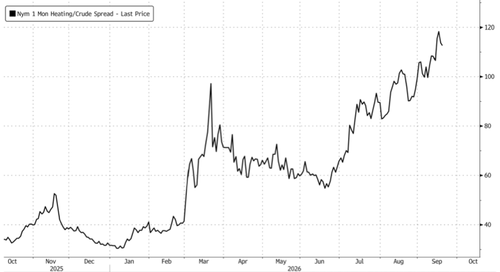
The squeeze was even more severe in refining spreads. The US heating oil crack, which measures the difference between fuel and crude prices, surged to $117 a barrel on Wednesday, the highest level in Bloomberg data going back to 2009.
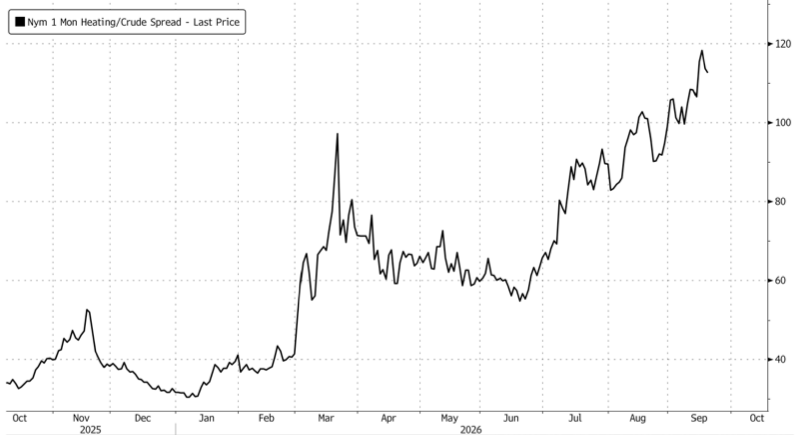
Bloomberg Intelligence senior commodity strategist Mike McGlone has warned that the diesel price shock echoes similar moves in gasoline during the 2008 energy shock.
Tyler Durden
Sun, 09/20/2026 – 08:45

