

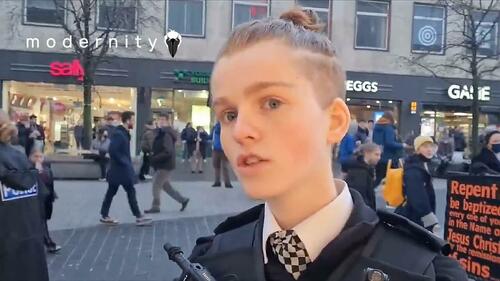
Watch: British Cops Grill Street-Preacher After Someone Takes ‘Offense’ At Bible Passages
Authored by Steve Watson via Modernity News,
Britain’s latest public-order farce is not a machete fight, a rape gang or a phone-snatch. It is a man on a high street with a Bible.
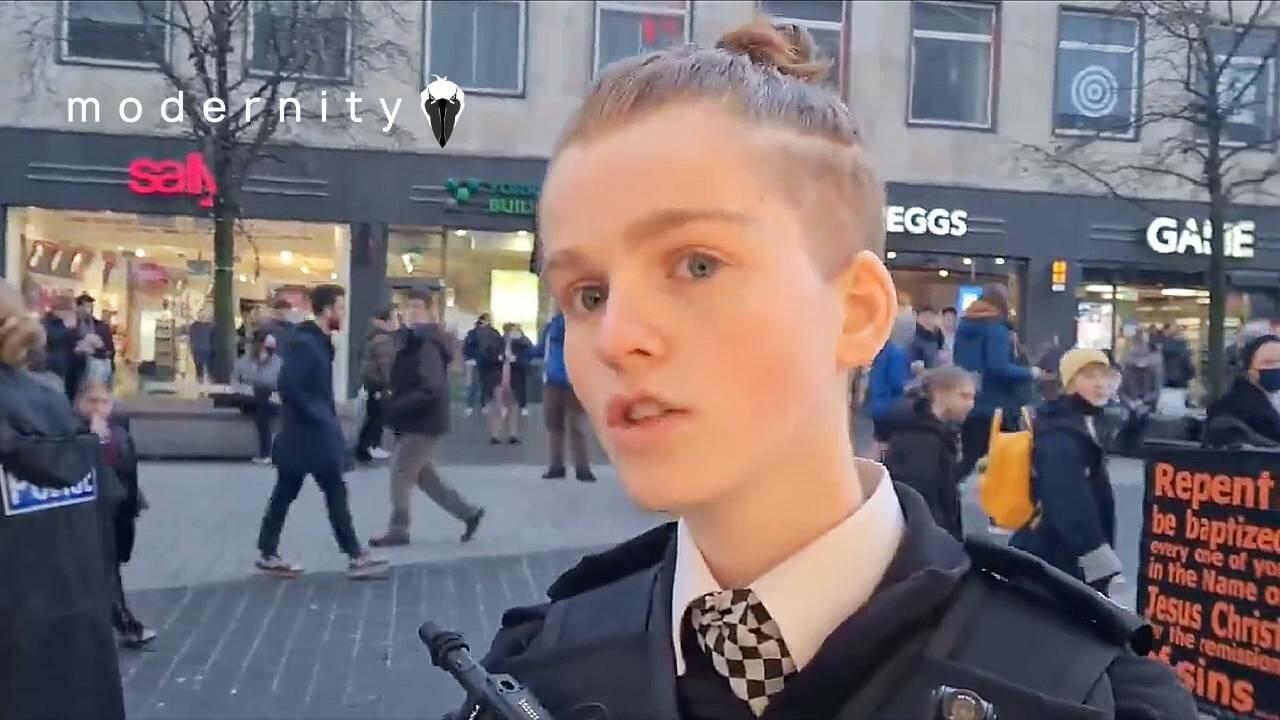
Footage circulating Friday shows three female officers surrounding a Christian street preacher in a busy shopping precinct.
One of them looks like she should still be sitting exams at school. The other two hover, phones out, expressions tight, as if they have been sent to defuse a bomb.
In the UK they now have children policing the streets. pic.twitter.com/MsvD2QBFzT
— HJB News (@HJB_News__) September 18, 2026
The clip is eight minutes of modern Britain in micro. A member of the public reports being “offended” by words. Officers arrive and the preacher is treated as the problem.
The all inclusive term ‘hate speech’ is waved around and ‘intimidation’ is offered as the hook for an investigation. The man citing Scripture is expected to justify himself to people who appear unfamiliar with the very statutes they are leaning on.
The Strong Arm Of The Law ???? pic.twitter.com/ObHEvBtT53
— Ben Dover (@BenDoverh45da) September 18, 2026
This is not law enforcement. It is customer service for the emotionally fragile.
As we hear in the footage, Sections 4A and 5 of the Public Order Act 1986 are the blunt instruments used again and again against street preachers.
Section 5 makes it an offence to use threatening or abusive words or behaviour within the hearing or sight of a person likely to be caused harassment, alarm or distress. “Insulting” was stripped out of Section 5 in 2013. There is a defence if the conduct was reasonable.
Section 4A is the heavier charge. It requires intent to cause harassment, alarm or distress, plus proof that harassment, alarm or distress was actually caused. Police guidance itself describes 4A as aimed at “more serious, planned and malicious incidents.”
Yet here are yet more female police officers spewing those statutes at the guy as if they’re citing parking restrictions.
Being offended by the Bible is not grounds for a public order offense. Reciting the Gospel in a public street is not automatically “threatening.” Calling the encounter “intimidation” because a passer-by disliked the message does not conjure the mental element the statute demands. Courts have said as much, repeatedly, after officers have already cuffed, swabbed and bailed the preacher.
That distinction is lost on too many in uniform. In the new footage the officers look lost in it. One of them is literally a frightened child. The other two look scared of the conversation they started. The preacher is the only person on camera who appears to have read the law.
We’ve seen this all too often in Britain recently.
In another similar incident, a volunteer Met officer ordered 20-year-old gospel singer Harmonie London to stop performing “church songs” on Oxford Street, claiming she was “not allowed to sing church songs outside of church grounds.”
The Met later apologised and admitted the officer “was mistaken,” adding: “We’re sorry for the offence caused and will take the learning forward.”
There are many many more cases.
Pastor Dia Moodley was arrested in Bristol in November 2025 on suspicion of a religiously aggravated Section 4A offence and “inciting religious hatred” after preaching on Islam and transgender ideology.
He was held for eight hours and banned from the city centre over Christmas before the case collapsed.
“Avon and Somerset Police have arrested me twice because my lawful speech was seen as offensive to some Muslims and people with a progressive worldview,” he said.
When a Muslim bystander later told him on camera, “If you do that again bro, we’ll send the boys round,” police filed it as “unpleasant” comments that “do not constitute an offence.”
John Steele was arrested in Rotherham after a 30-second conversation about Quran 4:34 at a domestic-abuse stall. Charges were dropped as “not needed in the public interest.”
Pastor Steve Maile was handcuffed in Watford and held for 12 hours; Hertfordshire Police confirmed a Section 5 public order investigation.
Shaun O’Sullivan has been arrested 16 times, including for saying “God bless you.” A jury acquitted him after a six-day trial that cost an estimated £20,000.
Many such cases.
British Metropolitan Police Officer threatens to arrest Christian Preacher for speaking about God in the street.
“You might be committing offences. If you are making members of the public [feel] harassment, alarm and distress it’s a criminal offence.”
— Oli London (@OliLondonTV) May 21, 2024
British police officer tells Christian street preacher that it’s “wrong” she is preaching about God outside Kings Cross station in London.
“These people just want to do their journey. They’re not coming here to listen to you. I just think it’s all wrong.” pic.twitter.com/xrN68ZDYXp
— Oli London (@OliLondonTV) June 21, 2025
? CHRISTIAN STREET PREACHER ARRESTED IN LONDON – DAYS AFTER TRAFALGAR SQUARE MASS ISLAMIC PRAYER ?
A Christian preacher was arrested near London Stratford station while preaching the gospel.
Police reasons (per on-scene accounts & video):
1. Needed a licence/permit for the… pic.twitter.com/QpcPUDyPtg
— Skint Eastwood (@Skint_Eastwood1) March 19, 2026
Police attempt to detain Christian preacher at London Pride. Part 1 pic.twitter.com/9pWYgNcCjd
— SteveSpCorner (@SteveRightNLeft) July 4, 2026
Street preacher in London getting arrested for preaching the gospel of Jesus Christ.
The police and all bystanders heard the gospel, and that is the main thing.
They let the preachers of sin and evil continue. The preachers of good and Jesus they stop,
Life is spiritual. pic.twitter.com/0yAcydH8Yp
— Rikki Doolan (@realrikkidoolan) July 22, 2025
??? British Christian Preacher gets shut down in Manchester Shopping Centre by the Police because some of the ‘locals’ can’t stand Christianity.
Are you happy with this Britain? Really think if you’re ok with the Police treating a British Christian who has probably preached… pic.twitter.com/6rJ8jxS5Y2
— Concerned Citizen (@BGatesIsaPyscho) November 30, 2024
Street Preacher in London confronted by Police for preaching the word of God.
WATCH UNTIL END. Hallelujah! ???? Revival Times. pic.twitter.com/gV9AkYWtx8
— Rikki Doolan (@realrikkidoolan) June 10, 2025
Guy on the Left is a UK Christian Street Preacher about to be arrested on a quiet English Street.
The Guy on the right has his own private Police Escort whilst he sings Islamic Prayer on London Bridge right in the heart of the Nations Capital.
Do you see the problem yet? pic.twitter.com/thq1JlOW7A
— Concerned Citizen (@BGatesIsaPyscho) November 19, 2025
A Christian preacher this afternoon was arrested at Southgate station London N14 for preaching about Jesus . @CConcern the police told him it’s because public had said he was being islamophobic . We have the full video and wondered when preaching was now illegal ? @Campaign4T pic.twitter.com/ZxC1DhlZCf
— Eye On Antisemitism (@AntisemitismEye) February 23, 2019
UK: ?? A “Christian country” in name only.
A Christian street preacher threatened with arrest by police because he speaks peacefully through a sound system!! Christians are repeatedly arrested for using speakers to share the Gospel peacefully (Bristol 2024, Glastonbury 2024,… pic.twitter.com/ywnslHt4WZ
— ExWren (@VoWalesWren) December 5, 2025
? BREAKING: PREACHING THE GOSPEL NOW A CRIME IN MODERN LONDON? ?
Shocking scenes as a Christian preacher is CIRCLED by multiple Met Police officers – and THREATENED WITH ARREST – for simply sharing the Word of God on the streets of London.
YES… THIS IS LONDON 2025.
— Jim Ferguson (@JimFergusonUK) April 15, 2025
? “Preacher Of The Gospel” Arrested In Sadiq Khan’s London:
Gray-haired Christian preacher dragged away in handcuffs for preaching the Gospel.
Police swarm him and handcuff him as he tells them: “No offence has been committed here – this is an utter disgrace.” pic.twitter.com/fwzxl5b9Jx
— Skint Eastwood (@Skint_Eastwood1) April 20, 2026
Met Police stand watching a Christian preacher in “Modern London”, waiting for him to say something from the Bible that may “offend” Muslims to confront him with.
Sadiq Khan sets the strategy of Met Police.
Coincidence? pic.twitter.com/jyT7dL2x3I
— Tommy Robinson ?? (@TRobinsonNewEra) August 1, 2026
This is not a handful of confused constables. It is policy.
And who exactly is calling the police to report being ‘intimidated’?
In February, a lone female Met officer in Whitechapel, was surrounded by angry men insisting “This is a Muslim area,” after a Christian preacher dared to recite the gospel.
In a refreshing change, the officer told the men “In this country, we have freedom of speech.”
She added: “I understand that you guys don’t want to hear it, so I would just recommend that you walk away and don’t listen to him. He’s not in your home.” That officer understood the job. Too many of her colleagues do not.
This is part of a wider crackdown on speech in general.
At least 62,199 people were arrested for communications offences between 2021 and 2025 – roughly 34 a day. Only about one in five of those cases ends in a conviction.
Big Brother Watch’s Silkie Carlo called it “an Orwellian mess” and said people have been arrested “for holding blank pieces of paper.”
Lord Toby Young asked why authorities police tweets while shoplifting, phone theft and sexual offences rise.
Shadow home secretary Chris Philp put it simply: “Police shouldn’t be wasting time on the internet. They should be catching real criminals.”
After the 2024 Southport riots, police stood up a National Internet Intelligence Investigations team to flag “protest-related” posts to local forces. More than 100 referrals followed. Nigel Farage called it “the beginning of the state controlling free speech.”
On the street the same instinct now wears a high-vis jacket. Offence becomes “intimidation.” A Bible becomes a public-order risk. Officers who cannot explain Section 4A still feel entitled to demand names and deliver a public grilling.
Anyone who still assumes the person in the uniform knows the statute should watch another clip making the rounds: security guards outside a migrant hotel fail to display SIA licences – a criminal offence under the Private Security Industry Act – and the attending officer’s response, after being walked through the law, is: “He’s breaking the law. What am I supposed to do?”
This is the depressing reality of the situation. Quote the Act at them and they freeze. Point to an actual offence by the state’s preferred clients and they shrug. Send three young women to lecture a preacher because someone felt intimidated by Scripture, and they treat the complaint as gospel.
Keir Starmer told JD Vance last year: “We’ve had free speech for a very very long time in the United Kingdom and it will last for a very very long time.” The high street footage says otherwise. So do the 62,000 speech arrests. So does the officer who looks like a child, standing between a Bible and a country that no longer trusts its own laws.
Freedom of speech that dies the moment someone claims offence is not freedom.
Tyler Durden
Sun, 09/20/2026 – 09:20

