
China’s Quad-G Plan For Global Hegemony Involves The UN And AI
Authored by Anders Corr via The Epoch Times,
The regime in China denies that it has plans for “hegemony or expansion,” but its history – from the peasant land seizures of the 1920s to claims on the entire South China Sea today – is replete with land grabs and territorial expansion.
Starting in 2021 with its first of four global initiatives, the Chinese Communist Party (CCP) has used ideas for such initiatives and Beijing-led international organizations as engines to extend its expansion toward its long-held goal of global hegemony.
The CCP’s four global initiatives are ostensibly related to development, security, civilization, and governance. They are meant to seem palatable to the international community while integrating the United Nations and other forms of global governance into the CCP’s own system, with itself in the lead.
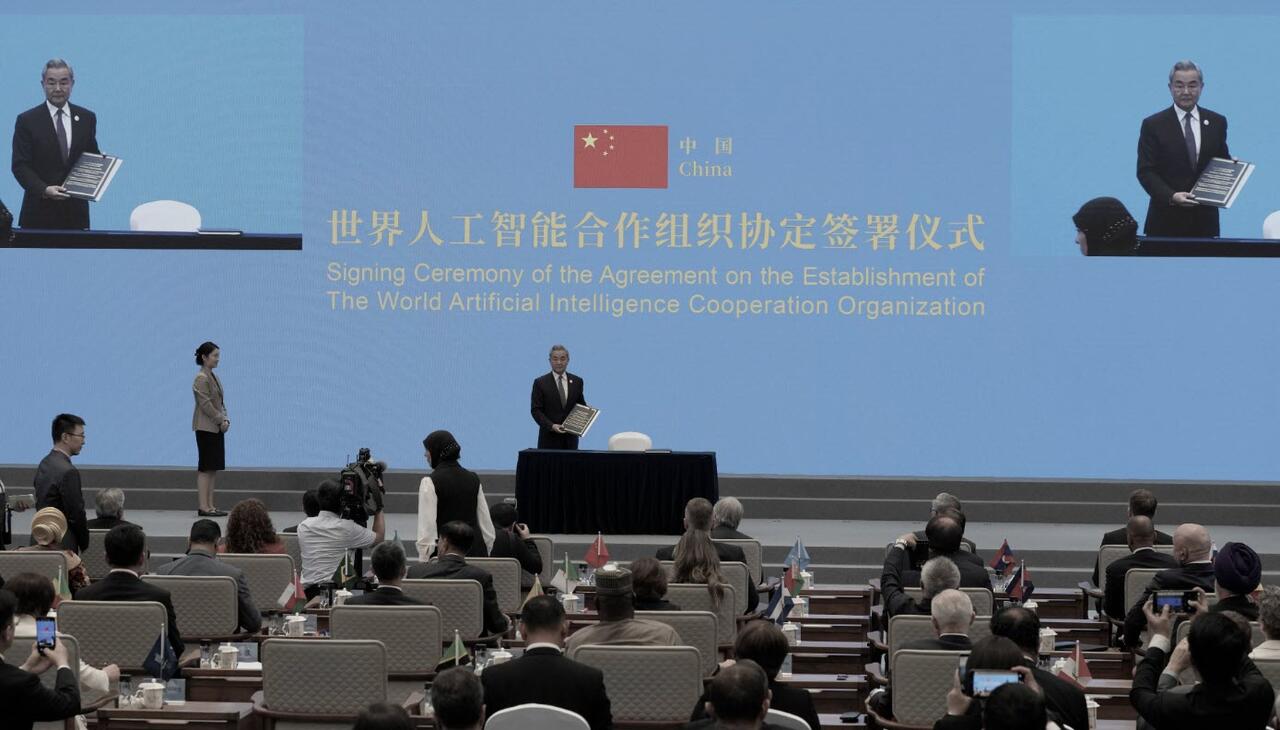
The initiatives are currently expanding and strengthening. On Sept. 12, China expanded the digital element of its Global Development Initiative (GDI) by inviting additional countries to join its World Artificial Intelligence Cooperation Organization (WAICO). The organization was founded in July and is headquartered in Shanghai.
CCP leader Xi Jinping gave the keynote speech at the event. He called for “true multilateralism,” which analysts interpret as a justification for a parallel global order with Beijing in the lead.
WAICO already has approximately 30 member countries, including Russia and Iran. It serves as a key economic and intelligence initiative led by Beijing to expand the CCP’s global influence by promoting China’s AI software and cloud infrastructure.
The more countries use China’s AI assets, the more Beijing’s authoritarian approach to AI is normalized, and the more opportunities for global espionage and influence open up for China’s military and intelligence agencies.
More generally, the GDI uses a wedge strategy to increase the CCP’s influence in countries by aligning development aid with the U.N. Sustainable Development Goals (SDGs). The resulting influence can then be expanded through larger Belt and Road Initiative projects such as ports, trains, roads, pipelines, and digital infrastructure.
This broader penetration turns countries toward joining the BRICS group, originally Brazil, Russia, India, China, and South Africa, and now including Iran, among others. The group is economically dominated by Beijing, which expects BRICS countries to follow the CCP’s lead on relatively anodyne statements such as Middle East peace, as well as on more substantial international projects such as AI development and efforts to shift world trade away from the U.S. dollar. Xi has personally invited BRICS countries to join WAICO.
The Global Security Initiative (GSI) overlays China’s preexisting military partnerships, such as the Shanghai Cooperation Organization (SCO), with the vision of a “common” security led by the CCP. The Beijing Xiangshan Security Forum, a key vehicle for extending the GSI to influential international military stakeholders, took place from Sept. 15 to Sept. 17. One subject during the forum was reportedly “the impact of AI on future warfare.”
The threat posed by the GSI and its networking with military and economic partners is real and current. Iran supports the GSI and is a member of the SCO. On Sept. 12, news broke that Chinese entities, most likely with the approval of the CCP, provided Iran with satellite images of U.S. forces in Jordan. Those images likely assisted Iran’s missile attack that killed three U.S. troops in July.
China has also provided Iran with dual-use components and fuel precursors for its missile and armed drone technologies used against Israel, Saudi Arabia, and Ukraine. Other than U.S. sanctions against a few Chinese companies, there were few repercussions imposed on the regime in China for providing Iran with dual-use items and satellite intelligence during a war. This signals to Beijing that it can provide the same to other SCO and BRICS countries in the future simply by changing the names and addresses of the Chinese entities involved.
Afghanistan, which hosts al-Qaeda terrorists, is an observer nation in the SCO and could also receive Chinese intelligence or equipment for use against the United States, Pakistan, or India. Beijing has long had a positive relationship with the Taliban in Afghanistan, which has suppressed non-Pashtun ethnicities in the country.
This accords with Beijing’s Global Civilization Initiative (GCI), which claims to create a more pluralistic world in part through supporting the sovereignty of dictators even as they stifle free markets, speech, and diversity within their own countries.
When Xi announced the GCI in 2023, he hypocritically said: “We advocate the common values of humanity. Peace, development, equity, justice, democracy and freedom are the common aspirations of all peoples. Countries need to keep an open mind in appreciating the perceptions of values by different civilizations, and refrain from imposing their own values or models on others and from stoking ideological confrontation.”
The hypocrisy of this position is evident because then and now, Xi’s regime militarily threatens democratic Taiwan; steals maritime territory from the Philippines, Vietnam, and other South China Sea claimants; takes Himalayan territory from India by force; and destroys the freedoms of religious minorities like the Uyghurs, Christians, and Falun Gong within China.
Now, with the CCP’s four global initiatives, this violent illiberality threatens to scale globally. Xi unveiled his Global Governance Initiative (GGI) last September at an SCO meeting in Tianjin. It promotes international law with the CCP in the lead and a coordinating function for the three prior initiatives.
According to Chinese state media, “Viewed as a unified framework, the four initiatives form a ‘four-in-one’ interactive structure: development as the foundation, security as the guarantee, civilization as the bond, and governance as the coordinating mechanism – all serving the overarching objective of building a community with a shared future for humanity.”
The CCP’s “community with a shared future for humanity” sounds acceptable on first blush but can be directly compared to Imperial Japan’s “Greater East Asia Co-Prosperity Sphere” in that both used anti-colonial rhetoric and regional economic integration to try and replace “Western hegemony” with an illiberal hegemony of its own making, led by an authoritarian and territorially aggressive power.
What could be called the CCP’s Quad-G Plan for global hegemony is dangerous to free markets, human rights, and democracy. The CCP is a totalitarian political party attempting to use the large economy of China, its diplomats, an international AI norms-setting body, and an already-existing international institutional structure at the United Nations and elsewhere as the power and tracks for moving an established U.S.-led international system with true sovereignty for members toward a global and illiberal hegemony with Beijing at the center.
The CCP’s Quad-G approach raises questions about whether U.S. national security and the safety of democracies everywhere necessitate significantly reducing the CCP’s influence at the United Nations and other international organizations, as well as expanding sanctions from targeting a few Chinese entities to targeting China as a whole.
Options at the U.N. include canceling the visas of China’s U.N. diplomats, as was done to Iranian diplomats in 2014 and 2020, to working to return China’s seat at the forum to democratic Taiwan. Though Taiwan does not currently propose this, other more powerful countries and groupings, including the United States, the European Union, and the G7 countries, should consider encouraging this idea to more effectively counter the CCP.
The more democratic countries legitimize the CCP by engaging with it diplomatically, the more latitude it has to influence other countries to depend on its financing, join CCP-led international partnerships, and fall in line with Beijing’s proposals to international organizations. This acclimates them and others to further accept the CCP’s leadership and its preferred authoritarian forms of global governance, with Beijing at the center.
We publish a variety of perspectives. Nothing written here is to be construed as representing the views of ZeroHedge.
Tyler Durden
Wed, 09/23/2026 – 14:25

