

Futures Tumble As Yields Hit Multi-Decade Highs, Oil Surges
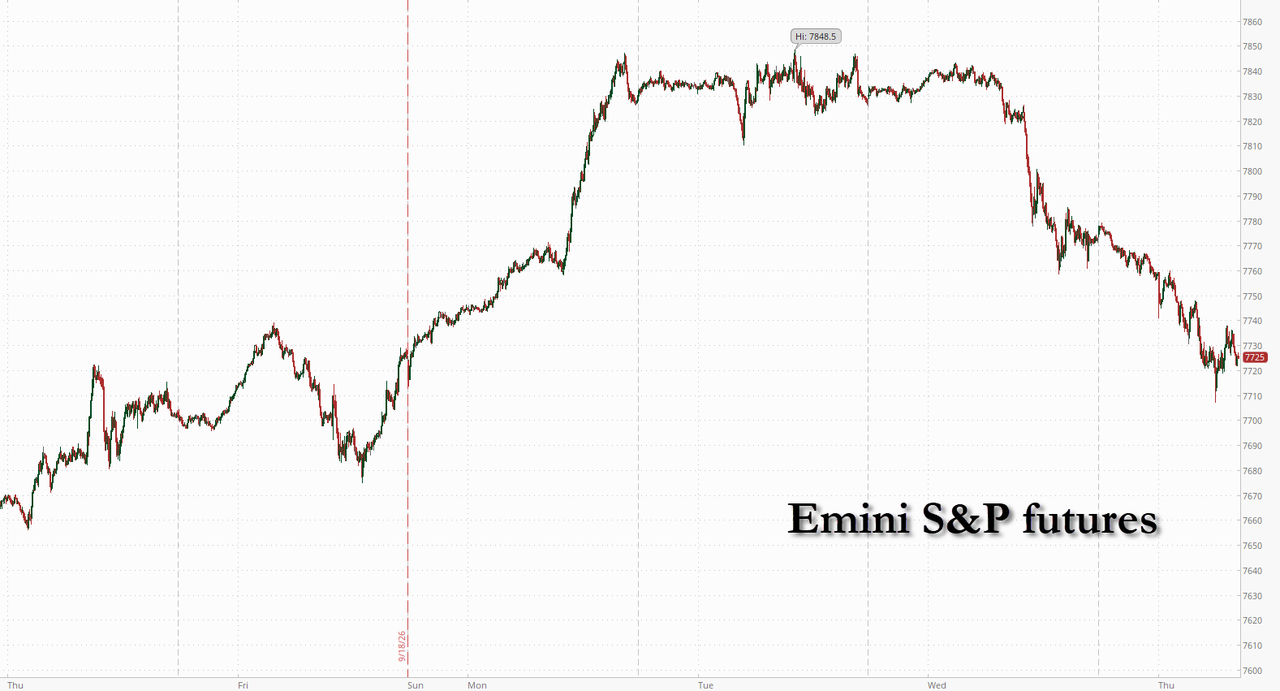
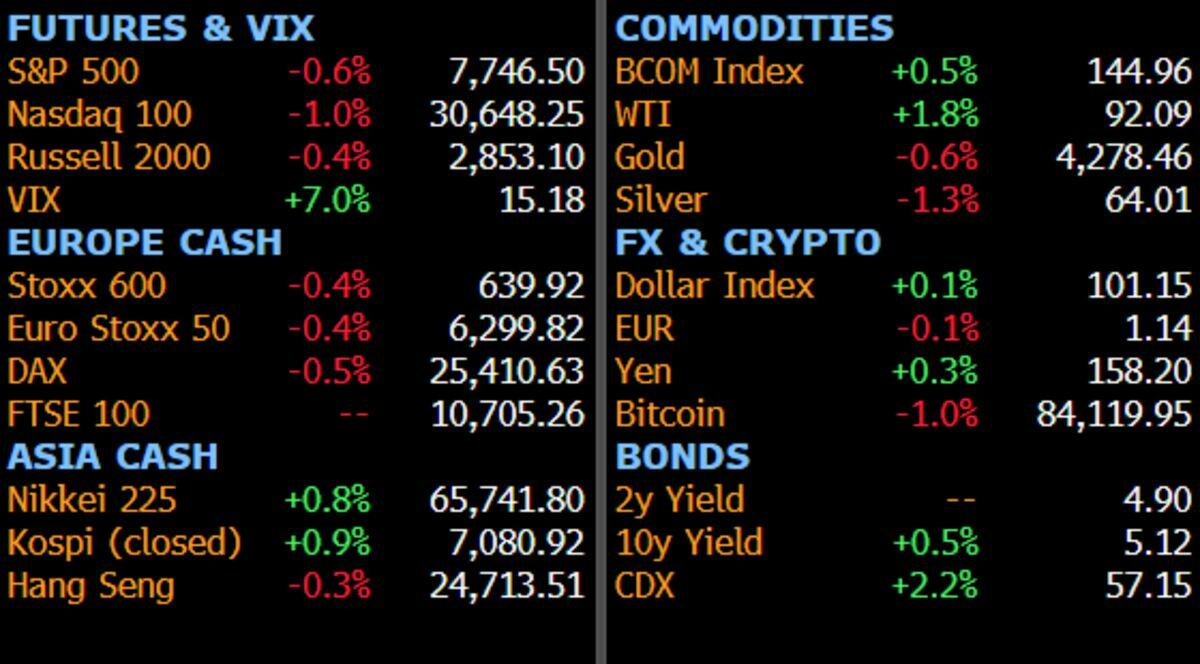
Futures are lower with Tech underperforming as part of a global risk-off tone with few areas of safety, driven by a global bond rout that has sent yields across the globe to levels not seen in a generation. As of 8:00am ET, S&P futures are 0.6% lower with Nasdaq futures sliding 1.0% and reflecting the fallout from Wednesday’s barrage of inflationary signals, which sent stocks in Asia and Europe lower. In premarket trading, semis and memory are lagging the broader tech tape for the 2nd day, with software seeing slight outperformance, but still lower. Defensives and energy are leading cyclicals. The yield curve is bear steepening with the back-end yields making multi-year highs; pushing the 10Y yield to 5.14% and the 30Y yield to the highest since 2004. This follows Wednesday’s US data and auction-led selling in US paper with an ascent in energy prices today driving the moves further. The rout in bonds swept into Asia, with yields in Japan, Australia and New Zealand climbing by more than 10 basis points on Thursday. The USD remains bid and DXY is less than 40bp from its 52-wk high. In commodities, energy and ags resume their leadership as the market reduces its optimism for an imminent solution in the MidEast; metals are weaker with precious lagging ase. The Trump-Xi meeting will be one to watch on today’s calendar, following US Treasury Secretary Bessent’s announcement of a two-month extension to the trade truce which appears to have disappointed markets as it was less than what China expected. US economic data slate includes 2Q current account balance and weekly jobless claims (8:30 a.m.), August new home sales (10 a.m.) and September Kansas City Fed manufacturing activity (11 a.m.)
In premarket trading Magnificent Seven: Alphabet (GOOGL) -0.7%, Amazon (AMZN) -0.9%, Apple (AAPL) unchanged, Microsoft (MSFT) -0.6%, Tesla (TSLA) -1%, Nvidia (NVDA) -1.1%, Meta Platforms (META) -2%
- Darden (DRI) falls 5% after the restaurant-chain operator posted first quarter sales that disappointed.
- Dropbox (DBX) declines 5% after Citi downgraded the file management software company to sell, writing that recent optimism about its AI strategy “derives too much success too early.”
- Etsy Inc. (ETSY) slips 2% after Arete downgraded the online retail platform to neutral, citing concerns over its valuation and growth sustainability.
- Everpure (P) jumps 7% after the data-storage company forecast revenue for 2028 that exceeded the average analyst estimate.
- MGM Resorts International (MGM) is down 9% after Barry Diller’s People Inc. dropped plans to acquire the rest of the casino giant.
- Stitch Fix (SFIX) falls 19% after the online personal styling platform forecast a much weaker full-year 2027 Ebitda that analysts expected.
- Viking Therapeutics (VKTX), which had surged 36% Tuesday on experimental weight-loss drug results, is down 12% after offering $200 million in common shares and another $200 million in convertible notes to help fund clinical development.
In other corporate news, a consortium backed by BlackRock and IFM are said to be closing in on $25 billion deal to buy Stack Infrastructure’s Asia Pacific data centers. Morgan Stanley is working to contain the damage from a leaked deal list after one of its top bankers accidentally sent an email to some clients containing a list of deals the firm was working on and monitoring.
Wednesday’s strong economic data, a weak debt auction, and mounting concerns over diesel prices and policy is rattling both Wall Street and Main Street, driving yields across most maturities to the highest in almost two decades. This has pushed inflation anxiety back to being front and center for investors, with concerns about Brent above $100 and an overheating US economy piling fresh pressure on bond markets. That’s taken the shine away from stocks, pulling the Nasdaq 100 down from a record high.
“Higher bond yields are becoming a more meaningful headwind for equities,” said Simon Wiersma at ING Bank. “Middle East de-escalation could take some pressure off bond markets, but the bigger story is the structural rise in global borrowing needs.”
Futures reflect the fallout from Wednesday’s barrage of inflationary signals. According to BBG, Traders are unlikely to commit fresh capital before tonight’s Trump-Xi summit, despite Bessent saying the US and China have extended their trade truce.
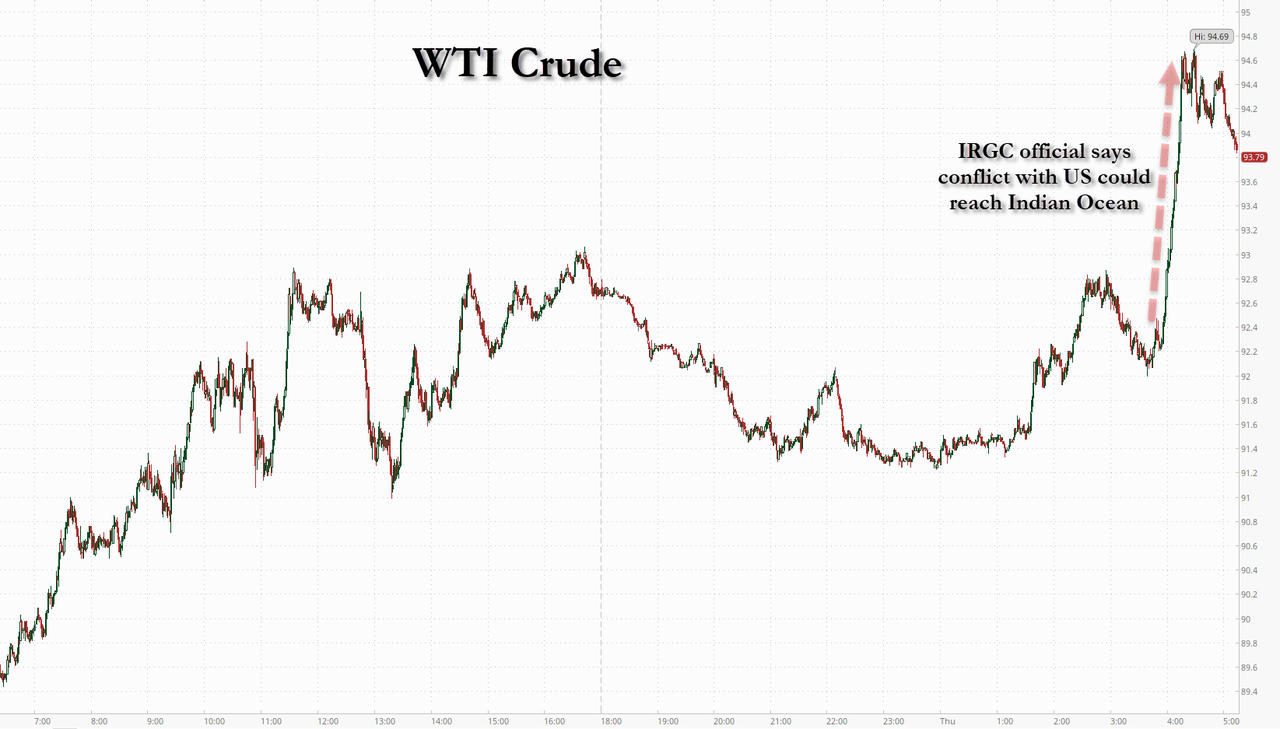
Oil’s latest leg higher came after an Iranian official warned Tehran may expand the war to the Indian Ocean if the US or Israel attacks again. “Now that the war has expanded from the Persian Gulf and the Strait of Hormuz to the Red Sea, it may, in the next phase of a potential conflict, widen further,” Iran’s semi-official Fars cited Yahya Rahim Safavi, who’s also a senior member of the Islamic Revolutionary Guard Corps, as saying.
“Oil prices remain the key driver overall,” said Nadege Dufosse, head of multi-asset at Candriam. “Investors are flying blind as it’s impossible to guess which way the talks between Iran and the US will go.”
Energy Secretary Chris Wright told oil industry leaders to brace for possible US curbs on diesel exports amid an intensifying debate within the Trump administration over that approach. A potential diesel export ban would carry “significant implications” and even have the counterintuitive effect of an increase in gasoline prices if US refiners cut runs, notes Morgan Stanley.
Meanwhile, as extensively noted here, the entwined mix of AI and inflation is causing angst. Debt pressures return with Amazon, Alphabet CDSs topping the year’s highs, and Nvidia insurance costing more amid circular financing concerns.
“Before the year draws to a close, a choice is likely to be needed between inflation and the debt-financed capital expenditure boom,” notes Jonestrading Chief Strategist Mike O’Rourke. “Main Street has paid the price for five-plus years and does not have much left to give,” O’Rourke adds.
Hyper CDS new all time wides, led by ORCL, SPCX, NVDA and META pic.twitter.com/gr7OcinLUl
— zerohedge (@zerohedge) September 23, 2026
Fresh warnings about price pressures were raised at two rate decisions in Europe. The Swiss National Bank lifted its inflation forecast as it dialed down its threat of intervention to support the franc. Norges Bank increased borrowing costs for a second time this year and said it was primed to hike again. For the Fed, swaps fully reflect three quarter-point hikes over the next year, with significant hedging for a fourth.
“A resolution in the Middle East would certainly bring some relief, particularly to European rates given the energy channel, but in the US the story goes beyond oil at this stage,” said Alessandro Gabellone at Bank Degroof Petercam.
“Inflation has been above target for years, while fiscal imbalances and rising interest costs are increasingly part of the discussion around long-term yields,” he said.
Traders will follow the summit between Trump and China’s Xi Jinping later today at a time when tensions between the world’s two biggest economies persist over rare earths, technology curbs and Taiwan. “Super Intelligence” would be a big topic of discussion, Trump said on social media. “I want to leave it exactly where it is. That is China’s position also.”
Treasury Secretary Scott Bessent announced that a trade agreement struck by the leaders last year will now run an additional two months until Jan. 10, clearing the way for two more meetings in the coming months at summits in Shenzhen and Miami.
In Europe, the Stoxx 600 is down 0.4% with the average yield rising to levels not seen in almost two decades. Tech and autos are the worst performers. Energy gains. Here are some of the biggest movers on Thursday:
- Mitchells & Butlers shares rise as much as 3.9% after the pub chain reported a pick-up in like-for-like growth in the final quarter, aided by a strong showing over the August bank holiday weekend.
- Motor Oil Hellas shares rise as much as 1.9% after Goldman Sachs upped its price target on the Greek refiner, predicting it to benefit from higher diesel crack spreads.
- BioGaia gains as much as 5.1% after Danske Bank reiterated its buy rating and raised its price target on the Swedish health additives company, seeing a good risk/reward opportunity going into the company’s third-quarter report, due on Oct. 22.
- Raspberry Pi rises 23% after first-half revenue at the micro-computer maker jumped 90% to $256.9 million.
- OVS shares rose as much as 4% in Milan trading after the Italian fashion retailer’s adjusted net sales grew 11% year on year.
- H&M shares fall as much as 3.7% after US tariff refunds were largely credited for driving a beat in third-quarter profits at the Swedish fast-fashion retailer.
- Tryg shares fall as much as 3.5% after Danske Bank downgraded the Danish insurance firm to hold from buy, predicting headwinds from inflation and rising interest rates.
- Verbio declines as much as 6.9% as Jefferies says that despite a solid finish to the year, the biodiesel and bioethanol fuel producer’s new FY26/27 Ebitda guidance is below consensus.
- Vistry shares drop as much as 11% after the housebuilder reported weak interim results and outlined the findings from the review conducted by its CEO.
Asian stocks declined for a second day amid renewed pressure from elevated oil prices and US bond yields. The MSCI Asia Pacific Index dropped 0.9%, with China the worst performer in the region. Indian equities dropped the most in over two months amid a selloff in the heavyweight financial sector after the nation’s insurance regulator proposed changes that include capping commissions. Japanese stocks were mixed as markets reopened following a three-day holiday. South Korea was shut for a holiday. .
In FX, the Bloomberg Dollar Spot Index continues to carve out fresh multi-month highs, adding 0.2%. The Norwegian Krone leads G10 FX, whilst the Swiss Franc lags after respective rate decisions. USD/JPY has eclipsed its 200DMA for the first time since early September.
In rates, treasuries are mixed in early US session with the yield curve steeper around a little-changed 7-year sector. Front-end tenors unwind some of Wednesday’s steep losses while long-end has added to them, lifting 30-year yield to 5.44%, highest since 2004. 10-year reached 5.15%, highest since 2007. US 2-year yields are lower by around 3bp with long-end yields higher by around 3bp, close to cheapest levels of the day, steepening 2s10s and 5s30s curves by 4bp-5bp. 10-year yield is little changed near 5.125%, with bunds in the sector lagging by 1bp and gilts outperforming by 2bp. European rates are a touch higher with the French-German 10-year spread widening to about 111bps. Higher energy costs have hit sentiment in Europe. $44 billion 7-year note auction at 1 p.m. New York time follows poor demand for Wednesday’s 5-year note sale, which tailed by more than 3bp. WI 7-year yield near 5.055% is ~54bp cheaper than last month’s, which stopped on the screws. IG dollar issuance slate empty so far. Five borrowers priced a combined $5.2b Wednesday, paying about 6bp in new issue concessions on deals that were 1.9 times covered. Weekly volume stands near $33b, about $6.5b short of the $40b projected by dealers. Focal points of US session include weekly jobless claims data and 7-year note auction.
In commodities, WTI crude oil futures are up around 1.4%, off session highs, extending Wednesday’s rally after an IRGC official threatened to expand the war in the Middle East into the Indian Ocean.Brent is higher by 2.5% and up nearly 10% from the week-to-date low as hopes of a US-Iran deal fade and rhetoric remains hostile. Brent gained after US Energy Secretary Chris Wright told oil industry leaders to brace for possible US curbs on diesel exports amid an intensifying debate within the Trump administration over such a move. The firmer greenback is dragging precious metals lower with spot gold down 0.6%. Bitcoin declines nearly 1%.
US economic data slate includes 2Q current account balance and weekly jobless claims (8:30 a.m.), August new home sales (10 a.m.) and September Kansas City Fed manufacturing activity (11 a.m.) Fed speaker slate includes Richmond’s Barkin (8:30 a.m.), Cleveland’s Hammack (8:50 a.m.) and Philadelphia’s Paulson (10:10 a.m.). New York President John Williams said in a London event Thursday that more work needs to be done to lower US inflation.
Market Snapshot
Top Overnight News
- The US 30-year yield climbed to its highest level since 2004 as comments from Iran further stoked oil-driven inflation fears and fiscal concerns. Equity futures fell. BBG
- Brent surged to around $106 after a military adviser to Iran’s supreme leader said Tehran may expand the war to the Indian Ocean if the US or Israel attacks again, further undercutting hopes of a deal. BBG
- Saudi Arabia has sold almost 100 million barrels of oil to Asian buyers since the middle of last week, helping to avert a looming supply crunch in the region. The crude will be sent via the Strait of Hormuz to buyers including Chinese state-run and independent refiners, as well as processors in India, Japan and South Korea. BBG
- President Donald Trump’s strong rapport with Xi Jinping is set to be on display in Washington this week as the Chinese leader makes his first U.S. state visit in more than a decade. But below the surface-level pageantry at the White House, little is likely to be resolved as the world’s two biggest economies continue to spar over trade, Taiwan, AI and more. NBC
- US Treasury Secretary Scott Bessent announced on Wednesday that Washington and Beijing have agreed to extend the trade agreement reached in South Korea for just two months, as Chinese President Xi Jinping arrives in Washington for a state visit. SCMP
- Large cargo ships have recently paid up to $5 million to pass through the Panama Canal, as the global shipping industry reacts to trade disruptions from the Iran war and extreme weather patterns in the Western Hemisphere. WSJ
- The AI build-out is on track to become the biggest economic bet in U.S. history, dwarfing the investments made to fund other huge U.S. infrastructure projects such as the railroads, the highway system and the plumbing for the internet. WSJ
- AI firms are rushing to discount their products as some enterprises express caution about paying full price for all the new tools. The Information
- Sellers are feeling the strain of US mortgage rates around 7%. Nearly one in five homes for sale had a price cut in August, while 45% of sales involved a seller concession, according to Redfin data. BBG
- Mark Carney said he had seriously considered the “extreme tail risk” of a US invasion when asked about the possibility in a NYT interview. BBG
- A US judge issued an order blocking the Trump administration’s White House ban on CNN, MS NOW and Politico.
- US Senate Majority Leader Thune believes President Trump is open to implementing AI guardrails despite his public defiance on the issue: Axios.
- An industry group representing US tech companies is reportedly pushing the US administration to withdraw its proposal to charge for H-1B visas: WSJ.
- BofA Total Card Spending (w/e Sep 19th) +6.9% Y/Y (prev. +5.8% W/W); surging gas prices have opened up a gap in ex-gas spending between higher and lower income households.
A more detailed look at global markets courtesy of Newsquawk
APAC stocks were mostly pressured following on from the declines in global peers alongside the recent bond turmoil and jump in yields, owing to several factors including strong US data, hawkish Fed rhetoric and mixed reports regarding a US diesel export ban.
ASX 200 retreated with the declines led by weakness in miners, real estate and materials, while sentiment was not helped by mixed jobs data including an unexpected rise in the Unemployment Rate to a five-year high. Nikkei 225 outperformed after Japanese participants returned from the long weekend and with tech names playing catch-up to the recent AI-related momentum. Hang Seng and Shanghai Comp retreated despite early optimism from President Xi’s state visit to the US, while a two-month extension to the US-China trade truce until January 10th also failed to spur risk appetite.
Top Asian News
- PBoC will offer lenders a record amount of up to CNY 1tln in overnight funds each day over the upcoming holiday period, according to Bloomberg.
- PBoC to comprehensively use and timely adjust monetary policy tools to keep liquidity ample; to step up counter cyclical adjustments.
- Japan’s Finance Ministry is to consider cutting issuances in liquidity-enhancement auctions for medium-term JGBs, according to sources.
- Japanese Finance Minister Katayama said the principles on forex established since the joint US-Japan intervention remain in effect, while she won’t comment on specific FX levels.
- Japan reportedly plans to finance economic security spending mainly through “bridging bonds”, reducing the need for the issuance of deficit bonds, Nikkei reported citing sources.
European bourses (STOXX 600 -0.3%) opened entirely in the red and has come under a fresh leg of pressure in recent trade amid the upside across the energy space. The source of the move came amid comments by the Senior adviser to Iran’s Supreme Leader Major General Safavi, saying the US conflict could expand further into the Indian Ocean. Sectors highlight the negative bias. Energy, Food, Beverages & Tobacco and Optimised Personal Care are the only sectors in the green. Leading the downside is Tech, followed by Autos and Financial Services.
Top European News
- The UK Treasury is open to smaller fiscal headroom and Chancellor Healey may accept a smaller fiscal buffer to reduce tax rises in next month’s Budget, according to FT.
- German Ifo Expectations (Sep) 90.4 vs. Exp. 89.3 (Prev. 89.1).
- German Ifo Current Conditions (Sep) 89.5 vs. Exp. 89 (Prev. 88.5).
- German Ifo Business Climate (Sep) 89.9 vs. Exp. 89 (Prev. 88.8).
- French Business Confidence (Sep) 101 vs. Exp. 102 (Prev. 101).
- French Consumer Confidence (Sep) 86 vs. Exp. 85 (Prev. 86).
Central Banks
- Norges Bank hiked rates by 25bps to 4.50%. Expectations heading into the announcement were split. The Bank noted that inflation has been above target for several years, and that by raising the rate, it will help reduce inflation and that the policy rate will be elevated for a time. The Committee is prepared to raise the policy rate further if warranted by the inflation outlook. The decision was backed by continued elevated inflation metrics, with the Bank alert to upward risks to the inflation outlook; it stated that “Inflation may then become stickier and harder to bring down again”. Governor Bache suggested that the inflation outlook has not materially changed, as such, stated that the Bank is prepared to deliver further rate hikes to bring inflation down to target. This is reflected in the rate path projection, which does not point to further tightening later this year, but will continue into Q1/Q2’27.
- The Riksbank left rates unchanged at 1.75%, as expected. With the commentary, and particularly the forecasts, a hawkish bias can be seen with the language being that “it is expected that the increases to the policy rate will begin this year”, while the forecasts imply a hike around end-2026/start-2027 and then another one in the Q2/Q3-2026 period, and then thereafter there is some optionality of another hike by Q3-2028, a marked hawkish tilt vs the June projections. Albeit, this is caveated by the assessment that Q2 GDP strength was somewhat due to temporary factors, though the general commentary remains constructive. Overall, the strengthening of the SEK highlighted the overall hawkish tone.
- The SNB left rates unchanged at 0%, as expected. The main update was the tweak to the FX language, which now shows “…willing to be active in the foreign exchange market…” from the June line of “If necessary, the SNB has an increased willingness to intervene in the foreign exchange market”, omitting the “increased” framing. In terms of the Bank’s inflation forecast, they were lifted across 2026, 27 and 28, primarily due to higher energy prices. They also noted that the recent uptick in inflation was attributed to a rise in goods inflation, driven by higher prices for oil products. In an immediate reaction, the CHF weakened given the aforementioned change to the intervention language.
- Fed’s Williams (voter, Neutral) said the big challenge is on inflation and need to get it back to target in a timely manner while stating that it is reasonable to see another rate hike by year-end. He said short-run inflation expectations have been more encouraging, though the longer term they have not. On the economy, Williams said it has been remarkably resilient and downside risk to achieving maximum employment have receded.
- BoE’s Lombardelli said policy is increasingly likely to need to tighten if elevated energy prices persist. On second-round effects, she said the absence of evidence is something but not much, and that it is likely still too early to see evidence in the data. On policy, Lombardelli described it as restrictive and that it is increasingly likely to need to tighten if elevated energy prices persist, absent clear evidence of disinflation or weaker activity.
- BoE’s Dhingra said most of the financial conditions have done a lot of tightening work already in the UK and is encouraged on what pricing is doing. Dhingra added that the labour market looks pretty weak, while highlighting that winter energy prices will be critical for second round effects.
- ECB’s Kocher said the ECB must prevent excessively high inflation from becoming entrenched and that the Eurozone economy remains fragile. Kocher added that there has been signs of somewhat more Eurozone momentum since summer.
- ECB’s Schnabel said the energy shock is much more persistent than thought.
FX
- G10s are mostly lower against the USD, albeit only marginally. The EUR holds afloat, joined by the Kiwi, Loonie and GBP, whilst the CHF underperforms a touch.
- DXY holds within a 101.00 to 101.23 range. The Dollar traded steady throughout overnight and early-European trade, but then moved higher alongside a bout of strength in the energy complex. This came after an IRGC official noted that the “war could expand” to the Indian Ocean or Bab el Mandeb Strait if the US decides to go to war again. More generally, crude benchmarks will be digesting reports that the US dismissed Iran’s Hormuz offer during UN talks, saying Tehran does not control the Strait.
- Fed’s Williams spoke this morning, where he suggested it was reasonable to see another rate hike by year-end. Markets are pricing in a 38.4% chance of one 25bps hike by year-end, with a c. 50% chance of another this year.
- Policy announcements from the SNB, Riksbank and Norges Bank have led to some volatility in the respective currencies. Kicking off with SNB, the Bank opted to hold rates, lifted inflation projections and removed its “increased willingness” for intervention. As such, the CHF moved lower following the announcement. Over in Sweden, the SEK was initially choppy following the Bank’s decision to hold rates. But then gradually strengthened, as the Bank lifted its rate path forecasts to imply a hike towards the end of this year/start of next year. Elsewhere, the only hike today was delivered by Norges Bank. It lifted its Key Policy rate by 25bps to 4.50%, and reiterated its tightening bias. EUR/NOK knee-jerked lower as traders unwound their bets of a hold, before paring around half of that move.
Fixed Income
- The very modest bearish action at the start of the morning has given way to downside of c. 40 ticks in Bunds. Amidst a combination of factors, namely: energy upside on Iranian commentary, hawkish central banks, strong German Ifo & trade/tariff concern ahead of the US-China meeting, and also from Germany via the VDA.
- Unsurprisingly, the bulk of the move was on the Iranian adviser Safavi intimating that the “scope of the war may expand…”, to include the Indian Ocean and other regions. An update that, over the course of around one hour, lifted Brent by over USD 2.00/bbl and pushed the US 30yr yield to its highest in over 20 years.
- Bunds hit a 119.87 trough, nine ticks above Wednesday’s contract low. As mentioned, much of the focus has been on yield action, with upside seen across curves globally and a slightly steepening bias seen.
- For USTs, no real move to Fed’s Williams, though he did note that pricing for another hike by end-2026 is “reasonable”. As it stands, markets imply a 38% chance of one 25bps hike by year-end, and just over a 50% chance of two. At a 104-28 contract low with yields bid across the curve.
- Ahead, the focus remains on central banks with several speakers due, before the Trump-Xi meeting begins and the readout which is scheduled for just after 15:00BST commences. A meeting that is framed by recent remarks from Treasury Secretary Bessent that while the truce has been extended to January 2027, he does not know if a bigger deal can be done.
- Italy sells EUR 2.5bln vs Exp. 2.5-3bln 3.00% 2028 BTP: b/c 1.64x (prev. 1.58x), average yield 3.64% (prev. 3.02%).
Commodities
- WTI Nov and Brent Dec futures started the European morning with only modest gains, but gradually picked up as the session progressed. The bullish bias potentially comes amidst the lack of US-Iran diplomatic progress and after an IRGC official noted that the “war could expand” to the Indian Ocean or Bab el Mandeb Strait if the US decides to go to war again.
- Focus also remains on the potential US diesel export ban, although the White House denied reports that the Trump administration is preparing a 90-day ban. Morgan Stanley warned that such a move, while not its base case, could have significant implications and potentially raise gasoline prices as barred diesel exports fill storage and force refiners to cut runs. The bank estimated refiners could need to reduce runs by around 2mln BPD, in turn cutting gasoline supply by roughly 650k BPD.
- WTI trades around USD 93.70/bbl within a USD 91.23-94.69/bbl range, while Brent trades above USD 100.00/bbl within a USD 97.09-100.94/bbl range. Dutch TTF is firmer, with the contract trading within a EUR 73.39-75.04/MWh range. The Trump-Xi meeting could provide some impact amid reports of potentially reducing or removing China’s 15% tariff on US LNG.
- Precious metals remain subdued following Wednesday’s surge in the USD and global yields, with hawkish Fed rhetoric and strong US data continuing to weigh on the complex. Spot gold trades towards the bottom of a USD 4,254-4,303/oz range, with the 100 DMA at USD 4,309/oz. Spot silver similarly trades around the lower end of a USD 63.52-64.55/oz range.
- Base metals are mixed/rangebound against a subdued risk backdrop, with copper also digesting news that BHP suspended operations at its Escondida mine in Chile following an accident. 3M LME copper resides in a USD 14,575.08-14,677.78/t range.
- Saudi Aramco CEO said that it is studying a “a fourth and a fifth route” for crude oil exports and noted that the Co. can restore disrupted operations within days.
- China’s NDRC raised retail fuel prices in the current bi-monthly cycle, effective September 25th, with gasoline prices up CNY 395/tonne and diesel prices up CNY 385/tonne.
- BHP (BHP AT) said operations at the Escondido mine in Chile were suspended following an accident.
Trade/Tariffs
- US President Trump said it was a great greeting with Xi and that the entire tech and banking world will be at Thursday’s dinner. Trump also stated that he had some great conversations with leaders at the UN General Assembly.
- Chinese President Xi said he looks forward to in-depth exchanges with US President Trump and will expand cooperation between the two countries in various areas, while he is confident the US trip will produce fruitful results. Xi also commented that China and the US must be allies, not adversaries, and he is confident China and the US can find the right path to coexist in a new era.
- US Treasury Secretary Bessent said the US-China trade truce was extended to January 10th, while he doesn’t know if a bigger trade deal can be done with China and could just roll the current deal forward. Furthermore, Bessent said that presidents Trump and Xi are expected to meet four times this year and that China is doing well so far in meeting 2026 pledges.
- China’s MOFCOM said they discussed AI with the US under the bilateral economic and trade consultation mechanism.
- Germany’s VDA is reportedly endorsing new tariffs against China for the first time, according to Handelsblatt.
- India cut import duties on crude palm oil and soybean oil to 5% (prev. 10%).
Geopolitics: Iran
- Senior adviser to Iran’s Supreme Leader Major General Safavi said the scope of the war may expand to the Indian Ocean and other regions, if the US starts a new war.
- Israeli source said an additional round of strikes against Iran seems to be a matter of time, Al Hadath reported. The source added that Iran is intensifying the transfer and fortification of the Natanz nuclear project. Additionally, the source said Israel does not see a real chance of reaching an agreement between the US and Iran, and that the US wants to end the Iran war with a political agreement or a decisive attack that topples the regime. On further strikes, the Israeli source said they will strike Iranian nuclear facilities again if Iran crosses the red lines, with or without US involvement.
- US Treasury Secretary Bessent said they are getting sometimes up to 17mln oil barrels out of Hormuz and noted that probably 80-90% of Iran’s external flights are shut down.
- Chinese Foreign Minister said the Strait of Hormuz conflict must be resolved through dialogue and calls on all parties to seek a peaceful solution, Al Arabiya reported.
- Pakistan’s Foreign Minister told Iran’s Foreign Minister that they must remain committed to dialogue and diplomacy.
- Iran’s Foreign Ministry noted that Iran’s Foreign Minister held a meeting with Pakistani counterpart at the UN General Assembly.
- UK Chancellor Healey said he spoke with US Treasury Secretary Bessent today about stepping up pressure on Iran and how to work together to drive growth in both nations.
- EU’s Costa spoke to Iran’s President Pezeshkian and urged Iran to resume its cooperation with the IAEA, while he also called for an end to Iran’s strikes against its neighbours and a full restoration of freedom of navigation in the Strait of Hormuz.
- Initial reports noted two explosions in Bandar Abbas and one in Sirik, southern Iran, with the explosion in Sirik reportedly coming from near the coast, off to the sea.
Geopolitics: Ukraine
- Russia’s Kremlin said no decision yet has been made on a December summit between US President Trump and Russian President Putin and that discussing a possible agenda is premature.
- Waves of Russian missiles attacked Kyiv and more than a dozen heavy explosions were heard in 30 minutes, according to an FT reporter.
US Event Calendar
- 5:00 am: Aug F Building Permits, prior 1394k
- 8:30 am: 2Q Current Account Balance, est. -257.4b, prior -226.83b
- 8:30 am: Sep 19 Initial Jobless Claims, est. 200k, prior 196k
- 8:30 am: Sep 12 Continuing Claims, est. 1740k, prior 1730k
- 10:00 am: Aug New Home Sales, est. 615.55k, prior 607k
Central Bank Speakers
- 4:10 am: Fed’s Williams Speaks During Moderated Discussion
- 8:30 am: Fed’s Barkin In Fireside Chat With Economic Club of Washington
- 8:50 am: Fed’s Hammack Delivers Opening Remarks at Inflation Conference
- 10:10 am: United States Fed’s Paulson Speaks At Fintech Conference
DB’s Jim Reid concludes the overnight wrap
As we go to press, the main story is still the huge global bond selloff, with yesterday seeing the biggest jump in the 10yr Treasury yield (+15.2bps) since the market turmoil around Liberation Day in April 2025. The main driver was a strong batch of PMIs, along with a rebound in oil prices, which both led to mounting speculation about faster rate hikes. Indeed, futures this morning are pricing a 71% chance of a Fed rate hike at the next meeting in October. So that drove a bunch of records, and we even saw the 5yr Treasury yield (+16.7bps) rise above 5% for the first time since 2007. In addition, there were growing signs of stress in Europe, where the Franco-German 10yr spread (+6.2bps) rose to 110bps by the close, marking its highest level since the Euro crisis in 2012. So it was a rough day all round, and risk assets came under fresh pressure, with the S&P 500 (-0.75%) posting its biggest decline in a month, with futures down another -0.21% this morning.
Those moves had several catalysts, but the biggest were the US flash PMI numbers, where the composite PMI unexpectedly hit a 5-year high of 58.4 in September (vs. 55.3 expected). So that played into the narrative of resilient growth, which in turn would enable the Fed to keep hiking rates to deal with inflation. And significantly, this was part of a global theme, as we found out earlier that the Eurozone composite PMI hit a 3-year high of 53.1 (vs. 51.7 expected). So if anything, the initial signal from the PMIs suggested that growth was accelerating in September across many of the world’s biggest economies.
That positive data drove the hawkish repricing, but it got a further boost thanks to a fresh rebound in oil prices. Indeed, Brent crude (+3.86%) ended a run of 5 consecutive declines yesterday, closing back up at $103.08/bbl. That came amidst growing doubts about the chance of a US-Iran deal, despite the talks at the UN this week. For instance, a spokesman for Iran’s foreign ministry said that Iran had presented a list of conditions to the US for restarting negotiations via Qatari mediation. That included the US accepting a shipping route agreed by Oman and Iran, along with an end to the naval blockade and the release of Iran’s frozen assets. And Iran’s President Pezeshkian struck a defiant tone, saying that Iran would not allow freedom of navigation through Hormuz while the US blockade and sanctions remain in place. So for investors, the sense was that the two sides were still far apart, and the 12-month Brent future (+0.42%) hit a 3-month high of $80.96/bbl by the close. So it was clear that investors were still expecting a protracted period of higher oil prices.
Collectively, that strong data and the oil rebound led to growing speculation about faster rate hikes. But interestingly, this fits into the usual pattern of recent cycles, where investors have tended to underestimate the scale of hikes at the outset, before adjusting in a hawkish direction. We explored this pattern on Monday (link here), where we pointed out several reasons that leant in the direction of faster hikes. For instance, much as inflation is lower than in the 2022 cycle, broader financial conditions are much more accommodative today. Moreover, another historical pattern is that central banks tend to correct for the last crisis, and in 2021-22 they faced criticism for not reacting to inflation fast enough, so we’re already seeing a more hawkish reaction function this time. And looking forward, the latest uptick in commodity prices hasn’t filtered through to the inflation numbers yet either.
This hawkish repricing was clear over the last 24 hours, and when it came to the Fed, market pricing for an October hike rose from 53% on Tuesday, to 69% by last night’s close. Similarly for the ECB, the chance of an October hike rose from 48% on Tuesday to 66% by the close. So in other words, there was a mounting sense that central banks would need to accelerate the hiking cycle, and that hikes at every other meeting might not be enough to get inflation back to target again. Looking beyond the next meeting as well, market pricing also shifted hawkishly. So for year-end, investors are now pricing in 37bps of Fed hikes, implying a near-even chance that they’ll deliver two more hikes before the year is out, which is the most hawkish pricing for December 2026 so far. That backdrop led to another huge bond selloff yesterday, with yields seeing big rises across the board. That was particularly clear for US Treasuries, where the 10yr yield (+15.2bps) saw its biggest daily jump since the market turmoil after Liberation Day in April 2025, taking it up to a post-2007 high of 5.11%. The moves were clear across the curve as well, with the 2yr yield (+14.2bps) jumping to its highest since May 2024, at 4.90%, whilst the 30yr yield (+9.9bps) hit a post-2007 high of 5.40%. A weak 5yr auction also didn’t help matters, with yields up to their intraday highs after $70bn of notes were sold at 5.03%, +3.1bps above the pre-sale yield. And in turn, the rise in US yields saw the dollar index (+0.49%) rise to its highest since July, while gold (-1.68%) had its biggest decline in two weeks.
That selloff was echoed in Europe, where the energy price gains and the strong PMIs drove a hawkish repricing as well. So that pushed bond yields up to fresh multi-year highs, with the 10yr bund yield (+9.2bps) at a post-2009 high of 3.55%, whilst the 10yr OAT yield (+15.4bps) hit a post-2008 high of 4.66%. Notably as well, it also pushed the Franco-German 10yr spread up to 110.4bps, which was a level last seen in July 2012, a few weeks before Mario Draghi delivered his famous “whatever it takes” speech that was a key turning point in resolving the crisis.
All that put a lot of pressure on equities, even though the growth data surprised on the upside. So the S&P 500 (-0.75%) posted its biggest decline in a month, with all the major sector groups apart from energy (+1.04%) losing ground. The NASDAQ (-1.13%) and the small-cap Russell 2000 (-1.77%) saw even larger falls. Meanwhile in Europe, the STOXX 600 (-0.44%) also saw a pullback, alongside declines for the DAX (-0.66%) and the CAC 40 (-0.39%) as well.
Overnight in Asia, the bond selloff has continued, with Japan’s 2yr yield (+4.8bps) up to a post-1995 high of 1.88%, whilst the 10yr yield (+11.1bps) is up to its highest since 1996, at 3.07%. And that’s been echoed in other countries, with Australia’s 10yr yield (+10.4bps) up to 5.32%, whilst New Zealand’s 10yr yield (+14.1bps) is up to 5.04%, the highest since November 2023. So equities have also struggled, with losses for the Hang Seng (-0.52%), the CSI 300 (-1.29%), the Shanghai Comp (-0.93%) and the S&P/ASX 200 (-0.80%). The main exception has been the Nikkei (+0.94%) although that reflects a catch-up after the index has been closed for the previous three days. Meanwhile in South Korea, markets are closed for a public holiday.
Looking forward, a key event today will be the summit between Presidents Trump and Xi. From a market standpoint, the main news was US Treasury Secretary Bessent saying they’d agreed to extend last year’s trade truce by two months, which will now keep tariffs lower until January 10. This extension was shorter than had been floated by US officials beforehand, but does offer more time to potentially reach a longer deal.
Finally, as oil prices were rising, another energy story yesterday was around whether the US might restrict diesel exports. Trump said on Tuesday that he was considering a possible export ban, and US diesel prices then slumped yesterday after Politico reported that the US was preparing a plan for a 90-day export ban. However, Reuters then reported a White House official who said this wasn’t accurate, while US Energy Secretary Wright said that “a full blanket ban or zero exports of diesel” are not being discussed. However, he did say that the administration was working with refiners to voluntarily curb exports of diesel. So despite the rises in crude, US wholesale diesel prices settled -3.35% lower after trading as low as -7.45% intra-day.
Looking at the day ahead now, and US data releases include the weekly initial jobless claims, new home sales for August, and the Kansas City Fed’s manufacturing index for September. Then in Europe, we’ll also get the Ifo’s business climate indicator from Germany for September. Otherwise from central banks, we’ll hear from the Fed’s Williams, Barkin, Hammack and Paulson, the ECB’s Schnabel and Lane, and the BoE’s Dhingra, Breeden and Lombardelli. The ECB will also publish their Economic Bulletin.
Tyler Durden
Thu, 09/24/2026 – 08:46

