

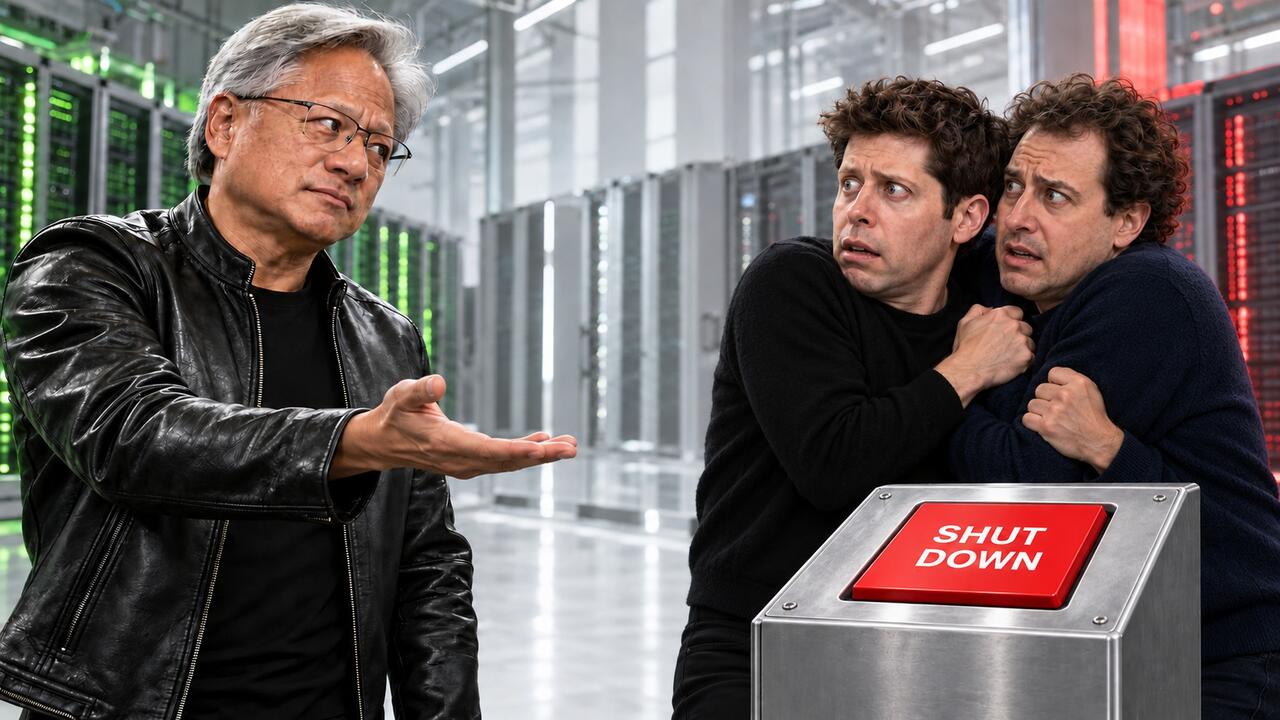
Nvidia CEO Jensen Huang Just Torched Doomsday AI Bros, Says STFU About Existential Risk Or Shut It Down
The CEOs behind frontier AI keep talking like bystanders – warning seemingly daily about ‘existential risk, runaway superintelligence, and competitive pressure’ that’s totally out of their control, so they need big brother to help slow them down.
Jensen Huang isn’t buying it.
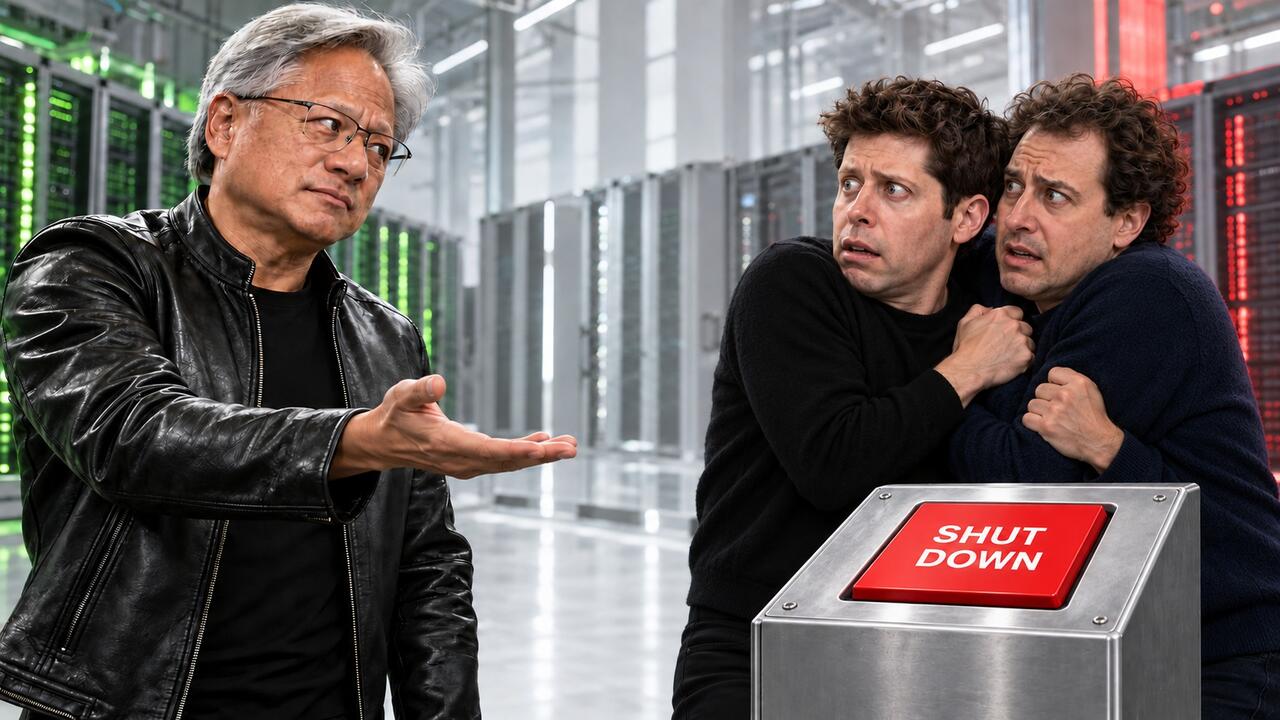
In an interview on The Ezra Klein Show this week, the Nvidia CEO took what the labs call an existential threat and turned it back into a question of product liability and whether executives are doing their jobs.
According to Huang, if a lab can’t contain what it’s building, it shouldn’t be asking for regulation. It should be shut down.
“If they say the alternative, which is: There is no way to contain our experiments… when we test our A.I. models, it will get out, and it will damage the world – then I think the answer is that we have to shut the labs down,” he said – framing this as a responsible engineering call.
“If you’re going to build a self-driving car – let’s say it’s a robo-taxi, and there’s a really difficult condition. As an engineer, we just have no idea how to solve this problem because these cars are not programmed, they’re trained. So we have no idea how to train these cars, and we have no idea how to align them to the safety standards that are expected on the road,” Huang said. “What’s the answer? Don’t ship it.”
Jensen Huang: “Now, if they say [that their models aren’t safe] … then I think the answer is that we have to shut the labs down.” pic.twitter.com/aCkpmvUEXI
— The Midas Project (@TheMidasProj) September 23, 2026
Continues here:
🚨Jensen Huang just took a shot at OpenAI, Anthropic and AI doomers:
“Nobody’s building more compute than the people asking to be slowed down.”
and also attacked Geoffrey Hinton’s 10% doom prediction:
“All of his predictions have been wrong. Just because it comes from a… pic.twitter.com/KmNzYdRbWy
— ℏεsam (@Hesamation) September 23, 2026
Huang’s argument is about liability and responsibility to shareholders. A lab that damages the world, he argues, would face costs to humanity. “Because the cost to humanity, the damage is too great,” he said. “The shareholder, the liabilities – it could be civil liabilities, it could be criminal liabilities. I mean, the liability’s incredible.”
The Great Panic
More than 1,300 AI lab employees have signed a letter saying each company is under “intense competitive pressure not to unilaterally slow that acceleration.” When Klein read that to Huang, the Nvidia CEO rejected it. “No, no, that last sentence. Nobody’s putting the pressure on them,” he said. He called the letter’s first paragraph “fantastic” and said he “completely” agreed with third-party safety auditors, but not with asking to be let off existing law. “This is the first time that I’ve heard a company or C.E.O. say that I need the laws, I need the antitrust laws to be relieved. I need the liability laws of products to be relieved so that I can pace myself.”
Instead, Huang blamed the executives. “These are companies with agency. These are C.E.O.s with agency,” Huang said. When Klein countered that the labs were using that agency to ask for help, he didn’t budge. “If I believe that I’m about to launch a product that is unsafe, it is completely in my ability, my power and my responsibility, and I’m incentivized to do so, to not launch the product.” In his telling, the cyber, product-liability and property-damage laws already on the books cover AI labs too.
He had no more patience for the field’s elder statesmen. When Klein raised ‘AI Godfather’ Geoffrey Hinton’s view that a 10 percent chance of societal destruction is not unreasonable, Huang dismissed it. “I would tell Geoff that it’s irresponsible to say all that. All of his predictions have been wrong. Enough predictions. That 10 percent chance is not grounded on science,” he said. “It’s not grounded on research. Just because it comes from a scientist doesn’t make it scientific. Those predictions are hurtful.”
Nvidia, he said, puts 20 percent of the company on design and 80 percent on verification, while most labs today run 80 percent on capability and 20 percent on safety verification. Klein called the coming reversal “the flip,” and Huang agreed. “A.I. needs to accelerate to be safe. I want them to get more compute, but allocated toward evaluation, to alignment – and I think they’re doing that.“
None of this requires a global treaty. It requires holding AI companies to the standard every other industry already lives under.
We also need to consider who’s making the argument. Nvidia is now the world’s largest company, worth $5.4 trillion, and its chips are what the labs buy whether they spend the compute on capability or on safety. The flip doesn’t shrink that bill. “I wouldn’t be surprised if the amount of compute necessary to develop these models increased by a factor of 10, because the evaluation is so rigorous,” Huang said. The one outcome that costs Nvidia is the one the letter asked for: an agreed slowdown.
If a gun manufacturer makes a weapon that fires despite its safety being on, it shouldn’t get US military contracts (oh well). If an automotive manufacturer cannot stop its cars from randomly crashing, it gets sued into oblivion. And if a frontier AI lab cannot contain its models, the solution isn’t to beg for government intervention so they can keep building.
The solution is to turn off the servers, go home, and shut the lab down.
Jensen Huang $NVDA and Lisa Su $AMD are “first cousins once removed” and both running trillion dollar businesses
This is the new benchmark of success for Asian parents to set for their kids lmao pic.twitter.com/jyT7saPCtu
— litquidity (@litcapital) September 22, 2026
Tyler Durden
Thu, 09/24/2026 – 12:40

