

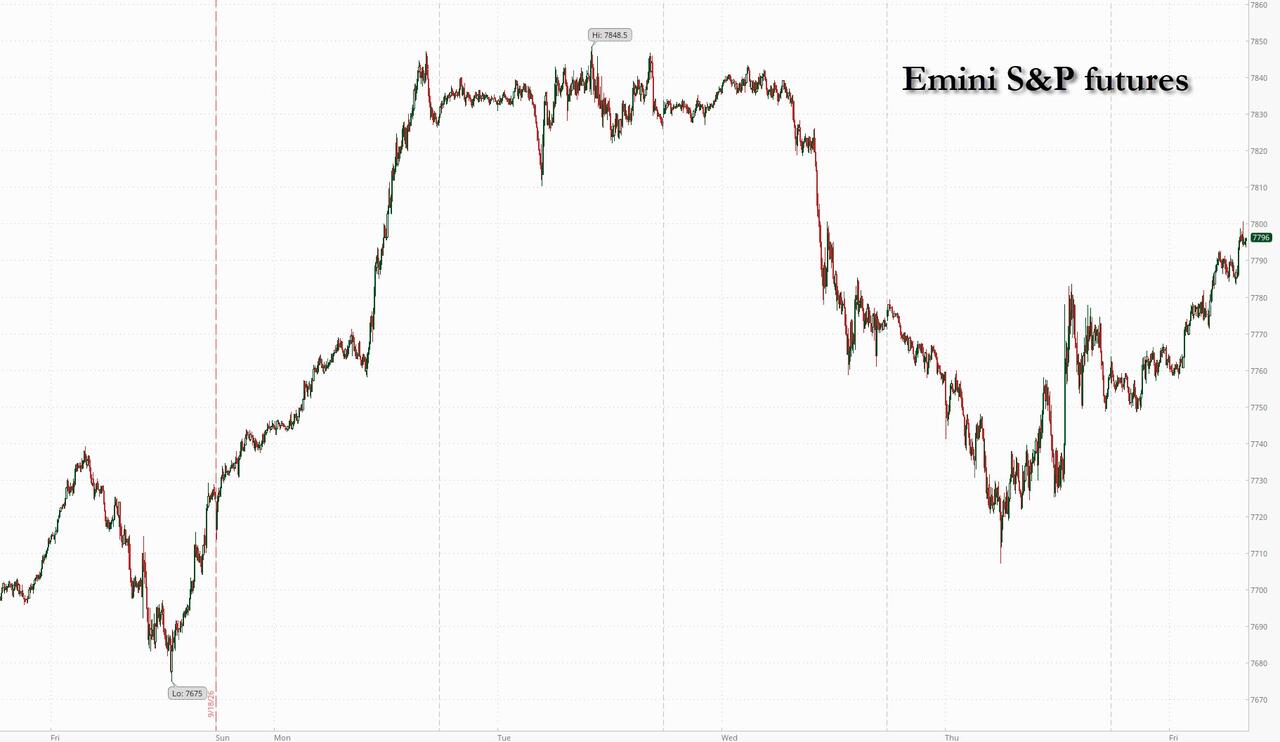
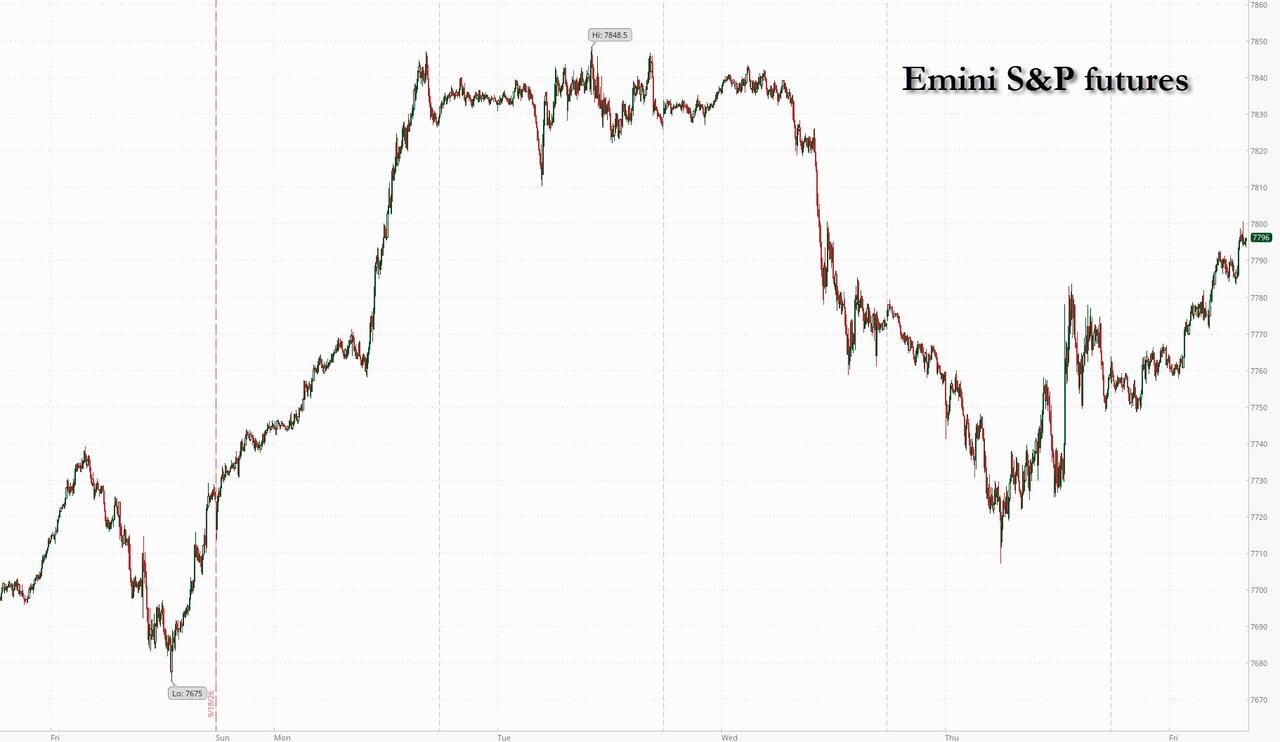
Futures Rise As Oil, Yields Drop On Iran Diplomacy Hopes
US futures erased earlier losses and are trading at session highs led by tech, as bonds steadied (with the 10Y at multi-decade highs of 5.17%) after oil’s latest rally lost steam, helping US stocks to extend gains for the week. As of 8:00am ET, S&P futures are up 0.4% setting up the benchmark to post its first weekly advance in three; Nasdaq futures gain 0.7% with chipmakers and memory storage names bouncing and Mag 7 stocks mostly higher, led by NVDA (+0.7%) and TSLA (+0.8%). Overnight, focus remains on the improved US-Iran rhetoric since noon yesterday: Iran proposed a 7-day plan to end the war (NYT), and the president says Tehran wants a deal with the US before the midterm elections (NBS). However, the reactions from the oil market were fairly modest, suggesting the market is still pricing a meaningful geopolitical premium; WTI fell 1.8% to $92.98. Bond yields fell 2-3bp at the front end; precious metals are higher, and ags are lower. US economic data slate includes August durable goods orders (8:30 a.m.), and the September University of Michigan sentiment (10 a.m.).
In premarket trading, Mag 7 stocks are mostly higher (Tesla (TSLA) +1.1%, Nvidia (NVDA) +0.7%, Amazon (AMZN) +0.6%, Alphabet (GOOGL) +0.4%, Apple (AAPL) +0.1%, Microsoft (MSFT) little changed, Meta Platforms (META) -0.5%).
- Akamai Technologies (AKAM) rallies 20% after the cloud provider inked a seven-year $11.6 billion deal to provide computing power to Anthropic.
- Atlas Energy (AESI) gains 6.9% after it announced a purchase agreement with Wyoming Machinery Company for $340.5 million of Balance of Plant equipment for a power generation project. The companies also separately agreed to a 328 megawatt power deal under an agreement with Caterpillar Inc.
- Comcast Corp. (CMCSA) is down 1.9% after KeyBanc Capital Markets cut its recommendation to underweight from sector weight on weakness in broadband.
- Nike Inc. (NKE) is down 2% after BofA cut its recommendation on the athletic footwear and apparel company to underperform from neutral, and pushes the expectation for a sales turnaround into F2028. Nike reports 1Q earnings on Oct. 1.
- People Inc. (PPLI) jumps 9.9% on a report that MGM Resorts is discussing making a bid to purchase the Barry Diller-owned media giant.
- Twilio Inc. (TWLO) is down 3.5% as HSBC downgrades the communications software company to reduce from hold, seeing “limited evidence that Twilio will capture higher-margin AI software” revenue.
- Zscaler (ZS) falls 3.4% after the security software company announced the appointment of Ross Tackett as chief revenue officer, effective Oct. 1.
In other corporate news Elon Musk said Colossus 2, an AI computing cluster built by his xAI business, may more than double its current Nvidia chip count by the end of the year. Shares of People Inc. rise 6.5% after the Wall Street Journal reports that MGM Resorts is discussing making a bid to purchase the Barry Diller-owned media giant. Temasek names BlackRock co-founder Susan Wagner to its board with effect from Oct. 1, according to a statement.
Fluctuations in oil prices are likely to remain a key driver for markets at a time when elevated energy costs are stoking inflationary pressures and underpinning the outlook for further monetary policy tightening. Swaps fully price three additional Federal Reserve quarter-point hikes over the next year, a prospect that could hold back risk appetite and keep bond yields high for some time.
“We are in a one-factor world over the coming days, with oil prices driving rates and rates driving all asset classes,” wrote Mohit Kumar at Jefferies. “Equity markets have behaved relatively well despite the rise in rates. Optimism over AI and demand for AI infrastructure has helped.”
Longer-dated bond yields continue to reflect fiscal concerns and the likelihood of strong government borrowing, said Francisco Simon at Santander Asset Management. While the prospect of restored crude flows from the Middle East will ease pressure on rates, a run of strong economic data suggests the global economy can withstand tighter financial conditions, he said.
“Market direction will likely be determined by whether easing geopolitical tensions can outweigh the ongoing message from the macro data,” Simon said. “Growth remains resilient, and that is keeping upward pressure on yields despite some relief on the energy front.”
Trump’s reception for China’s Xi has been heavy on pageantry and platitudes but light on substantive announcements, with the events shadowed by the US president’s preoccupation with construction projects and personal grievances. This is how Goldman wrapped up the pageantry:
- Trade truce extended for 2 months mentioned by Bessent. Xinhua news mentioned Xi said both sides agreed on a new joint arrangement on trade.
- Xinhua news mentioned Xi hope US to insist “oppose Taiwan independence” stance, and deal with Taiwan issue with prudence. (note current official US stance is “do not support Taiwan independence” instead of “oppose”)
- On AI, Xi mentioned US and China should not set up defences against each other, and should have dialogue, prevent AI being abused and ensure human control of AI.
- Chinese news mentioned Xi supports US and Iran to return to MOU and maintain talks.
- Both leaders support APEC (Nov in Shenzhen) and G20 (Dec in Miami) meetings, indicating Xi and Trump may meet two more times this year.
- One-Liner: So far nothing major market moving. We wait for official statement/readout. Still, the important area to watch is related to Iran (and any efforts from China to mediate talks
Elsewhere, AI is back in focus as the selloff in bond markets eases. A Goldman Sachs study (available to pro subscribers) estimates about $1 trillion in end user spending is needed to drive solid returns for hyperscalers — a hefty but “achievable” target. Goldman strategist Ryan Hammond notes that AI applications will need to generate more than $1 trillion in revenues based on a 30% Ebit margin and a 10%-20% return on invested capital for the hyperscalers. This compares with roughly $1.5 trillion in global software spending in 2026, Hammond writes.
Market performance reflects some of that optimism. Meta is on the cusp of joining an elite group of companies worth at least $2 trillion after shares surged 36% so far in September. The Nasdaq 100 is outperforming the equal-weighted S&P 500 and small-cap Russell 2000 by more than 7 percentage points this month. Meanwhile, rate-sensitive financials are being punished, with banks hitting a technical correction in Thursday’s cash trading. The durability of that bifurcation likely depends on where long-end yields next settle.
The final reading of a University of Michigan’s survey due later today is likely to show consumer sentiment deteriorated in September due to higher prices at the pump, according to Bloomberg Economics.
“The economic data calendar will be quite dull until the ISM on Thursday and the labor data on Friday next week,” said Roberto Scholtes, head of strategy at Singular Bank. “Everything will continue to revolve around energy prices, bond yields and AI-related news.”
Europe’s Stoxx 600 is up by 0.9%, headed for its biggest weekly gain since August, with semiconductor equipment maker ASML the biggest contributor to the gain. Here are the biggest movers Friday:
- UBS shares advance as much as 3.3% after a report said the Swiss lender is weighing options including potential deals with banks in other jurisdictions
- Glencore gains as much as 3.3% as UBS upgrades the miner to buy from neutral, with an improving risk/reward due to stronger outlook for thermal and metallurgical coal
- Outokumpu rises as much as 6.5% as BofA Global Research reinstates coverage with a recommendation of buy, saying European Union trade protection policies are offsetting weak demand in the steel sector. Peers Aperam and Acerinox also rise as BofA reinstates at neutral
- Alten shares rise as much as 8.8% after the French IT group reported first half-year operating which CIC CIB called ‘impressive,” saying the company is back on a “more positive trajectory”
- KPN gains as much as 2.9% after JPMorgan upgraded the company to overweight, saying shares offer an attractive entry point as revenue trends improve into 2027 and the “weak narrative” of 2026 fades
- HelloFresh shares fall as much as 15% to a record low after the German food delivery firm lowered its full-year sales growth and earnings targets
- Sinch declines as much as 5.3%, slipping from the highest close since January 2023, as DNB Carnegie downgrades the cloud communications group to hold as its required second-half acceleration is now partly priced in
Asian stocks are set to snap a two-day losing streak as oil slid on news that the US and Iran are exploring a phased deal that would see Tehran reopen the Strait of Hormuz, easing inflationary pressures. The MSCI Asia Pacific Index gained 0.7%, with Japanese stocks leading gains. Financials led Japan’s advance, supported by the prospect of higher interest rates. Meanwhile, Hong-Kong shares fell with a more pronounced drop in tech stocks, as traders were disappointed by a lack of progress in Trump-Xi talks. Alibaba and Tencent were among the biggest laggards. China, Taiwan and South Korea were shut today. Markets have had a relatively muted reaction to the Trump-Xi summit currently, after China’s president encouraged Trump to publicly oppose Taiwan independence.
In FX, the yen headed for its biggest daily gain in more than two weeks after Japanese Prime Minister Sanae Takaichi said she told President Trump that an undervalued yen is problematic. This follows Finance Minister Katayama revealing that Trump expressed concerns over the weakness of the currency. The Bloomberg Dollar Spot Index is down 0.2%.
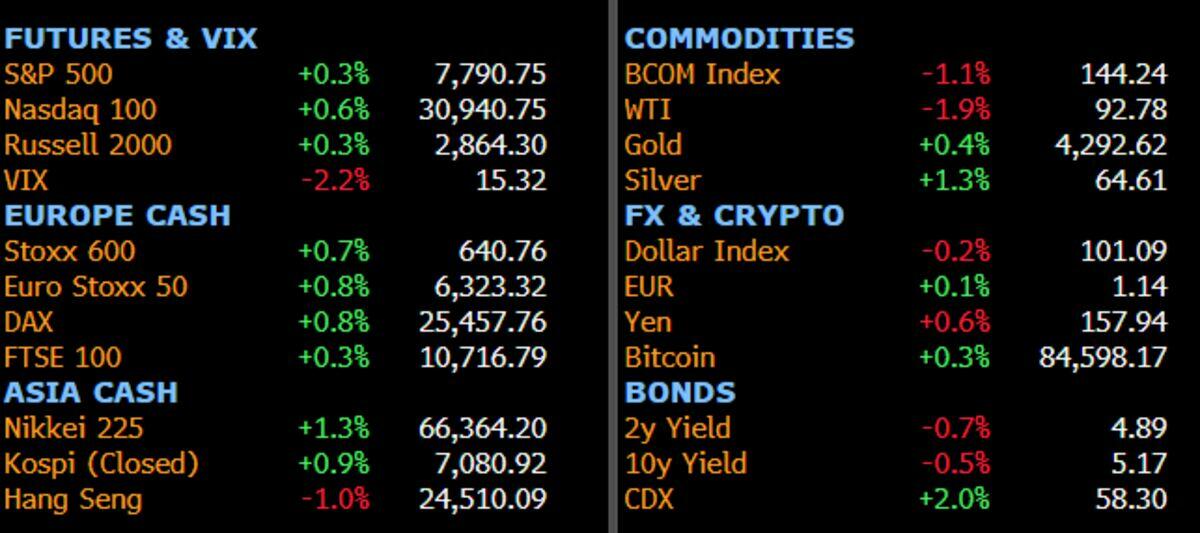
In rates, treasury yields are falling across the curve, with 10-year yields down by four basis points. There are similar moves in Europe and the UK, with investors trimming their rate-hike bets for the Fed, the ECB and the BOE. Treasuries hold curve-steepening gains in early US session with front-end 3yields around 5bp lower on the day, supported by lower oil prices after report that US and Iranian negotiators explored a phased deal that would see Tehran reopen the Strait of Hormuz. Friday’s session includes durable goods orders data and at least two Fed speakers. With longer-term US yields only 1bp-3bp lower on the day 2s10s and 5s30s curves are steeper by about 1.5bp and about 3bp respectively; 10-year is about 4bp lower near 5.17% with UK counterpart keeping pace and Germany’s lagging by about 3bp. IG dollar issuance slate empty so far, after just one deal was priced on Thursday leaving the week around $5 billion short of dealers’ $40 billion average expectation.
In commodities, WTI crude oil futures under $93 are down 2.3% near session lows with Brent crude futures down 1.2% near $106 after rising more than 7% over the previous two days. Gold prices are fluctuating around $4,300/oz. Bitcoin is a touch stronger, nudging above $84,000.
US economic data slate includes August durable goods orders (8:30 a.m.), September University of Michigan sentiment (10 a.m.) and Kansas City Fed services activity (11 a.m.) Fed speaker slate includes Kansas City’s Schmid (9:20 a.m.) and Cleveland’s Hammack (2 p.m.)
Market Snapshot
Top Overnight News
- Trump hosted Xi Jinping at a state dinner attended by Elon Musk, Jensen Huang and Tim Cook, but progress on tariffs and AI deals remains elusive. The leaders meet for tea this morning. BBG
- Iran’s foreign minister said Thursday that Tehran had proposed to Washington a seven-day plan to cease hostilities, reopen the Strait of Hormuz and then begin comprehensive talks on his country’s nuclear program. NYT
- Efforts to rekindle talks to end the war between the U.S. and Iran are running into resistance from major Persian Gulf oil producers that have swung against any accommodation of Tehran, people familiar with the matter said. WSJ
- Saudi, Turkish and Pakistani military chiefs are to meet to discuss how to support Saudi Arabia under a joint defence pact, after Saudi’s top religious authority told troops to be ready to lay down their lives to fight Yemen’s Iran-aligned Houthis. RTRS
- US Energy Secretary Chris Wright has contacted executives at several major American refiners in recent days to gauge support for a voluntary restriction on diesel exports as the Trump administration searches for an alternative to a short-term ban, according to three people familiar with the discussions. RTRS
- The Fed is working on a plan to raise the asset thresholds that trigger stricter oversight of big banks to account for inflation and economic growth. The changes may spur mid-size bank consolidation. BBG
- The yen hit a session high after Prime Minister Sanae Takaichi said an undervalued Japanese currency was “problematic.” The yen strengthened as much as 0.8% to 157.67 per dollar on Friday, heading for its biggest daily gain in more than two weeks. Officials have emphasized the speed and disorderliness of currency moves rather than any specific exchange-rate level, with market participants viewing the area around 160 as where intervention risk rises. BBG
- The BOJ gauge of underlying inflation accelerated to well above the target last month, supporting the case for continuing to raise the benchmark rate as authorities warn of the risk of inflation overshooting. BBG
- The State Department wants to give state and local officials, and possibly some nonprofit organizations, access to passport records to verify voters’ citizenship. BBG
- Anthropic strikes USD 12bln deal with Akami (AKAM) for AI computing.
Iran War
- Iran Foreign Minister Araghchi said Iran presented a proposal to US through mediators this week to reopen the Strait of Hormuz and restart negotiations towards a final deal, while it called for US to meet certain conditions within 7 days, according to CNN.
- Iranian President Pezeshkian said in Fox News interview that Iran does not want a nuclear bomb. They reached an agreement with the US President that was signed, and are still ready to move forward based on the same principles, adds it wasn’t Iran that closed the Strait of Hormuz and it was open. They didn’t seek war and that it was imposed on them, while they don’t seek war but will defend themselves. They didn’t start the war but will respond decisively.
- Iranian President Pezeshkian said Iran is ready for an agreement with the US and makes demands only within the framework of international law and could give up highly enriched uranium if it reaches an agreement with the US, according to TASS.
- Iran’s President Pezeshkian said Tehran wants to revive its ceasefire memorandum of understanding with the US before the November midterm elections, saying Iran does not want talks delayed until after the vote. said:. Iran is open to inspections of its nuclear facilities and denies that Tehran is seeking to assassinate President Trump or his family.
- Iran’s Foreign Minister Araghchi said the Strait of Hormuz can reopen if certain conditions are met by the US and that it would be better to implement before the Midterms, according to a Sky reporter.
- IRGC spokesperson warned in the event of another attack, Iran’s method of defence will change including geography of the confrontation, the type of equipment and weapons used, and targets in defensive operations in line with new conditions.
Iranian Brigadier General Sheikh said “we seek to expand our capabilities and reconsider our tactics and technologies”, via Al Mayadeen. - Sources say a return to the June 18 memorandum of understanding between Iran and the US is no longer sought by either side, with both seeking amendments to some clauses, further complicating negotiations, Al-Akhbar reported.
- Pakistan’s Defence Minister said intensive efforts are underway to establish a mechanism for ending the conflict as quickly as possible and reopening the Strait of Hormuz, according to Tasnim.
A more detailed look at global markets courtesy of Newsquawk
APAC stocks were ultimately mixed following the inconclusive handover from the US, where the major indices finished flat after the bond rout deepened, while conditions were thinned in the region owing to the holiday closures in South Korea, Taiwan and Mainland China. ASX 200 was led lower by underperformance in tech and with nearly all sectors in the red aside from financials and consumer staples, while price action was not helped by the lack of catalysts and data releases. Nikkei 225 extended on recent momentum and rose above 66,000, while the index was unfazed and Japanese banks were underpinned by a higher yield environment, which saw the 30yr yield at its highest since its debut in 1999. Hang Seng suffered despite the pleasantries at the Trump-Xi summit and state dinner, as the meeting of the leaders failed to result in any major breakthroughs, while there were losses in nearly all but a handful of the Hong Kong benchmark’s constituents and the Stock Connect was shut due to the closure in the mainland for the Mid-Autumn Festival.
Top Asian News
- Japanese Finance Minister Katayama said specific monetary policy tools are up to BoJ to decide and that the central bank will conduct appropriate monetary policy while coordinating with government, adds Trump voiced concerns about yen weakness at summit. said:. Won’t comment on specific FX levels or rate checks. Japan will closely coordinate with US on foreign exchange. PM Takaichi expressed concern about the yen’s weakness in general.
- Japanese Economic Minister Kiuchi said not in era to do monetary easing, adds phase of monetary easing and agile fiscal spending ended.
- Chinese VP Han said China willing to work with Serbia to lift bilateral ties to higher levels, according to Xinhua.
- Trump and Xi confirmed that they would support each other in hosting the APEC Economic Leaders’ meeting and the G20 summit in 2026, Xinhua reported; new trade arrangements between China and US is good news for the global economy.
European bourses (STOXX 600 +0.8%) are entirely in the green. The IBEX 35 (+1.2%) outperforms this morning, joined closely by the DAX 40 (+1%). The bullish bias seen this morning is facilitated by increased hopes of the reopening of the Strait of Hormuz. This comes after the Iranian President said that Iran presented a proposal to the US through mediators this week to reopen the Strait of Hormuz and restart negotiations towards a final deal. Whilst nothing is concrete at this stage, the path to diplomacy appears to be opening. European sectors hold a strong positive bias, with cyclical industries holding towards the top of the pile. Basic Resources tops the sectoral list, joined closely by Banks and Travel & Leisure. The latter benefits from lower oil prices and the general risk tone. Unsurprisingly, Energy resides at the foot of the pile. Food Beverage and Tobacco is the other sector in the red.
Key movers: UBS (+3%, reportedly considering a merger with a foreign company as it looks to move out of Switzerland), Airbus (-1.8%, identified a corrosion protection defect affecting more than 500 A321neos), Leonardo (U/C, reportedly involved in the Airbus defect).
Top European News
- European Loans to Households (Aug YY) 3.1% vs. Exp. 3.2% (Prev. 3.1%).
- European M3 Money Supply (Aug YY) 3.5% vs. Exp. 3.5% (Prev. 3.4%).
- European Loans to Companies (Aug YY) 4.2% (Prev. 4.4%).
- Spanish GDP Growth Rate Final (Q2 QQ) 0.7% vs. Exp. 0.7% (Prev. 0.6%).
- Spanish GDP Growth Rate Final (Q2 YY) 2.6% vs. Exp. 2.7% (Prev. 2.7%).
- French Non Farm Payrolls (Q2 QQ) -0.1% (Prev. 0%).
- French Private Non Farm Payrolls Final (Q2 QQ) -0.1% vs. Exp. -0.1% (Prev. -0.1%).
- German GfK Consumer Confidence (Oct) -30.6 vs. Exp. -27.4 (Prev. -26.8).
- UK GfK Consumer Confidence (Sep) -13 vs. Exp. -16 (Prev. -14).
FX
- DXY is modestly softer amid lower oil prices and after the Yen-led move weighed on the index (see below), although the Buck remains underpinned by this week’s rise US yields and expectations for further Fed tightening, with DXY posting four consecutive sessions of gains this week thus far. DXY currently resides in a 101.11-101.30 at the time of writing,
- JPY is the clear G10 outperformer, with USD/JPY sliding ~30-40 pips on several separate occasions overnight and this morning, price action that can also be seen across other JPY crosses. The move comes after comments from Japanese Finance Minister Katayama, who stated that US President Trump voiced concerns about yen weakness, while she reiterated Japan will closely coordinate with the US on foreign exchange.
- EUR/USD is modestly firmer, with much of the upside stemming from the JPY-induced pressure on DXY rather than any fresh bloc-specific catalyst. The pair remains tucked within yesterday’s 1.1359-1.1399 range, with today’s parameter between 1.1368-1.1390.
- GBP/USD is modestly firmer but remains well below 1.3300 following this week’s Sterling weakness. UK-specific catalysts are light, leaving broader USD dynamics to dictate price action. Cable currently resides in a 1.3209-1.3241 range.
- Antipodeans are modestly firmer intraday with fresh domestic catalysts are limited, with moves largely reflecting the broader easing in the Dollar, whilst mainland Chinese participants were away overnight. AUD/NZD is modestly firmer but off highs in a 1.2375-1.2409 range.
- Goldman Sachs lowers USD/JPY 3-month forecast to 158.00 from 162.00, 6-month forecast to 155.00 from 163.00 and 12-month forecast to 150.00 from 165.00.
Fixed Income
- A modestly bullish start to the final session of the week for fixed, led by downside in the energy space after the overnight Strait of Hormuz related commentary. Since then, updates have been relatively light and thus the rebound in benchmarks has been modest.
- As it stands, USTs are set to end the week with downside of nearly a full point, but some 10 ticks off the WTD 104-14+ low. In brief, the week was characterised by further yield upside given geopolitical and, pertinently, diesel updates. The 30yr hit a 5.50% peak, firmer by 20bps on the week at that point, while around 5bps off highs as it stands, the move remains significant and resilient.
- Further out, the general desk view is that the move has further to run given the US economic backdrop, continued Middle East uncertainty and associated supply disruption (and elevated shipping costs, added to by record low Rhine levels), potential US diesel measures, AI spend and a credibly hawkish Fed. Factors which are all indicative of further yield upside.
- Gilts are firmer by c. 30 ticks but just off best levels. Providing some relative respite to UK yields, but nonetheless the 10yr is 6bps firmer at 5.34% WTD and over 25bps MTD, despite the BoE holding the Bank Rate at 3.75% in September.
- Finally, EGBs follow suit to the above. Bunds are firmer by around 25 ticks, just off a 119.95 peak. Specifics for the space light. Focus remains on the above points, and also the wholesale changes set to impact the ECB over the next few months, as Schnabel leaves post-December, Lagarde potentially early-2027 and Lane in May 2027.
- Japan sold JPY 649bln in 10yr, 20yr and 30yr JGBs in enhanced liquidity auction; b/c 2.95 vs. Prev. 3.20. Highest accepted spread +0.032% vs. Prev. -0.011%. Allotment of bids at highest spread 80.1862% vs. Prev. 58.2741%.
- Australia sold AUD 1bln 2.5% May 2030 bonds; average yield 5.0368% and bid/cover 4.34×.
Commodities
- WTI Nov and Brent Dec futures are softer on the session, with the complex pressured by growing diplomatic hopes around US-Iran negotiations and Hormuz. The US and Iran reportedly discussed a phased deal to reopen the Strait and end the US blockade, while Iranian Foreign Minister Araghchi said Tehran submitted a proposal through mediators to reopen Hormuz and restart negotiations towards a final deal. However, Al-Akhbar subsequently reported that neither side is seeking a return to the June 18 MoU and both want amendments to some clauses, potentially adding delays. Focus also remains on US diesel policy after Energy Secretary Wright reportedly contacted major refiners to gauge support for voluntarily restricting diesel exports. WTI trades off worst levels and within a USD 92.14-94.75/bbl range, while Brent trades around USD 99.00/bbl within a USD 97.81-99.76/bbl range.
- Dutch TTF is softer alongside the broader pullback in the energy complex, with tentative progress on US-Iran diplomacy helping remove some of the geopolitical risk premium.
- Precious metals are mixed but ultimately contained, with the USD strength this week and the rise global yields continuing to act as headwinds. Spot gold has recovered off worst intraday levels and trades in a USD 4,255-4,296/oz range. Spot silver remains softer around USD 63.72/oz within a narrow USD 63.36-64.08/oz range. Base metals are subdued amid the absence of mainland Chinese participants overnight, with 3M LME copper within a USD 14,615.68-14,701.97/t range at the time of writing.
- EU Commission said that gas supply remains stable; to reconvene on October 8.
Trade/Tariffs
- EU urges the UK to increase tariffs on Chinese cars to avoid ‘made in Europe’ barriers, according to FT.
- Chinese President Xi said China and US made common understanding on many issues and that he had frank and in-depth exchange with US President Trump.
- US President Trump said in state dinner for Chinese President Xi that US and China have never gotten along better, adds can continue prosperous and secure future with China.
- US President Trump posted on Truth Social that the state dinner at the White House for Chinese President Xi Jinping will be spectacular.
Geopolitics:
- Ukraine President Zelenskiy said that the US proposed a “technical meeting” with Ukraine and Russia in UAE; waiting on the date.
- Russia’s defense ministry said it bombed a drone assembly site in the Kyiv region.
- Explosion heard near Ukraine’s capital of Kyiv after a Russian drone attack.
- US envoys Witkoff and Kushner met with Russia’s Dmitriev today, according to CNN.
- Chinese President Xi said North Korea, Middle East and Ukraine was discussed with US President Trump, while Xi and Trump agreed to build a stable China-US relationship.
- Russian and Iranian Foreign Ministers say there is no alternative to a diplomatic solution to the war in Iran, Al Arabiya reported.
- Yemeni Houthi official warns the coming period will be more painful for Saudi Arabia if its actions against Yemen continue, ISNA reported.
- Israel’s channel 12 noted that the army will enter a new phase of fighting in southern Lebanon in the coming days. said:. Army has completed operation to destroy Hezbollah’s infrastructure in the Yellow Line area.
- Israeli military will enter a new phase of fighting in southern Lebanon in the coming days, Israeli Channel 12 reported cited by Sky News Arabia. The army completed the process of destroying Hezbollah’s infrastructure in the Yellow Line area.
- Strait of Hormuz’s commodity vessel crossings dropped to single digits, according to preliminary ship tracking data.
- Saudi Foreign Ministry said Saudi Arabia, Turkey and Pakistan will hold urgent chiefs of staff meetings to discuss support for Riyadh under the joint defence pact.
- Saudi Arabia’s civil defence issues emergency warning for the Jazan province, but announces the danger has passed shortly after.
US Event Calendar
- 8:30 am: United States Aug P Durable Goods Orders, est. -0.3%, prior 1.1%
- 8:30 am: United States Aug P Durables Ex Transportation, est. 0.6%, prior 0.4%
- 10:00 am: United States Sep F U. of Mich. Sentiment, est. 47.5, prior 47.8
Central Banks
- 5:15 am: United States Fed’s Williams Participates in Policy Panel
- 9:20 am: United States Fed’s Schmid Participates In Fireside Chat
- 2:00 pm: United States Fed’s Hammack Participates In Policy Panel Discussion
DB’s Jim Reid concludes the overnight wrap
I’m pleased to announce that I’ve just played a very small part in what will become a new Guinness World Record, pending official verification. Yesterday, Deutsche Bank colleagues from around the world set out to walk or run the equivalent of the Earth’s circumference — roughly 56 million steps in just 24 hours. In the end, nearly 30,000 of us across 50 countries channelled our inner Forrest Gump and racked up 275 million steps, covering around 138,000 miles. So we got 60% of the way to the moon.
While we were all walking, markets have had another rough 24 hours, as a fresh jump in oil and gas seemed to send bond yields in another tailspin. Brent crude rose +3.41% to $106.60/bbl, even if it did pare back some of its gain after Reuters reported that the US and Iran were exploring a phased deal to reopen the Strait of Hormuz and end the blockade. But this was not sufficient to stem the ongoing rout in bond markets, with the sell-off extending late in the US session and leaving 10yr Treasury yields (+8.5bps) at a new post-2007 high of 5.20%. Meanwhile the S&P 500 recovered from around half a percent down before the headlines to -0.02% at the close.
One important theme at the moment is that Treasuries continue to sell-off with oil but that breakevens aren’t moving, with pretty much all the move being driven by real yields. This is something I discussed in my CoTD yesterday (link here), and yesterday the trend continued with 10yr US real yields rising +9.8bps to a post-2008 high of 2.87% but 10yr breakevens actually falling by -1.3bps. The former has now risen +97bps in 2026 and the latter only +9bps. So at face value there is no concern about longer-term inflation even though oil is up around 75% so far in 2026. In addition measures of term premium have been range bound for around 18 months so the sell-off isn’t really fiscal related. Overall it feels to me that breakevens are too low and that real yields might be getting too high.
By the close, the 10yr Treasury yield (+8.5bps) rose to a post-2007 high of 5.20%, whilst the 30yr yield (+7.7bps) jumped to its highest since 2004, at 5.48%. Coupled with Wednesday’s slump, this marked the biggest 2-day rise (+23.7bps) in the 10yr yield since the post-Liberation Day turmoil last spring. And with the 3yr yield (+3.5bps) closing at 5.01%, that left the 2yr (+2.8bp to 4.93%) as the only coupon-paying Treasury tenor still below the 5% yield level. Yields have pulled back a bit overnight though, with the 10yr trading -1.43bps lower.
Over in Europe, the rise in yields was slightly less pronounced but there was another set of multi-year highs as well, with the 10yr bund (+4.5bps) at a post-2009 high of 3.60%, whilst the 10yr OAT (+3.3bps) hit a post-2008 high of 4.69%. So lots of milestones being reached all round.
That rise in yields came as oil prices continued to march higher. The initial driver were escalatory comments from Iran, which played into investor concerns about an extended conflict. For instance, Iran’s Fars reported an adviser to the Supreme Leader, who said that the war may “widen further and extend to the Indian Ocean or elsewhere”. So that pushed back on the optimism from earlier in the week, when there had been speculation about some kind of diplomatic breakthrough around the UN General Assembly. Meanwhile, Saudi Arabia faced an attack from the Houthis again yesterday, with a Saudi-backed coalition intercepting six ballistic missiles.
After hitting an intra-day high of $108.16/bbl Brent crude did see a mostly temporary drop of around $4 just after Europe closed as Reuters reported that the US and Iran are exploring a phased deal to reopen the Strait of Hormuz. We’ve been here many times before but the article made the valid point that it’s not just the US that has an incentive to get a deal done before midterms. The consensus seems to feel that Iran is happy to make life uncomfortable for the US ahead of the vote. However after the midterms the incentive for Trump to provide concessions probably goes down so the coming weeks might represent Iran’s best chance of a stronger deal. But at this point this is still wishful thinking. Last night, we also heard the FT report that Iran offered the US a new “7-day” ceasefire proposal to reopen the Strait of Homruz and restart broader talks, but that this proposal was still built around the June MoU which the US has been reluctant to return to as it pushes for a more comprehensive agreement. All that left Brent closing at $106.60/bbl (+3.41%), before declining by -0.91% this morning so far.
As all that was going on, there was also a sharp rise in US natural gas futures yesterday, after TC Energy Corp’s Columbia Gas Transmission pipeline system said that there was a need for “an immediate pressure reduction” on a pipeline, due to “an unexpected mechanical issue”. So US natural gas futures jumped up +9.06% on the day, their biggest daily jump since January, which only served to exacerbate the inflationary concerns.
On top of the energy moves, another factor lifting bond yields yesterday was the ongoing resilience in the economic data. For instance, yesterday saw the US weekly initial jobless claims come in at just 197k in the week ending September 19 (vs. 200k expected). That’s one of the timeliest indicators we get on the state of the labour market, and it also pushed the 4-week moving average (which Fed Chair Warsh has previously cited) down to 202.25k. So that played into the current narrative that the US economy is growing strongly, which in turn would give the Fed the space to keep hiking rates. Meanwhile, the number of new home sales also hit an 8-month high in August, up to an annualised rate of 684k (vs. 616k expected). And this wasn’t confined to the US either, as the Ifo’s business climate indicator from Germany also surprised on the upside at 89.9 in September (vs. 89.0 expected). In fact, that was the highest since 2023, and the current assessment also hit its highest since 2023 as well, at 89.5.
This backdrop led to another round of pressure on risk assets. In the US, equities did recover most of their decline following the Reuters story, but the S&P 500 (-0.02%) did still just about retreat for a third consecutive session. And the breadth of the moves was clearly negative, with almost two thirds of the S&P 500 lower on the day, led by declines for utilities (-1.02%) and materials (-1.01%). However, an advance for the Mag-7 (+0.74%) limited the aggregate decline. Meanwhile Europe saw more consistent declines, as the STOXX 600 (-0.55%) fell back, alongside declines for the DAX (-0.57%) and the CAC 40 (-0.52%). And credit sold off on both sides of the Atlantic, with US IG (+1bps) and HY (+8bps) seeing a little less widening than European IG (+2bps) and HY (+10bps).
Asian equities are heavily affected by holiday-thinned trading, with markets in China and South Korea closed. Japan’s Nikkei is trading 1.24% higher, while Australia’s S&P/ASX 200 is down 0.53%. US equity futures are down less than a tenth but European equivalents are back up +0.63% as I type and responding to the late rally back in the US after their close.
Looking at the day ahead now, and US data releases include preliminary durable goods orders for August, and the University of Michigan’s final consumer sentiment index for September. Then in the Euro Area, we’ll get the M3 money supply data for August. Otherwise, central banks speakers include the Fed’s Williams, Schmid and Hammack, the ECB’s Vujcic, and BoE Governor Bailey.
Tyler Durden
Fri, 09/25/2026 – 08:37

