

Another Day, Another Data Center Faceplant: Korea’s Biggest IPO Of The Year Craters 32% Within Seconds
Another day, another data center faceplant.
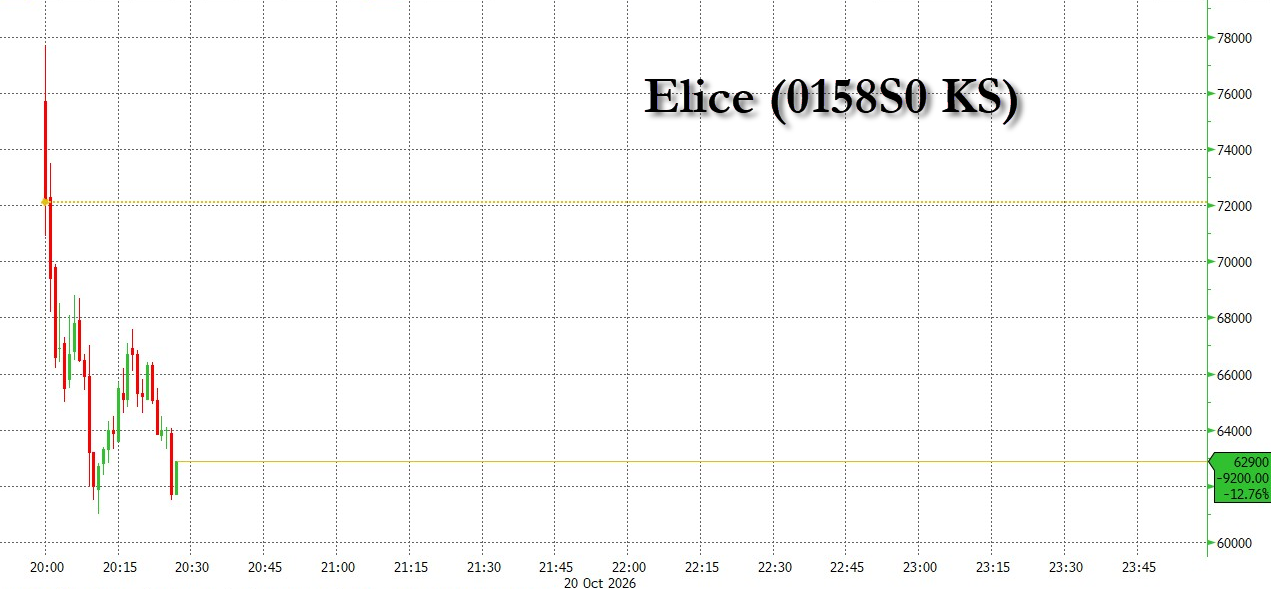
This time the venue is Seoul, where data-center infrastructure company Elice (0158S0 KS) plunged in its trading debut on South Korea’s tech-heavy Kosdaq after raising 201 billion won ($151 million) in the bourse’s biggest (and probably worst) initial public offering of the year. According to Bloomberg, the self-described “neocloud” priced at 90,500 won, the top of its marketed range, for a post-listing market cap of just over 1 trillion won (roughly $750 million). Shares then fell as much as 32% instantly to 61,400 won in early trading on Tuesday, after a brief opening pop to around 78,000 won which, for those keeping score, was itself still 14% below the offer price.
At last check the stock was hovering around 62,900 won, or about 30% below where the IPO priced, wiping out roughly 300 billion won of paper value in under half an hour.
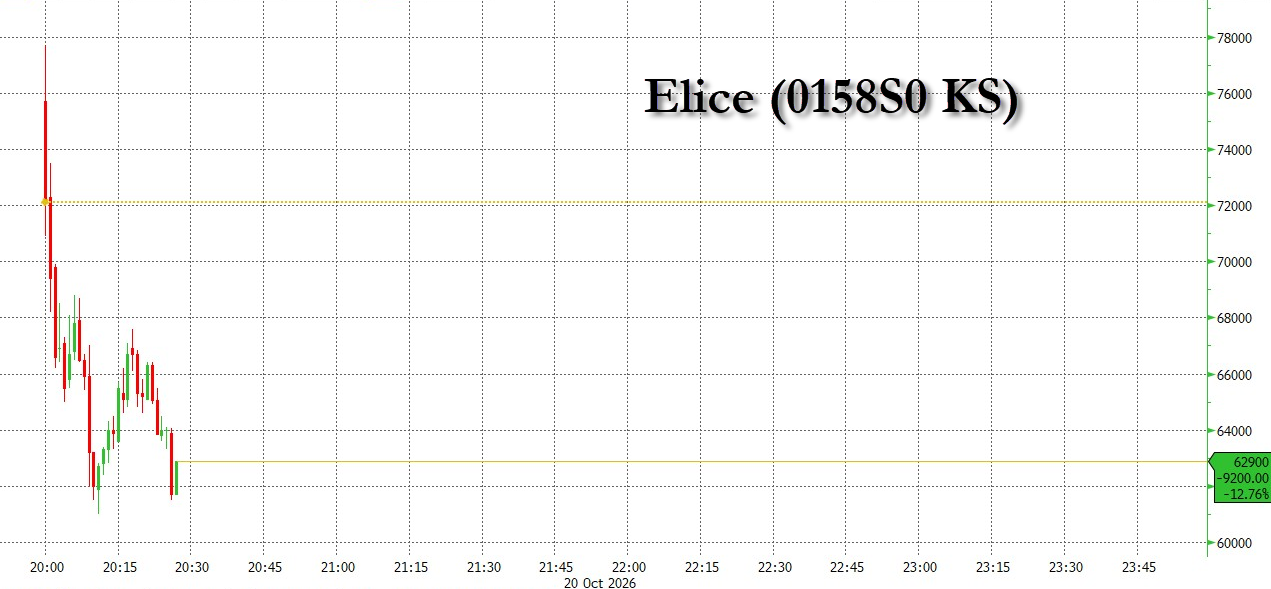
Bloomberg politely frames the debut as “a test of investor appetite for the sector after a series of setbacks around the world.”
Well, consider it tested. Regular readers know we have been keeping a running tally of these now daily faceplants since Firmus slashed and then pulled its ASX float on Oct 8, and we have been warning since last October that the AI buildout was running on borrowed money. What Elice adds to the story is a new and rather uncomfortable data point: even the cheap, profitable one can’t trade.
400x Oversubscribed, 32% Underwater
The demand was certainly there… on paper… according to the underwriters… who would never lie… right? Korean retail investors poured roughly 10.3 trillion won (about $7.7 billion) into subscription deposits for a shot at the shares, with the retail book oversubscribed more than 400 times (or so they claim). Put differently, mom-and-pop Seoul parked about 51 times the size of the entire deal in escrow to get an allocation. Then they got one.
Some context on just how fast it went wrong: under Korea’s IPO rules, a stock can trade anywhere between 60% and 400% of the offer price on day one. Elice’s floor was therefore 54,300 won. At the low, it was about 13% above the floor and 83% below the ceiling, which is probably not how the subscription ads pitched it.
None of this should shock anyone who has watched Korean flows this month. When the KOSPI tripped circuit breakers on Oct 15 for the first time since July (in its 7th straight down day), Goldman’s Korea desk reported that foreigners dumped $2.7 billion of stock while Korean retail bought about $1 billion of it, as we noted in “Goldman: Demand For Compute Can Grow Exponentially, But The Capital To Finance It Cannot.” Institutions selling, retail buying. Today the retail crowd just got to do it at the IPO price instead of the secondary market. Not that the volatility is anything new for what we have long called…
The cartoon “market” that is Korea is back at it. *SOUTH KOREA’S KOSPI INDEX FALLS 6.1% TO 6,343.87 *KOREA EXCHANGE ACTIVATES SIDECAR TO HALT KOSDAQ PROGRAM SELLING
— zerohedge (@zerohedge) July 28, 2026
And it’s not like the official bid has been there to catch anything: as we warned earlier this month, the KOSPI’s only buyer had left the building (Oct 7). Overnight, Goldman’s Seoul desk flagged in its Korea Open note (available to pro subs) that President Lee now says a correction “was inevitable after its rapid ascent,” while insisting that domestic stocks “remain undervalued.” Elice’s new shareholders would probably agree with at least half of that sentence.
The Cheap One Still Puked
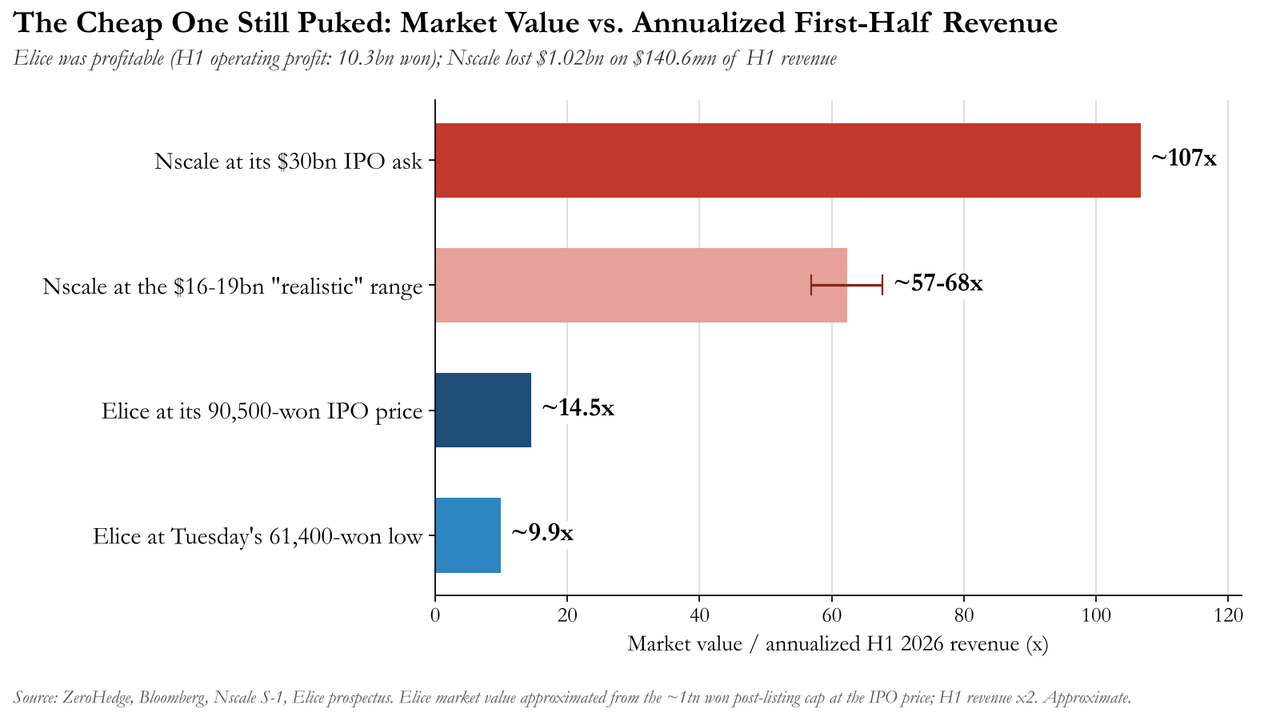
Here’s what makes the Elice debut more interesting than just another frothy deal getting its comeuppance. Unlike pretty much all of its peers, Elice actually makes money. Per its prospectus, first-half revenue surged 200% to 34.4 billion won, the company swung to an operating profit of 10.3 billion won, and EBITDA jumped more than 11-fold to 23.2 billion won. Smartkarma’s Douglas Kim expects an 83% sales jump in 2026 and an operating margin of about 33%.
Do the math and the IPO valued the company at about 14.5x annualized revenue, falling to roughly 10x moments after actually opening for trading on Tuesday. Compare that to Nscale, which, as we detailed on Sunday, was asking public investors for $30 billion, or about 107x sales, while losing $1.02 billion in the first half. Even the “realistic” $16-19 billion range Nscale’s would-be buyers are floating works out to some 57-68x.
Which is why the local fund managers quoted by Bloomberg sound a bit bewildered. Zian Investment Management CEO Kim Dojoon argued that “investor sentiment may have weakened due to CoreWeave, but its financial structure is quite different from CoreWeave so I don’t think investors need to view the company as particularly risky.” Petra Capital’s Albert Yong added that sentiment toward AI infrastructure has been “highly volatile and often disconnected from underlying fundamentals.”
Both are probably right about the fundamentals. The market, however, has moved on to a different question, and Goldman’s Rich Privorotsky nailed it last week in his “GS Basics – Bonds Up/AI Down. Neoclouds. Computer Inflation” note (available to pro subs):
“I think the market is discovering that demand for compute can grow exponentially, but the capital available to finance it cannot. I’ve learned to respect the credit market, and the widening across the AI vertical is a warning.”
In other words, the question now is how much capital a neocloud will need tomorrow and at what price – in other words, who is the greatest fool (that would be life insurers according to the CoreWeave founder) – and today’s multiple says very little about that. And Elice’s CEO Jae Won Kim was refreshingly candid on that front: the IPO proceeds go toward building more AI data centers in Korea and abroad. “We’re going all-in on becoming a full-stack AI infrastructure leader globally,” Kim told Bloomberg. “This IPO is about giving ourselves the financial firepower to execute.“
That is precisely the business model Privorotsky warned about: an equilibrium that “increasingly favors those with powered capacity and strong balance sheets over the leveraged middlemen.” Or as he put it, “Perhaps this was always how crowding out would manifest itself… through the marginal borrower.“
Or in this case marginal momentum-chasing sucker, which South Korea has plenty of.
And Korea is hardly the place where capital is getting cheaper. Goldman’s economists expect the Bank of Korea to deliver a “hawkish hold” this week after back-to-back hikes in Q3, with another 25bp hike most likely in Q1 2027. Meanwhile power, the other input every data center needs, is about to get pricier: state utility KEPCO, sitting on 210 trillion won (c. $148 billion) of debt, wants to open talks on raising electricity tariffs, per the same Goldman Korea Open note. Higher rates plus higher power bills, for a company whose pitch is “high-density power systems” for AI chip clusters. (Yet another reason we keep saying behind-the-meter generation should be mandatory for these projects.)
The Casualty List Grows Faster Than The Data Centers
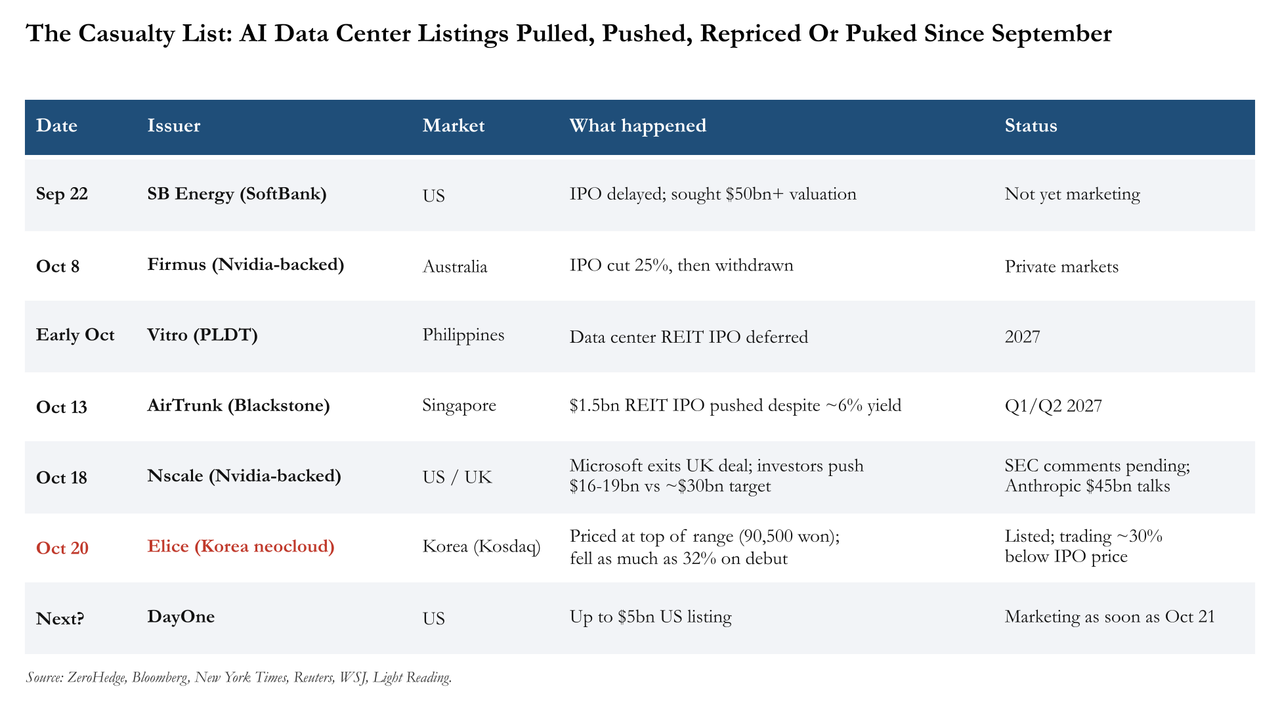
Elice is just the latest name on a list that is getting long enough to need its own table of contents. In roughly four weeks:
- SB Energy: SoftBank’s unit delayed the IPO meant to fund the world’s largest data center (Sep 22).
- Firmus: the Nvidia-backed Australian operator cut its IPO price by 25%, then pulled it (Oct 8), after asking for A$43.7 billion, nearly 3x its August private mark, on the back of a valuation metric best described as creative.
- AirTrunk / Vitro: Blackstone’s AirTrunk pushed its $1.5 billion Singapore REIT to 2027 (Oct 14) even after sweetening the yield to 6%, while PLDT’s Vitro deferred its own data center REIT.
- Nscale: Microsoft walked from its UK deal and IPO investors told the company to slash its $30 billion ask roughly in half (Oct 18).
- CoreWeave: shares have more than halved since their May peak, and its bonds traded into distressed territory last week, with CDS implying roughly 63% odds of default within five years.
Here is the full scorecard, now with a Korean entry:
Our verdict on the Firmus fiasco at the time still applies:
Firmus pulled its IPO because it seriously thought someone will buy its EV+1/EBIT+2 “valuation” metric -> Enterprise value based on debt in one year (lower of course), divided by projected EBIT in 2 years (higher of course). No, really
— zerohedge (@zerohedge) October 8, 2026
Nscale, for its part, spent Monday trying to change the subject with a reported $45 billion compute deal with Anthropic. We had a modest question about the timeline:
*NSCALE, ANTHROPIC IN TALKS FOR $45 BILLION CLOUD COMPUTING DEAL Is this for compute in 2040 when the UK finally has the electricity to power up the data center
— zerohedge (@zerohedge) October 19, 2026
Then there’s Gartner, which last week predicted that by 2030 “cost pressure and a lack of a differentiating business model will force over 80% of neocloud providers to cease independent operations,” with AI data center owners needing a cumulative $8.5 trillion in revenue through 2030 against no more than $3.6 trillion that can actually be attributed to them. Elice just volunteered for the stress test.
Meanwhile, Over At Goldman…
The timing of all this is, well, exquisite. On Monday morning, roughly 12 hours before Elice opened for trading, Goldman’s Gabriela Borges upgraded CoreWeave to Buy, while cutting her price target to $106 from $139. Her reasoning, per the bank’s “CoreWeave – Contract Economics Datapoints to Outperform” note (also available to pro subs):
“We think investors are currently overestimating upward revisions to WACC and underestimating unlevered IRR; despite raising our blended debt cost assumption to 1,000bps, we expect the company to successfully finance its expansion through asset-backed delayed draw term loans.”
Read that again: the bull case now explicitly assumes the company borrows at around 10%, and Borges thinks new long-term contracts can “comfortably clear a 15% unlevered IRR” because she sees AI compute supply-demand constraints persisting “for at least the next 24 months.” No wonder the market made an immediate mockery of her ridiculous analysis, with CRWV stock kneejerking higher only to close near the Friday lows.
Gonna need a bigger upgrade https://t.co/kIR0pDU7cd
— zerohedge (@zerohedge) October 19, 2026
To be fair, nobody really disputes the demand (well, some do). The question is the funding, and on that front Morgan Stanley offered a far less cheerful view in its latest AI capex work, which we highlighted on Sunday: combined hyperscaler and neocloud free cash flow hits its most negative point in 2027, with the hole just shy of $600 billion once lease payments are included.
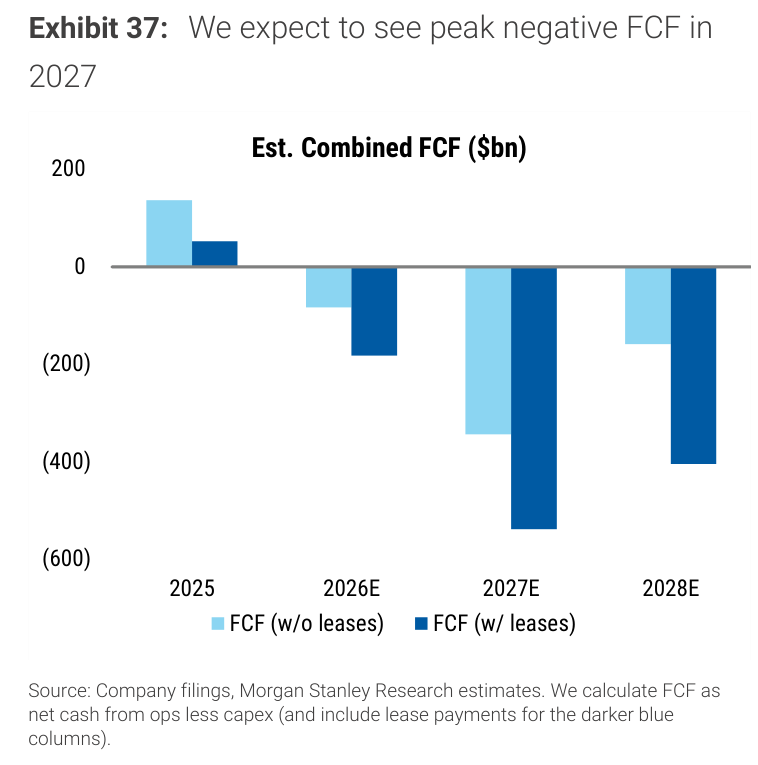
Translation: the year with the biggest capex bill is also the year with the biggest funding gap, and every dollar of it has to come from somewhere. The public equity market, judging by Firmus, AirTrunk, Nscale and now Elice, is increasingly unwilling to be that somewhere, at least at the prices sponsors want. That leaves debt, and that window is rapidly closing too.
Firepower, Meet The Cost Of Capital
“This IPO is about giving ourselves the financial firepower to execute,” Elice’s CEO said. And to be fair, he got the firepower: the 201 billion won is in the bank regardless of where the stock trades. The bill went to Korean retail, which handed over $7.7 billion in deposits for the privilege of buying a profitable, reasonably priced neocloud at the exact moment the market decided it doesn’t want to own neoclouds at any price.
Which brings us to what Elice really tells us. Firmus could be dismissed as a frothy outlier with a made-up multiple, and Nscale as a 107x-sales loss machine. Elice was neither, and it still lost a third of its value before most of Seoul had finished its first coffee. The problem, then, is the asset class and the cost of the capital needed to keep building it, and with global rates at their highest since 2007 (per Goldman’s economists) and Korea’s central bank still leaning hawkish, that cost is not coming down any time soon. Goldman can raise its debt cost assumption to 1,000bps and still call it a Buy; the public market, apparently, would rather not be the one lending at those rates.
Next up: DayOne, Firmus’ partner in Batam, which still wants to raise up to $5 billion in a US listing and could start marketing as soon as Wednesday. We’ll check back then… if the deal is still on.
Much more in the full Goldman “GS Basics – Bonds Up/AI Down” note and the “CoreWeave – Contract Economics Datapoints to Outperform” note, both available to pro subs.
Tyler Durden
Mon, 10/19/2026 – 21:22

