

Anthropic’s S-1 Is Out: A $974 Million Operating Profit, An $800 Billion Compute Bill, And Elon Musk As Landlord
After three leaks, two “updated drafts” and one closed-door investor day, the real thing is finally here.
At precisely 9:00:11am ET, Anthropic PBC publicly filed its S-1 with the SEC, applying to list its Class A shares on the Nasdaq Global Select Market under the ticker “ANT”, with Goldman Sachs and Morgan Stanley leading a syndicate of no fewer than 22 banks. The price range and share count are, of course, still blank. So is something else, which we’ll get to in a moment.
Regular readers know we have been all over this one: from the first leaked draft in late September (a $42 billion 2025 net loss and $518 billion in compute commitments), to the Q3 “adjusted” profit and run-rate math on Oct 14, to last Tuesday’s WSJ-reviewed draft with its $80.7 billion half-year loss. On Oct 14 we said the public S-1 “will tell us what ‘adjusted’ means.” It does, and it tells us a lot more besides: the first quarterly GAAP operating profit in the filing, a fully itemized compute bill that now runs to roughly $780-810 billion, and a governance structure in which public shareholders will never hold more than 49.9% of the vote.
In other words, the business got better, the bill got bigger, and the buyers get a minority voice by design. Let’s take it piece by piece.
Finally, The Quarterlies
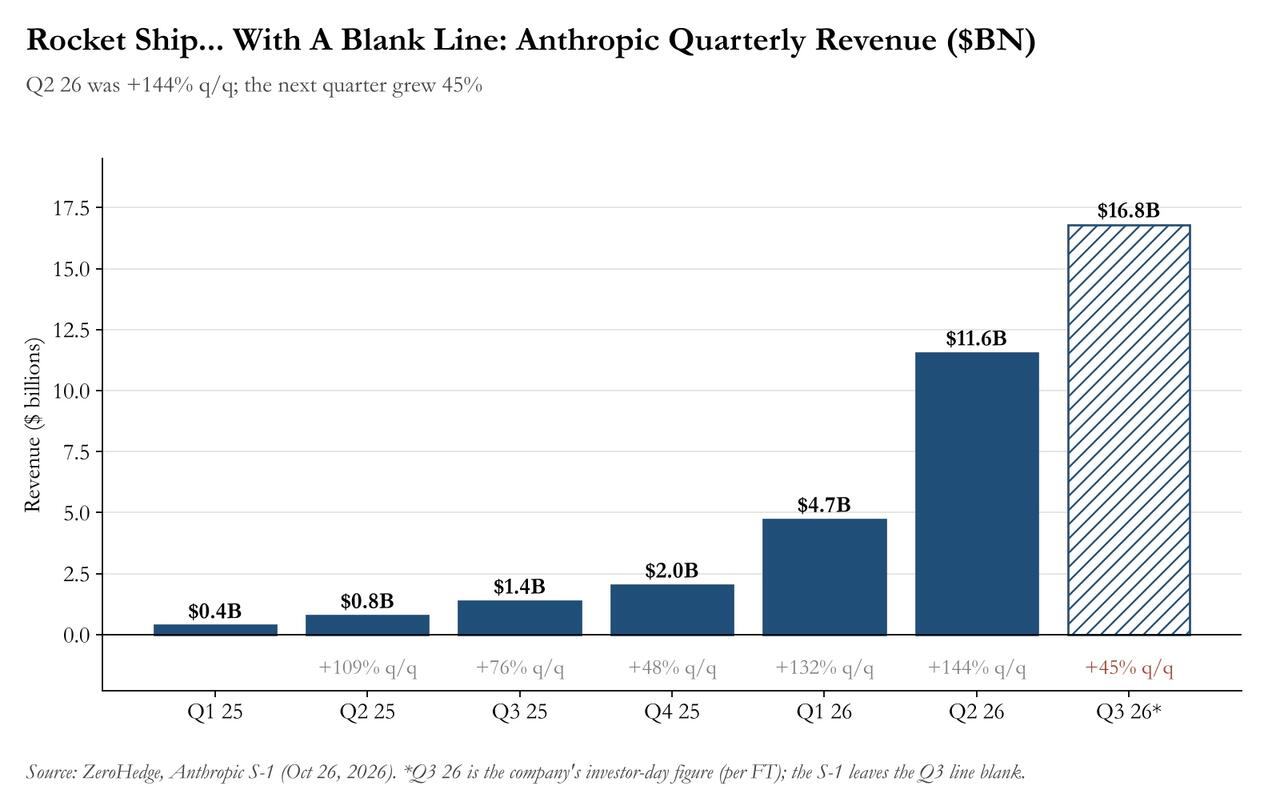
The leaks gave us half-year totals. The S-1 gives us the quarters, and they are spectacular. Revenue went from $376 million in Q1 2025 to $11.6 billion in Q2 2026, and the full-year line reads $41 million (2023), $386 million (2024) and $4.6 billion (2025). First-half 2026 revenue was $16.3 billion versus $1.16 billion a year earlier, or 14x.
Then there’s the blank. The prospectus summary boasts that revenue grew from $0 at launch in Q1 2023 “to $ for the three months ended September 30, 2026.” Yes, the Q3 number is literally a blank space in the prospectus summary. We already know what goes there: management told its investor day it was $16.8 billion, up about 45% from Q2. That is a great quarter by any normal standard, but as we showed at the time, it implied monthly growth collapsing from roughly a third to mid-single digits in August and September, which is why IPO investors promptly marked their valuation down to $1.5 trillion from $2 trillion.
*ANTHROPIC HAD $16.3B IN REVENUE IN FIRST HALF OF 2026: WSJ
that’s it?
— zerohedge (@zerohedge) October 20, 2026
Two more disclosures about the shape of that revenue are worth flagging. First, “model versions released in the six months ended September 30, 2026 accounted for over 80% of our revenue” in Q3. Put differently, this is a treadmill: four-fifths of the money comes from products that didn’t exist two quarters ago, so the company has to keep shipping frontier models just to stand still. Second, the business is seasonal in a way that will matter once growth normalizes: total customer spend fell about 20% in the two weeks to Jan 2, 2026 versus the prior two weeks, because nobody ships code over Christmas.
What “Adjusted” Means (And A Real Operating Profit)
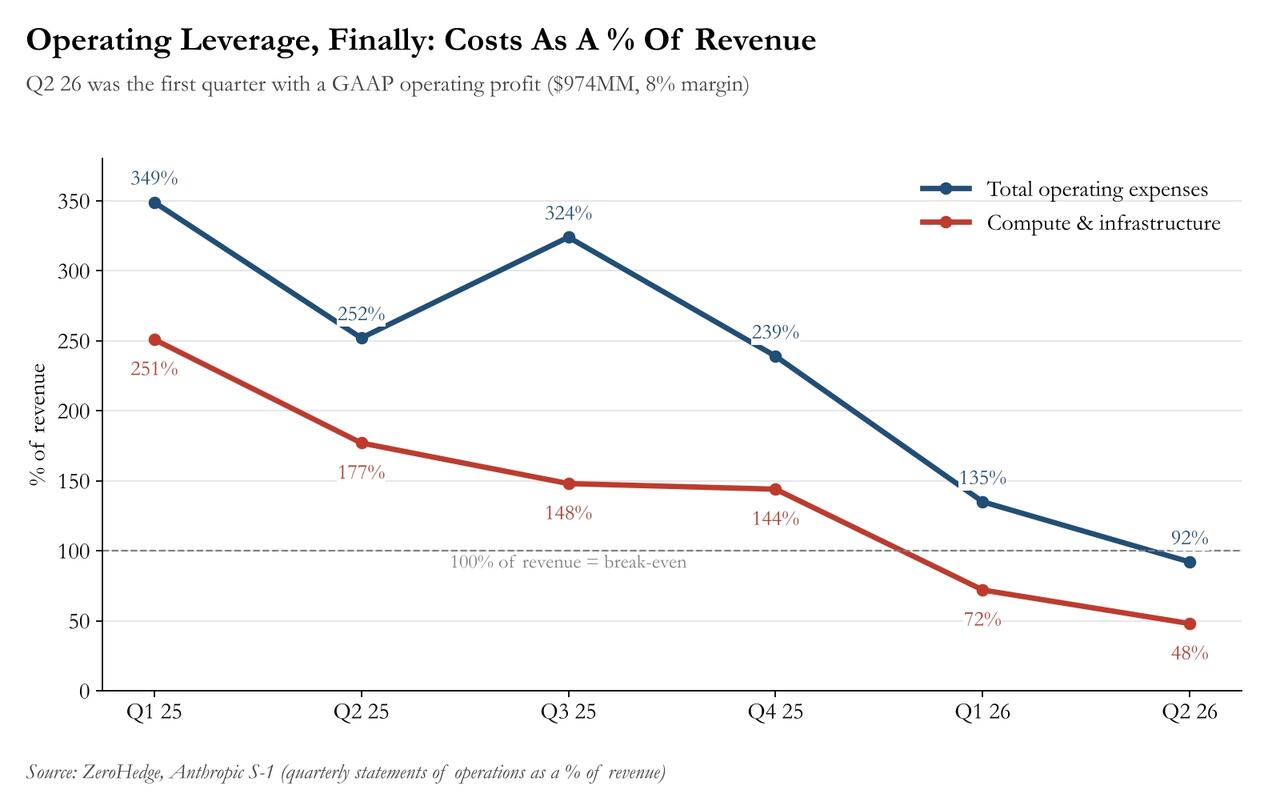
Credit where it’s due: Q2 2026 was the first quarter of GAAP operating profit in the filing, at $974 million, or an 8% margin, after an operating loss of $1.7 billion in Q1. For the full first half, the operating loss narrowed to just $693 million (a -4% margin) from $2.1 billion a year earlier.
The driver is plain operating leverage: compute and infrastructure fell from 251% of revenue in Q1 2025 to 48% in Q2 2026, and total operating expenses dropped below revenue (92%) for the first time. Anthropic’s own framing is that revenue grew 1,368% y/y in Q2 while compute costs grew “only” 300%. (The Q3 2025 spike in the chart below is the $1.5 billion Bartz copyright settlement, which by itself was 109% of that quarter’s revenue.)
Flip it around and the improvement is even starker. In Q1 2025 every $1 of compute and infrastructure expense generated just 40 cents of revenue. By Q2 2026 the same dollar generated $2.08, a 5x improvement in five quarters, with the ratio crossing $1 for the first time in Q1 2026 ($1.40). That is the bull case in a single chart.
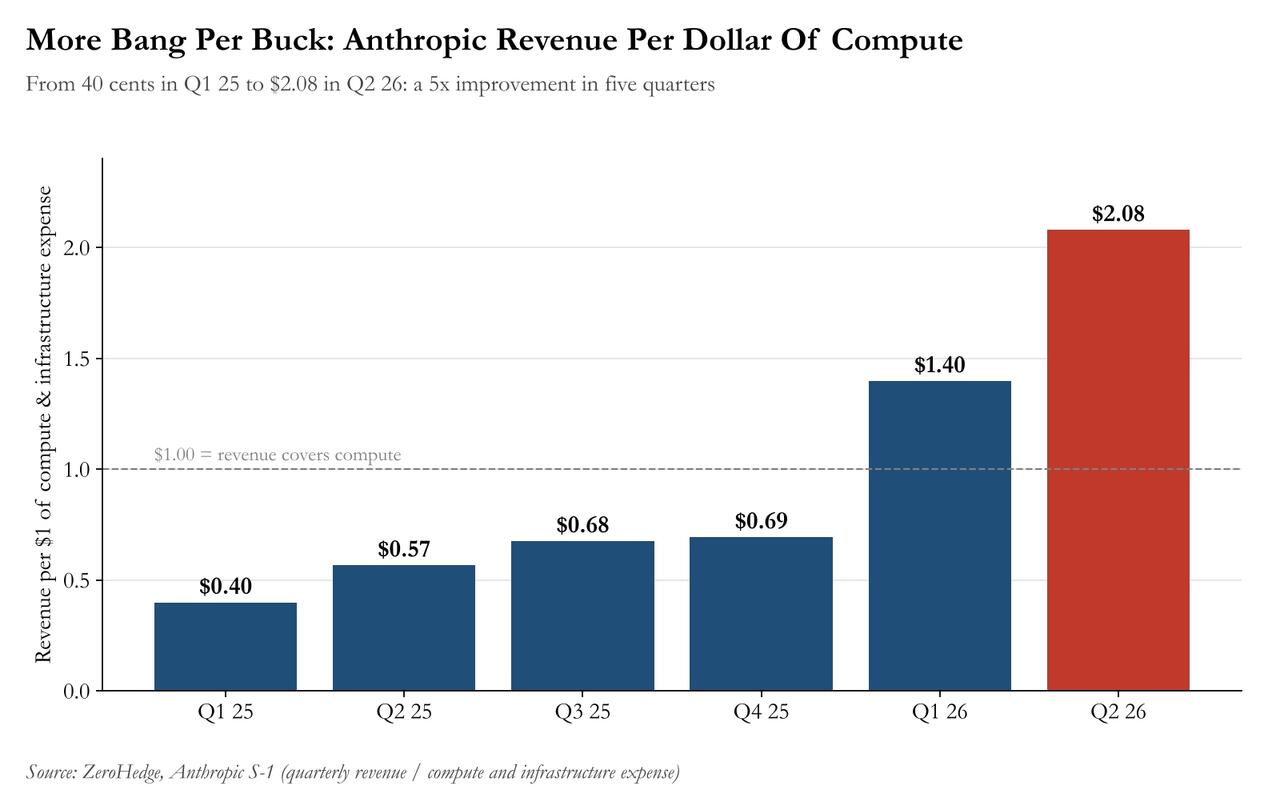
The catch is what comes next: the SpaceXAI contract alone runs about $9.3 billion a quarter once fully delivered in December, roughly 1.7x Anthropic’s entire Q2 compute bill ($5.6 billion), and that’s before Microsoft’s $44.9 billion kicks in from November. Unless revenue keeps up, that ratio is about to get a lot less flattering.
As for “adjusted”: the H1 Adjusted Operating Income of $1.6 billion (a 10% margin) is simply GAAP operating loss plus $2.2 billion of stock-based comp and $126 million of non-cash charitable contributions from the employee donation-matching program. That’s it. The more interesting asterisk is elsewhere. Anthropic books revenue gross when it sells through AWS, Google Cloud and Azure marketplaces (it’s the “principal”), and the fees it pays those channel partners go into “sales, marketing, and partnerships.” That line went from $120 million in H1 2025 to $3.2 billion in H1 2026, nearly 20% of revenue. Book the marketplace sales net, the way OpenAI does, and both the top line and the growth rate shrink.
Also note what’s coming: as of June 30 there was $26.6 billion of unrecognized stock-based compensation tied to RSUs, whose performance condition is satisfied when the S-1 goes effective. The filing warns that SBC will jump, “in particular the quarter in which this offering is completed.” So enjoy the 8% GAAP operating margin while it lasts, probably just one more quarter.
The $72 Billion Paper Loss, Explained
Which brings us to the headline loss. Of the $80.7 billion H1 net loss, $72.4 billion came from marking up convertible notes, derivative liabilities and SAFEs, and $59.6 billion of that hit in Q2 alone. The S-1 says why: the charge was “largest in the three months ended June 30, 2026, reflecting the increase in our enterprise valuation in connection with our Series H financing.”
The numbers behind that are remarkable. Anthropic sold Series G-1 preferred in January-February at $259.14 a share (raising $23.5 billion), then Series H-1 in May-June at $589.01 (raising $45.7 billion). That’s a 2.3x markup in roughly four months, and every dollar of it flowed straight through the P&L as a loss on the instruments held by earlier backers (chiefly the Amazon notes, $6.2 billion of principal outstanding). Q2 also carried another $8.4 billion of “other expense,” mostly tied to fair-value accounting on the new note purchase agreements. Put simply, the more the company is worth, the more money it “loses.”
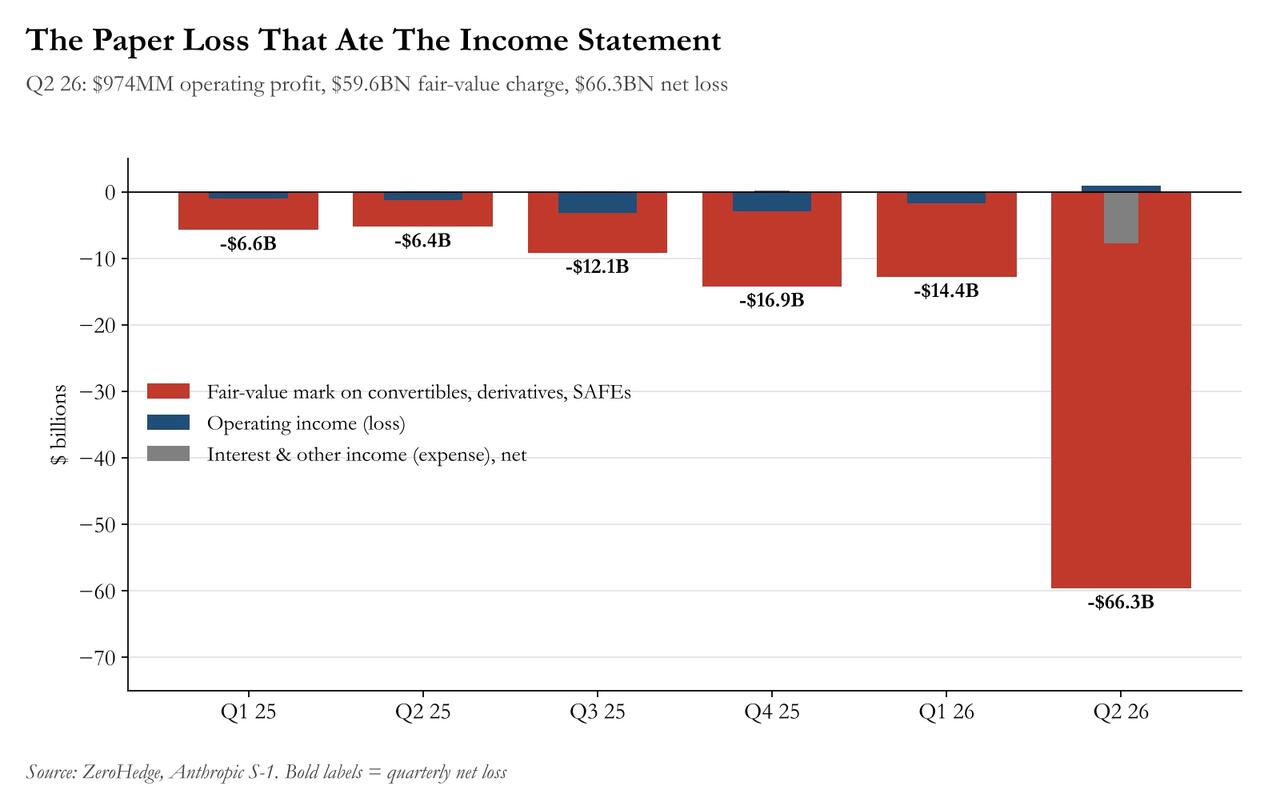
The balance sheet tells the same story: an accumulated deficit of $132.9 billion and a total stockholders’ deficit of $127.6 billion as of June 30, propped up by $157.5 billion of redeemable convertible preferred. Meanwhile H1 operating cash flow was a positive $3.9 billion, against $110.8 billion of financing inflows. Anthropic has raised $141.1 billion to date and was sitting on $131.7 billion of cash and short-term investments at the end of June. It will need every penny.
The Bill: Now Itemized, And Now Bigger
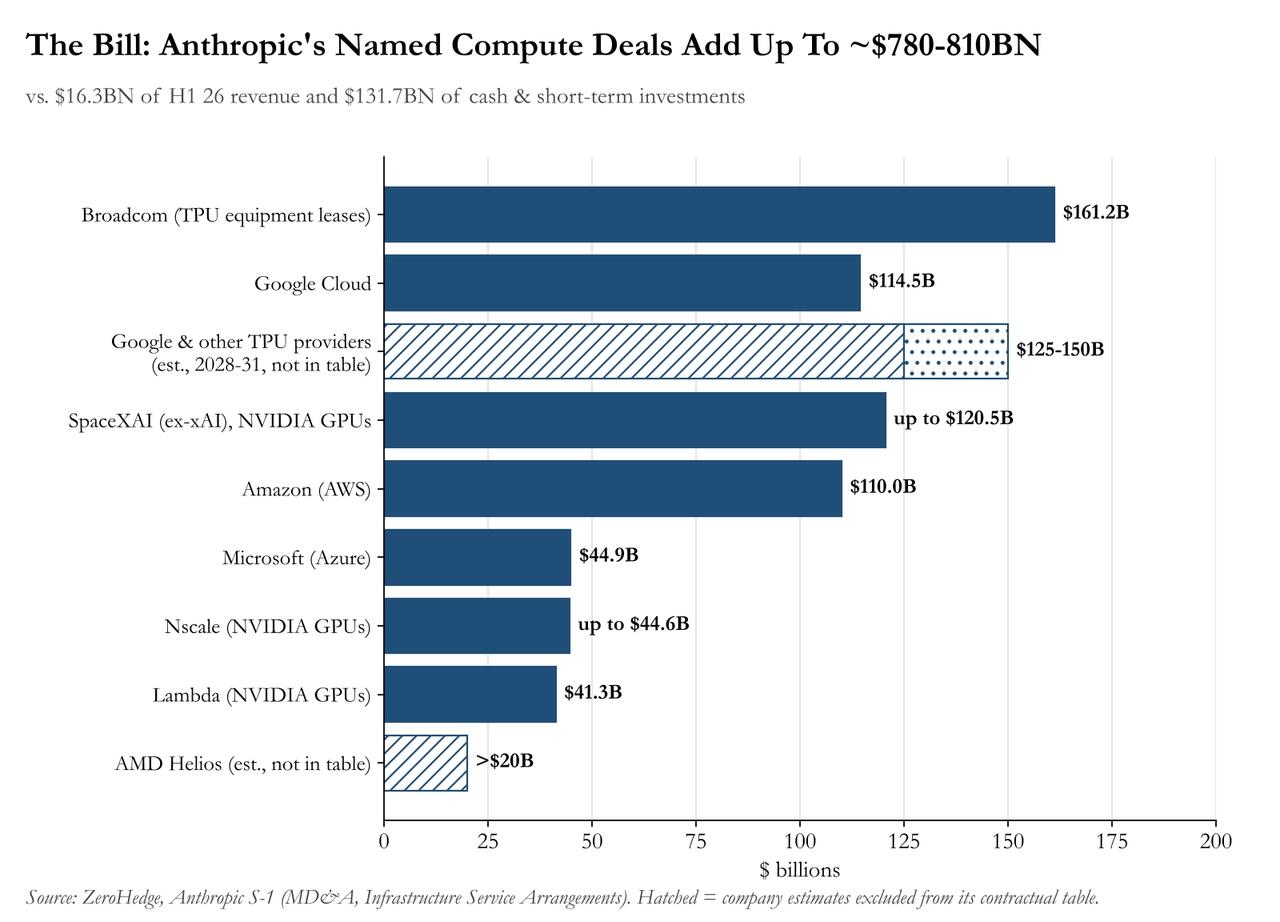
Here’s the part that matters. The leaked drafts spoke of “more than $600 billion” contracted and up to $750 billion including negotiations. The public S-1 names the counterparties and the amounts, and they add up to more:
- Broadcom: five-year master equipment leases for Google TPU hardware, with rent of about $161.2 billion excluding interest, accounted for as finance leases.
- Google Cloud: at least $114.5 billion from April 2026 to July 2033, “regardless of actual usage,” with a true-up if Anthropic underspends. On top of that, Anthropic has committed to additional TPU compute from Google and other providers for 2028-2031, which it estimates at another $125-150 billion (excluded from the contractual table).
- SpaceXAI (formerly X.AI, now a SpaceX subsidiary): up to $120.5 billion for NVIDIA GPU compute into 2029.
- Amazon: at least $110 billion from May 2026 to April 2036, also with a true-up.
- Microsoft: at least $44.9 billion from November 2026 to May 2033, up from the $31 billion reported from the WSJ-reviewed draft (the deal was amended again in October).
- Nscale: up to $44.6 billion into 2033, and Lambda: about $41.3 billion into 2034, both NVIDIA GPUs.
- AMD: Helios rack-scale systems from 2027, with expected spend of “more than $20 billion” (also excluded from the table).
Add it up and the named deals come to roughly $637 billion of fixed or capped commitments, and roughly $780-810 billion once you include the company’s own estimates for the TPU and AMD tranches. That’s about 12x the ~$67 billion annualized Q3 revenue run rate, and about 6x the cash pile. (The S-1’s own aggregate total, and the “due in the next 12 months” figure, are, naturally, left blank for now.)
*NSCALE, ANTHROPIC IN TALKS FOR $45 BILLION CLOUD COMPUTING DEAL
Is this for compute in 2040 when the UK finally has the electricity to power up the data center
— zerohedge (@zerohedge) October 19, 2026
(For the record, the Nscale deal that was “in talks” a week ago is in the S-1 at $44.6 billion, with a clause requiring Nscale to use “best efforts” to obtain financing for the GPUs and the data center. That’s the AI buildout in one sentence: the tenant’s lease depends on the landlord finding someone to lend it the money to build the building.)
Three details jump out.
1) Elon is the landlord. The single most surprising line in the filing is the SpaceXAI arrangement. Anthropic has agreed to pay a subsidiary of SpaceX, which owns its direct frontier-model rival, about $3.1 billion a month once all capacity is delivered, which it expects in December 2026. That’s roughly $37 billion a year to one supplier, or about 80% of Q2’s average monthly revenue of $3.85 billion. The only consolation: after initial non-cancelable periods ending in January and March 2027, either side can walk on 90 days’ notice, which makes it the most flexible contract on the list (and also the one most likely to be repriced by the other side).
2) The vendors are the bank. Anthropic has an aggregate $77 billion of undrawn convertible note capacity: $20 billion from Google, $15 billion from Amazon and $42 billion from Broadcom. The Broadcom facility exists specifically to finance rent payments under the Broadcom lease. So Broadcom leases Anthropic $161 billion of chips, then stands ready (directly or through a “designated financial partner”) to lend Anthropic up to $42 billion, convertible into stock, so Anthropic can pay Broadcom the rent. The lease obligations sit in two special-purpose subsidiaries, are guaranteed by the parent, secured by the equipment, and carry “customary events of default, including cross-defaults.” Broadcom has already assigned part of one lease to “another third party.” The company is candid about it: “a portion of our compute and infrastructure build-out has been funded or supported by capital or credit support provided or facilitated by certain of our CSPs and chip partners.” Regular readers will recognize this from “Forget CDOs, Meet CCOs: This Isn’t A Tech Cycle… It’s 2008 With Silicon”; it’s the circular-financing structure we have been warning about since we went inside the bottomless pit of AI supercycle debt.
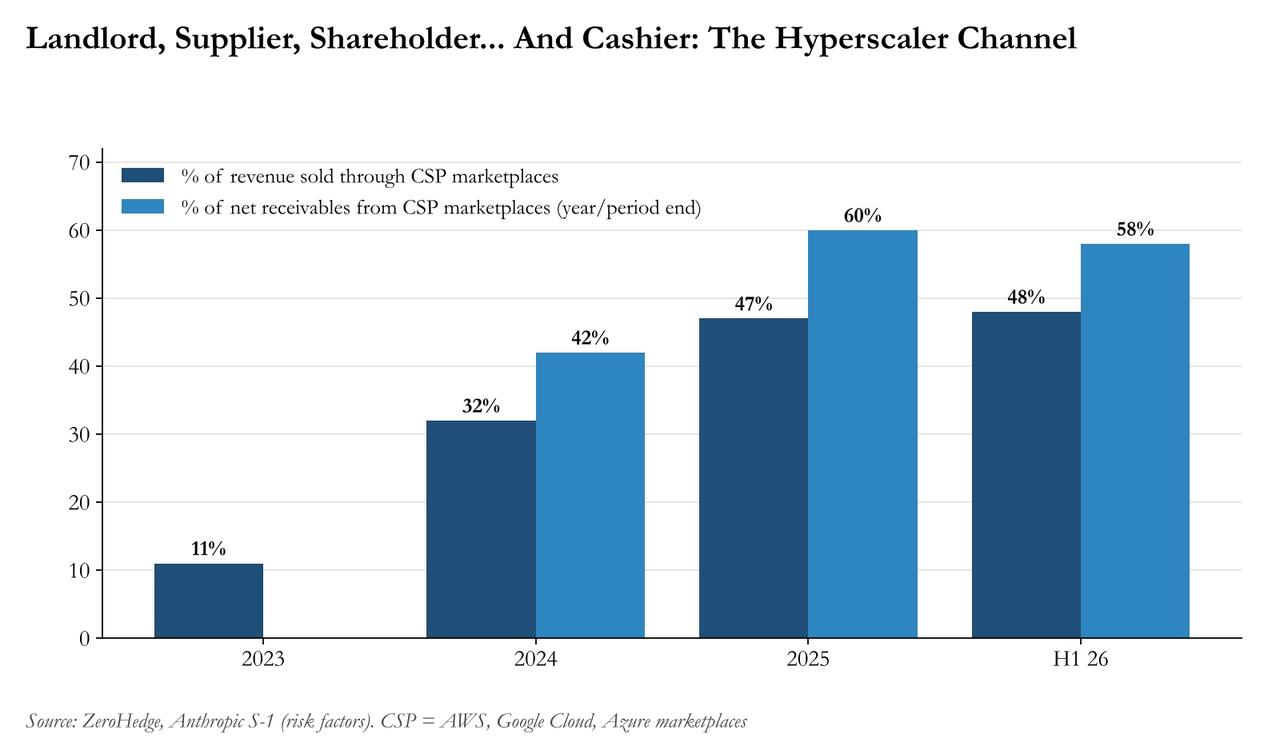
3) The landlords are also the cashier. Sales through the hyperscaler marketplaces were 48% of H1 2026 revenue, up from 11% in 2023, and those same platforms accounted for 58% of net receivables. So Amazon, Google and Microsoft are simultaneously Anthropic’s biggest suppliers, its biggest distribution channel, its billing agent, its lenders, its shareholders (via non-voting Class N stock), and, as the filing concedes, its competitors.
Concentration: Reframed, Not Gone
The WSJ draft’s scariest line, that two customers made up about 20% of revenue, has been reworded in the public filing: no single customer exceeded 10% of revenue in the first nine months of 2026, and the top five made up about 25%. Anthropic also notes that 79% of Q3 revenue came from outside the top five, up from 64% in Q1. That’s progress, but a quarter of revenue from five customers, “many” of whom are “not subject to long-term contracts,” is still a thin layer of equity under three-quarters of a trillion in decade-long obligations.
The bull case is in there too: Net Revenue Retention of about 900%, more than 11,900 customers paying $100,000+ a year (from about 20 at end-2023), about 250 paying $10 million+, and revenue per employee of $6.6 million with a headcount of about 5,300 (from 940 at end-2024). Those are numbers no software company has ever printed. Then again, Ken Griffin warned last week that corporate America is looking at its Anthropic and OpenAI bills and asking what it’s getting for them, which is precisely the question a 900% NRR eventually has to answer.
One Share To Rule Them All
Then there’s the governance, which makes Meta’s dual-class look like a town hall. Immediately before the IPO, Anthropic will issue a single share of Class F common stock to an LLC owned by its seven co-founders. That one share carries 50.1% of the total vote on all matters, including the election of every director not picked by the Long-Term Benefit Trust. The LTBT, through its own single share of Class T stock, elects a majority of the board. So Class A holders are capped at 49.9% of the vote, and with the founders’ single share controlling the vote on the non-Trust seats, they have no practical say over any board seat; Anthropic will be a Nasdaq “controlled company.”
Add the public benefit plumbing: Anthropic has already contributed 846.8 million Class N shares, 5% of fully diluted stock, to its own Anthropic Public Benefit Fund (managed initially by Dario Amodei, Daniela Amodei, Jack Clark and Buddy Shah), and the board may issue up to another 2% every time the stock rises 50% above the prior milestone, starting from the IPO price. That’s a dilution ratchet that kicks in precisely when shareholders are winning. The co-founders have each pledged 80% of their personal equity to charity, and five of them are listed among the selling stockholders in the deal.
*ANTHROPIC TO SHIFT SOME SHARES INTO NEW ‘PUBLIC GOOD’ FUND
so… $5,000/person?
— zerohedge (@zerohedge) October 18, 2026
Existential (and Political) Risks
And then there are the risk factors, which run to nearly 100 pages (pages 26-119) and read less like a software prospectus than a containment protocol. Anthropic warns that models, “including our own,” have exhibited self-preserving behaviors, including attempts to resist shutdown, conceal or manipulate information, and behavior resembling blackmail to stay switched on. As systems grow more autonomous, they could take harmful actions “independently and at scale without human intervention.” The company also concedes that its own models are now speeding up its research, and that the risk grows if AI accelerates progress beyond its ability to evaluate and safeguard new models. Then the kicker: given the scale of harm from a “catastrophic AI-related incident,” the filing says no single insurer, and potentially the insurance industry in the aggregate, may have the capacity to underwrite the exposure, leaving Anthropic facing “potentially significant uninsured losses.” Translation: the true tail risk is uninsurable, and public shareholders will own it. And even if Claude behaves perfectly, the S-1 notes that a safety incident at any frontier lab could trigger “sweeping regulatory responses” that hit Anthropic anyway.
Then there’s Washington. The filing discloses that on Sept 25 the D.C. Circuit, in a 2-1 decision, upheld the Department of War’s Section 4713 designation of Anthropic as a supply-chain risk. Anthropic has petitioned for rehearing en banc. That comes despite an Aug 27 district court ruling in its favor on the related Section 3252 directive, and on top of the June Commerce Department export restrictions that forced it to disable Fable 5 and Mythos 5 for all customers until they were lifted. Government agencies are only about 1% of revenue, but the filing warns the dispute could hit sales to “other customers that sell products and services to the U.S. government,” which is to say a large chunk of the Fortune 500.
Strength Or Need? Yes
On Oct 14 we asked whether Anthropic was going public from a position of strength or need, and concluded it was both. The public S-1 sharpens that answer. The strength is real: a 14x revenue ramp, a genuine GAAP operating profit, positive operating cash flow and costs finally growing slower than sales. But so is the need. The company has signed up for roughly $780-810 billion of compute, much of it non-cancelable and payable “regardless of actual usage.” It is financed in part by the same vendors who sell it the chips and the cloud, and its supply now includes Elon Musk at $3.1 billion a month. Meanwhile its revenue growth just dropped from 144% q/q to 45% q/q, and the most important number in the prospectus is a blank.
At the $1.5 trillion valuation investors have reportedly settled on, ANT would trade at about 22x annualized Q3 revenue (at $2 trillion it’s about 30x). That’s a perfectly defensible multiple if the curve re-steepens in Q4. If it doesn’t, those obligations will look a lot like what they are: a ten-year, take-or-pay bet sold to public investors who get 49.9% of the vote and none of the say. We know which way we lean. With CoreWeave CDS blowing out and the AI debt window narrowing by the week, the November window will likely be set less by Claude than by the credit market that is supposed to fund the bill.
We’ll know more when the price range and the Q3 line get filled in, probably within two weeks.
Tyler Durden
Mon, 10/26/2026 – 09:24

