

Futures Slide As AI Reckoning Claims Amazon, Intel; Oil Jumps On Hormuz Tanker Hits
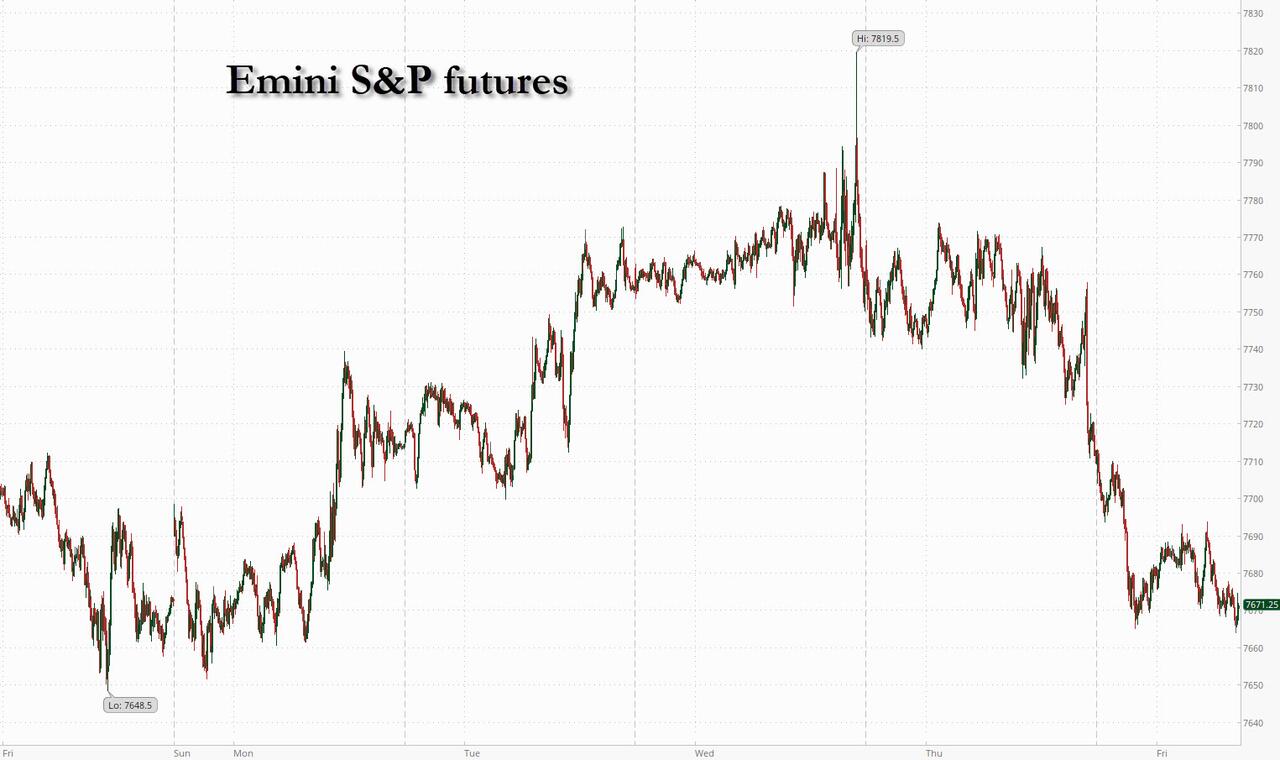
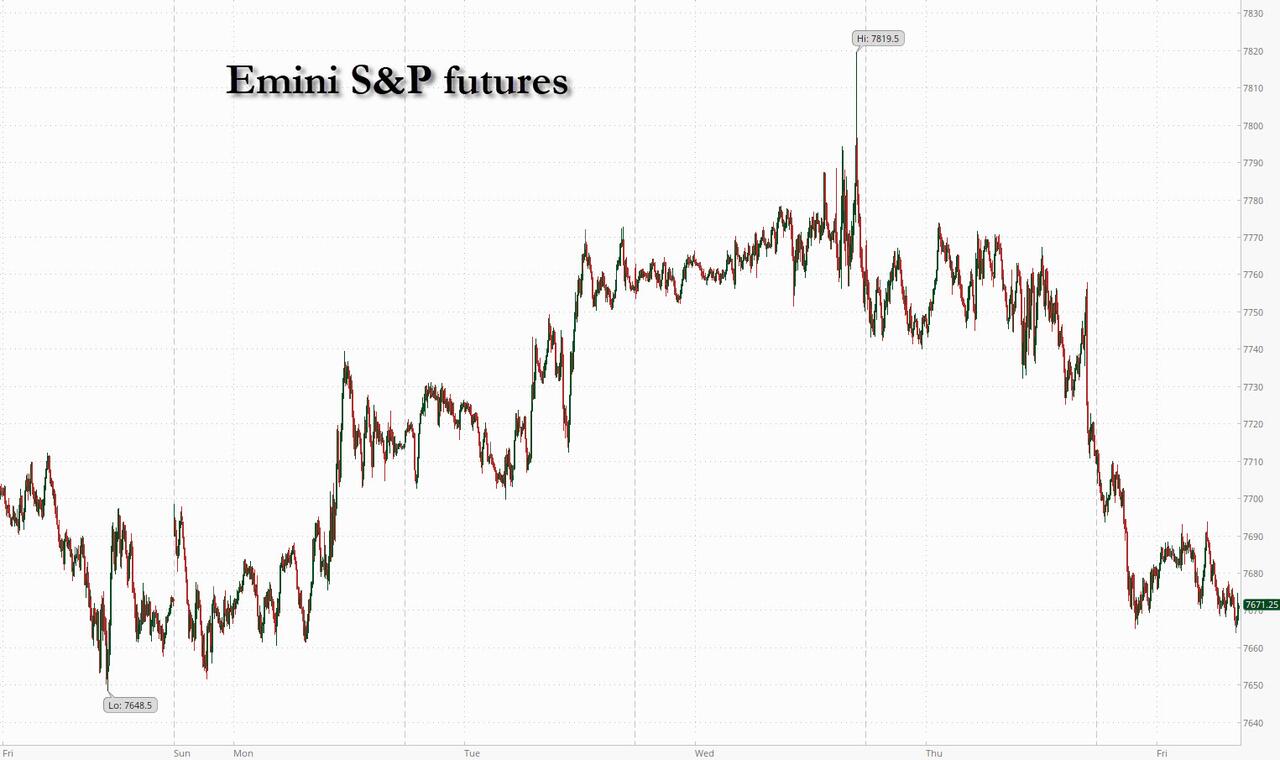
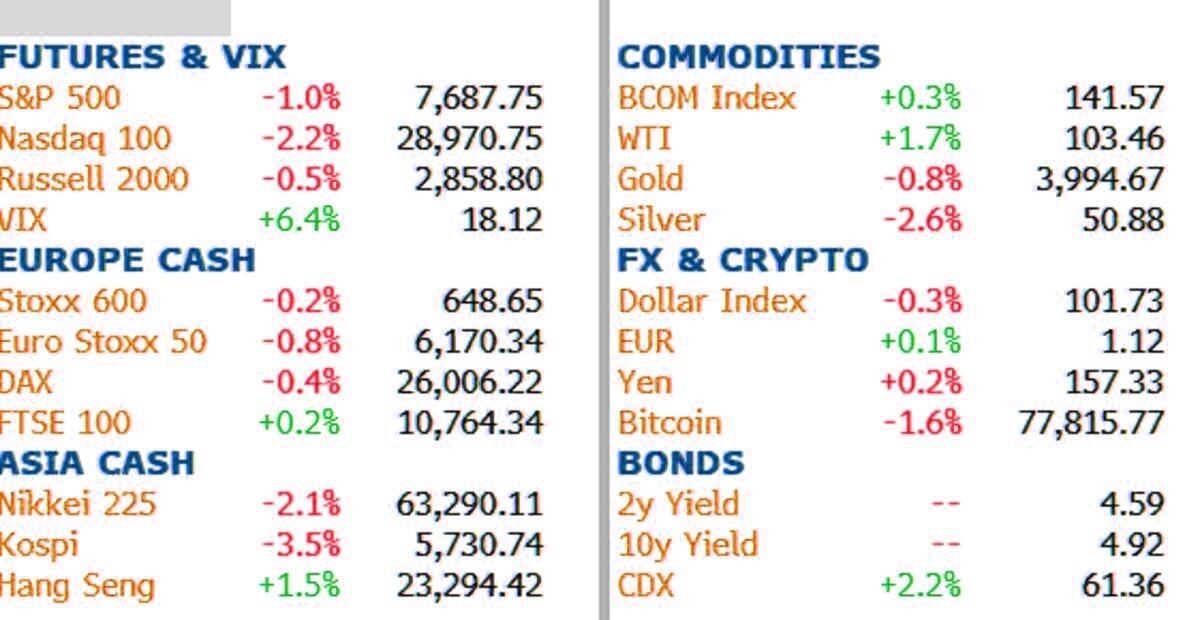
US futures slide with Nasdaq futures tumbling more than 2%, as the AI reckoning that started with Alphabet’s record plunge claims two more megacaps: Amazon slides after a capex shock and the slowest e-commerce growth in three years, while Intel craters 26% after a guide that was “much weaker than expected”; meanwhile oil keeps climbing on signs the US may resume strikes against Iran and on an Iranian claim that two oil tankers were hit and stopped in Hormuz; as a result, the Nasdaq 100 is now tracking its biggest monthly underperformance against the equal-weighted S&P since 2002, with its members having wiped out more than $1.2 trillion in market cap this month. As of 7:30am ET, S&P futures are 1.1% lower at 7,672 while Nasdaq futures drop about 2.2% (28,970.75 in the Markets at a Glance snapshot) and Dow futures are up 0.1% at 52,575; Russell 2000 futures are down a more modest 0.5%. The losses come after a session in which the S&P fell 0.3% (and the Nasdaq 1.4%) even as 406 S&P members rose and the equal-weight index hit its highest since August, a reminder that the market is rotating rather than running for the exits. In premarket trading, all Mag 7 names are lower, led by Amazon (-7.3%), while AI infrastructure stocks tumble after Amazon and Intel and crypto-linked names slide after Binance suffered the industry’s biggest-ever hack; Amazon’s slump confirms our post from last night. Defensives and the non-AI parts of the market are bid, with Mondelez, Gilead and Colgate higher. The day’s driver is oil (again): Brent rose as much as 2.5% to around $117.76 as reports keep pointing to US strikes on Iran after Tuesday’s midterms and the Houthis claimed attacks on Saudi oil facilities, while Exxon and Chevron both posted record refining profits. Treasuries are higher with the 10Y yield down 3bps to 4.91%, near the lowest in six weeks, as the tech rout spurs haven demand; bunds and gilts edge higher while French OATs lag after hotter than expected French inflation. The Bloomberg dollar index falls 0.3%, its third straight decline, the Swiss franc outperforms on haven demand and the pound hit the highest since Sept. 16. In commodities, WTI is up 1.7% at about $103.50, gold slipped below $4,000 and silver drops 2.6%. Bitcoin is down 1.6% near $77,800 after the Binance hack. US economic data slate includes 3Q employment cost index (8:30am, est. 0.8%, prior 0.9%) and October MNI Chicago PMI (9:45am, est. 56, prior 58.8). Fed speaker slate includes Barkin (9:30am), Daly (12pm) and Musalem (12:30pm).
In premarket trading, all Mag 7 names are lower: Amazon.com (AMZN) plunges 7.3% as growth in the company’s Amazon Web Services cloud-computing business was seen as underwhelming; Nvidia (NVDA) -2.8%, Tesla (TSLA) -2.4%, Meta Platforms (META) -1.8%, Apple (AAPL) -1.1%, Alphabet (GOOGL) -0.7%, Microsoft (MSFT) -0.6%. Here are some of the other notable premarket movers:
- AI infrastructure stocks tumble following discouraging results from Amazon and Intel.
- Cryptocurrency-linked stocks slide after Binance suffered the industry’s biggest-ever hack in a fresh blow to efforts to push digital assets into the mainstream.
- Alphatec (ATEC) plunges 33% after the medical devices company reported third quarter revenue that missed the average analyst estimate.
- Coursera (COUR) drops 9% after the nline educational firm provided a disappointing forecast for fourth quarter revenue.
- DXC Technology (DXC) falls 12% after the IT services company cut its adjusted earnings per share guidance for the full year. The company also said there are ongoing talks for the possible sale of its insurance business.
- FedEx Freight (FDXF), which was spun off from FedEx Corp. in June, climbs 4% after posting revenue of $3.3 billion in the four months ending in September, an increase of 9.2% over the same period last year.
- Gilead Sciences (GILD) rises 4% after the biopharmaceutical company boosted its product sales guidance for the full year.
- Intel (INTC) plummets 25% after the chipmaker’s outlook was much weaker than expected, due in part to sluggishness in PCs.
- Mondelez International (MDLZ) is up 7% after the company said it would acquire a majority stake in Undercover Snacks, bolstering the better-for-you part of its portfolio.
- Newell Brands (NWL) falls 11% after the household-products maker narrowed its normalized earnings per share forecast for the full year.
- Pinterest (PINS) falls 8% after the social-media company reported revenue for the third quarter that missed the average analyst estimate.
- Reddit (RDDT) tumbles 20% after daily active users for the third quarter and a fourth-quarter revenue forecast missed expectations. Analysts also debated a plan to limit access to its forums to users with accounts.
- Regeneron (REGN) climbs 7% after the drugmaker posted revenue and adjusted profit for the third quarter that are ahead of Wall Street’s expectations.
- Rivian (RIVN) jumps 6% after the maker of electric vehicles reported revenue for the third quarter that beat the average analyst estimate.
- Roblox (RBLX) slides 18% as the company reported a year-over-year decline in player engagement after deploying more robust child-safety measures.
- Stryker (SYK) falls 11% after slashing its outlook as the medical device company struggles to shake off the lingering effects of a cyberattack.
- Symbotic (SYM) inches 2% higher after robotics technology firm expanded an agreement with retail giant Walmart.
- Twilio (TWLO) is down 18% in the latest example of a software stock tumbling in the wake of results as investors reassess the sector’s growth outlook amid growing AI adoption.
In other corporate news, Anthropic turns out to be SpaceX’s largest single customer, accounting for more than a third of revenue at Elon Musk’s AI, satellite and rocket venture in the third quarter (the $3 billion-a-month “Customer B”; SpaceX is down 3.1% premarket); Microsoft’s $25 billion bond offering got a red-carpet reception, though that doesn’t mean the next Big Tech borrower will be as welcome (a question we asked here); Marvell is close to a megadeal for laser maker Lumentum; Chevron beat estimates on high oil prices and record refining margins (3Q adjusted EPS $5.28 vs est. $4.93) while Exxon reaped record refining profits as gasoline and diesel soared; Starbucks’ US sales rose faster than expected; Tesco will sell its Czech and Slovak operations at a €1.7 billion enterprise value; Evonik declined to enter takeover talks with BASF; SoftBank-backed OPay priced at a $4 billion value for its New York IPO; Mohawk announced a $500 million buyback and Repligen will issue $1 billion in convertible notes.
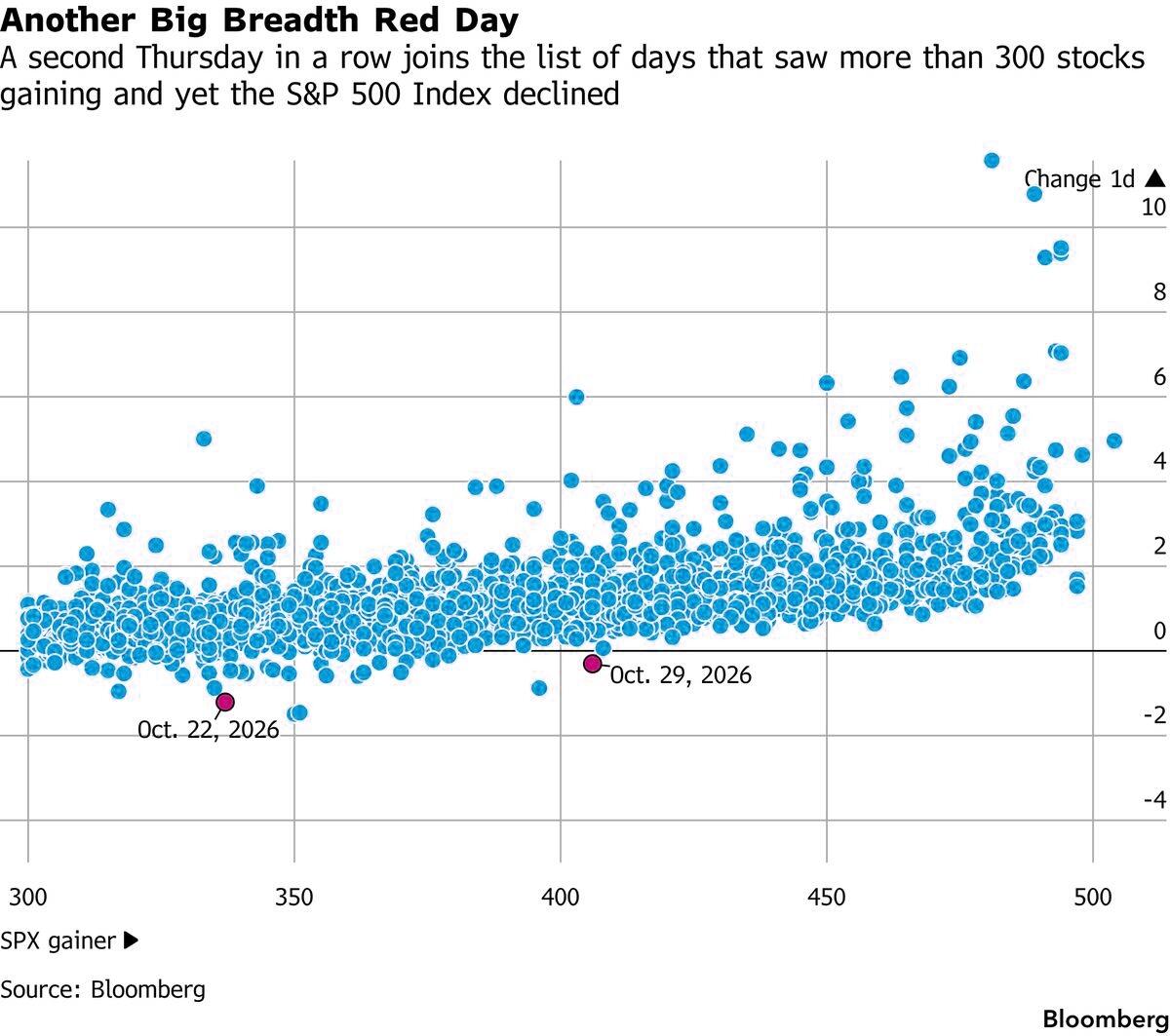
Disappointing reports from tech heavyweights including Amazon have fueled fears over massive AI spending, and the results compound the worries sparked by Alphabet, exposing concerns around trillions of dollars in future obligations to pay for a worldwide build-out of AI infrastructure. But, as Bloomberg notes, money is finding its way into other parts of the market instead of rotating entirely into cash: about 406 S&P 500 members rose on Thursday even as the index fell 0.3%, and in Bloomberg’s advance-decline data going back to 1996, the index has closed higher on all 987 previous sessions with at least 400 gainers. Thursday was another such outlier (Alphabet’s record drop, which we dissected here, saw to that).
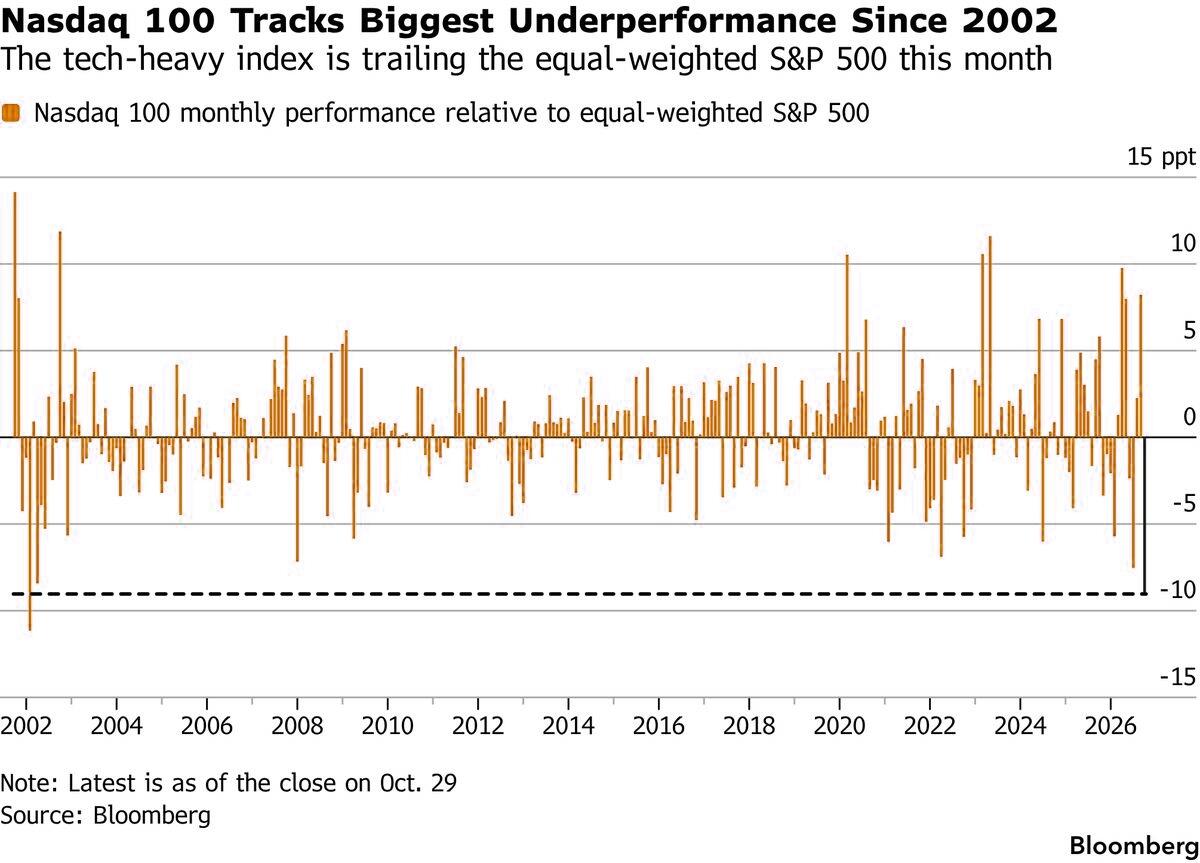
The result is a historic gap between the cap-weighted tech complex and everything else: the Nasdaq 100 is tracking its biggest monthly underperformance against the equal-weighted S&P 500 since 2002, the kind of chart that tends to get people asking which 1999 we are in.
“Tech earnings have proven a major hurdle with investors suddenly becoming capex vigilantes,” said Jai Malhi, a senior equity strategist at Vanda Research. “With seemingly higher funding costs of capex, if revenue growth is not beating a high bar then tech names are being punished.”
BofA’s Michael Hartnett said the reversal in tech leadership, along with the rise in the dollar and bond yields, was “classic painful tightening stuff but not mortal” unless accompanied by job losses or a credit event. He expects the next big risk-on mood to be sparked by the end of central bank rate hikes and a potential “collapse” in oil prices in the first half of 2027.
Not everyone is panicking: the risks impacting the AI trade “are very well known and priced in,” Suresh Tantia, head CIO Asia equity strategy at UBS Wealth Management, said in a Bloomberg TV interview, adding that he remains positive on the AI trade, though “easy money has been made.”
Bloomberg’s Markets Live team sees crude as the tiebreaker: oil will drive the next major cross-asset move, as any price declines validate the Treasury rally and cushion equities while rising yields would feed tech weakness.
JPMorgan’s Market Intel desk (Andrew Tyler) writes that “with renewed fears over AI Monetization, the Equity rotation is likely to continue today but the broader indices will reflect Tech’s downside”, noting AMZN -7.3% and INTC -25.7% pre-market are driving semis (SOXX -6%) and memory (DRAM -5.6%) lower, while there is a defensive bid and the non-AI parts of cyclicals are also higher. Tyler’s team remains Tactically Bullish, arguing that an economy growing at or above trend with positive earnings growth produces a bull market, although “we have yet to have a complete positioning washout despite sentiment being firmly in the Fear region.” Elsewhere at JPM, Nikolaos Panigirtzoglou finds that retail investors poured record amounts into leveraged equity ETFs over the past couple of weeks, while QQQ short interest rose to its highest since 2023, and Chase card data show October total spending growth decelerating to ~5.8% Y/Y from ~6.8% in September, driven by slower discretionary spending.
Over at Goldman, Rich Privorotsky’s flow and positioning note flags a “potential outright gross unwind” in Asia, and on Amazon says AWS was fine (+39.3% to $46bn) but “the problem is everything else”: advertising grew 12% vs 18% expected, the first miss in seven quarters, and trailing free cash flow is now -$42bn. “The point at which hyperscalers shift from needing more capacity at almost any cost to optimizing returns on what they’ve already built is the one I’d really worry about,” he adds. GS TMT specialist Sean Johnstone’s take: “AI demand is not the problem, capacity and the cost of delivering it are”; he notes Intel’s Q4 revenue guide of $15.5bn at the midpoint compared to a Street at $17.0bn, with gross margin seen at 38% vs 42.5%. Not everyone was selling yesterday: Goldman saw $9bn of MOC to BUY at Thursday’s close, while one customer bought 15k SPX March 5500 puts as a crash hedge.
The calendar adds to the tension: Trump canceled appearances in Kansas and Iowa for the closing days of the midterm campaign in favor of “tele-rallies” (more here), with prediction markets putting Democrats at 94% for the House (here is what Wall Street expects), and investors are worried that Fed Chair Warsh’s plan to reduce the number of interest-rate decisions each year could be a recipe for more volatility in the $32 trillion Treasury market.
In Europe, the bond story is once again France: the economy unexpectedly contracted while October inflation came in at 3.8% vs 3.6% expected, nearing a three-year high and adding to headaches that already include surging borrowing costs, violent protests and budgetary uncertainty. The OAT-bund spread widened 4bps to 160bps on lower risk appetite and the inflation beat, while Italian inflation exploded to 5.6% vs 4.6% expected and the euro-area economy grew 0.4% Q/Q in Q3, double the estimate, keeping the ECB on track for a December hike (Panetta said further increases “could prove necessary”).
In Europe, the Stoxx 600 is down 0.2% at 647.74, with 268 members up and 321 down, as renewed concerns over AI spending rattle global markets. European chip stocks are lower across the board after weak reports from Amazon and Intel (ASML -4.5%, ASM International -4.6%, AT&S -12%), while a fresh batch of earnings from Sanofi, AstraZeneca and BP lifted those shares and UMG soared as much as 15% on recovering subscription growth. The FTSE 100 is up 0.2% while the Euro Stoxx 50 drops 0.8% and the DAX 0.4%. JPM’s desk notes Quality and Size are leading with Growth and Beta lagging, with AI Disruption, Bond Proxies and Defensives baskets outperforming while Semis and AI plays lag. Here are the biggest European movers:
- UMG shares soar as much as 15% after the music label reported stronger-than-expected subscription revenue growth and profit margins, showing signs of improvement after the firm missed expectations on the key metric for two straight quarters.
- European chip stocks are lower across the board on Friday, after weak reports from Amazon and Intel overnight dent investor sentiment and revive the debate on the sustainability of AI spending. ASML -4.7%, ASMI -4.5%, BE Semiconductor -4.4%, VAT -3.0%, Infineon -3.4%, STMicro -3.2%, Soitec -5.7%, AT&S -11%, Technoprobe -5.2%
- NatWest Group shares decline as much as 3.9% after the lender’s third-quarter results. Analysts flag lingering risks to the income outlook, with softer revenue trends, higher impairments and intensifying competition overshadowing better costs and capital.
- Puma gains as much as 7.6% after reporting third-quarter results that were broadly in line with expectations, including narrowing its forecast Ebit loss for the full year.
- Sanofi rises 5.8%, the most since October 2025, after the French drugmaker reported a third-quarter profit beat and raised guidance. Jefferies analysts point to stronger-than-expected Dupixent sales.
Asian stocks fell, remaining on track for their worst month since March, as the US tech selloff and concerns over the AI buildout weighed on sentiment. The MSCI Asia Pacific Index fell 1.1%, extending October’s decline to over 6%, with Samsung and SK Hynix among the biggest drags; the Korean chipmakers have each lost more than 16% this month. South Korea’s Kospi sank 3.5% (triggering a sidecar), Taiwan’s Taiex fell 2.5%, Japan’s Nikkei dropped 2.1% and the Topix 1%, while Hong Kong’s Hang Seng bucked the trend with a 1.5% gain as platform names picked up the slack from chipmakers; Australia’s ASX 200 and India’s Nifty also rose. China’s CSI 300 fell 1.4% and Chinese stocks suffered their worst month in more than a decade as fading policy support and doubts over AI earnings deepened investor pessimism, prompting the CSRC to vow to stabilize markets. Goldman’s Privorotsky described the price action in Asia as a “potential outright gross unwind”, with AI winners hit 3-5% while consumer and AI laggards were bid. The BOJ kept rates at 1.25% in an 8-1 vote, declared underlying inflation has reached its 2% goal, nearly tripled the pace of its ETF sales, and Governor Ueda kept a December hike in play.
In FX, the Bloomberg Dollar Spot Index fell 0.3%, weighed down by the rout in US tech stocks, and is on track to end the month largely flat. The Swiss franc outperforms most G-10 peers on haven demand, while USD/JPY fell 0.3% to around 157.2 as the yen held gains after the BOJ said underlying inflation has reached its target; Japan’s MOF confirmed it did not intervene in October. GBP/USD rose as much as 0.4% to 1.3432, the highest since Sept. 16, and EUR/USD is up 0.2% at 1.12. ING strategists said that “to us, the main risk for the dollar today is some precautionary unwinding of net-long positions ahead of Tuesday’s US midterm elections,” adding “we’d be cautious in chasing the USD upside in the next few days.” Deutsche Bank’s George Saravelos says the “AI dollar” is here and its haven bias is less certain.
In rates, Treasuries inched higher, with the 10-year yield slipping 1bp to 4.93% (in a 4.89%-4.94% range) after Thursday’s rally took 2-year (4.60%) and 10-year (4.94%) yields to their lowest since mid-September, despite a strong batch of data including Q3 GDP of 3.4% and the lowest 4-week average of jobless claims since 1969 (an inconvenient fact for those who think good news is still good news). Per Goldman’s Asia macro desk, the December FOMC still has about 18.5bp of hikes priced. In Europe, bunds edged higher across the curve on demand for havens as tech stocks slid (10Y bund yield -2bps to 3.34%), while gilts are set for their third straight weekly gain, the longest winning streak since February, after the fiscally restrained UK budget and as government bonds benefited from rotation out of stocks (10Y gilt 5.28%, -2bps). French bonds lag after the hotter-than-expected CPI print. Money markets price about 22bps of ECB hikes in December.
In commodities, oil continues its rise: Brent December futures climbed as much as 2.5% to $117.76, after nearly reaching $118 overnight, while WTI rose 1.7% to around $103.50-104. Iran claimed two oil tankers were hit by incidents and stopped in Hormuz, after a Panama-flagged tanker and a dhow were hit in the strait on Thursday; meanwhile reports continue to point to US strikes on Iran after the midterms, the Houthis said they targeted Ras Tanura, Abqaiq and Rabigh, and Exxon and Chevron canceled plans to attend the Abu Dhabi oil conference. On the diplomatic side, Iran received a letter from VP Vance and a Qatari delegation arrived in Tehran for talks. Goldman’s commodities team estimates Brent embeds a $27/bbl geopolitical risk premium over its ~$85 fair value. Spot gold fell 0.8% to around $3,995, back below $4,000, silver dropped 2.6% to $50.88 and copper slipped as the tech selloff and oil rally dented risk appetite.
US economic data slate includes 3Q employment cost index (8:30am, est. 0.8%, prior 0.9%) and October MNI Chicago PMI (9:45am, est. 56, prior 58.8). Fed speaker slate includes Barkin on Sirius XM (9:30am), Daly (12pm) and Musalem (12:30pm). On the earnings front, ExxonMobil, Chevron, AbbVie, Colgate-Palmolive, Regeneron, General Dynamics, LyondellBasell, Dominion Energy and Cboe report before the open.
Market Snapshot
Top Overnight News
- Disappointing reports from technology heavyweights including Amazon.com have fueled fears over massive AI spending, with Nasdaq 100 constituents already wiping out more than $1.2 trillion in market capitalization this month. BBG
- Intel plummeted in late trading after its revenue forecast missed analysts’ estimates, hurt by a PC slump and supply snags. Amazon.com also dropped after reporting greater-than-anticipated capital spending and the slowest growth in the core e-commerce business in three years. BBG
- Binance estimated $6.3 billion in funds was impacted in crypto’s biggest-ever hack, which TRM Labs attributed to North Korea. The exchange suspended withdrawals and pledged to cover losses. Digital tokens fell. BBG
- Brent topped $117 on signs the US may resume strikes on Iran after the midterms. Qatari mediators returned to Tehran for deal talks coordinated with Washington. BBG
- Iran claims 2 oil tankers hit by incidents, stopped in Hormuz. BBG
- Vance messaged an Iranian hardliner, Mohsen Rezaei, and said he was prepared to meet in person to discuss a settlement to the war. WaPo
- The US reportedly informed mediators that Iran abandoning its nuclear programme is a prerequisite for negotiations: Al Arabiya citing sources. Mediators are discussing allowing inspectors access to Iranian nuclear sites in exchange for the release of some frozen funds.
- Exxon, Chevron cancel plans to attend Abu Dhabi oil conference. BBG
- The Bank of Japan has said that underlying inflation has reached its 2% target, in effect declaring victory in a war against deflation that had defined the Japanese economy for decades. The long-awaited breakthrough was announced on Friday in the BoJ’s quarterly outlook for economic activity and prices, which accompanied a decision to keep interest rates on hold at 1.25%. The rate decision, by an 8-1 margin, was widely expected by markets. FT
- The BOJ also announced it would step up the pace of ETF sales, accelerating the unwinding of its massive holdings. BBG
- The euro-area economy rose 0.4% in the third quarter, twice the pace analysts predicted, despite an unexpected 0.1% contraction in France. BBG
- Chinese stocks suffered their worst month in more than a decade as fading policy support for a weak economy and doubts over AI earnings deepened investor pessimism. BBG
- Ukraine’s military has paused its strikes against Russian oil refineries, people with knowledge of the operations said, after weeks of pressure from President Trump shook Kyiv’s confidence in U.S. support. WSJ
- The Pentagon is quietly preparing for a $400 billion cut to President Donald Trump’s military budget, as officials realize the president’s record-breaking request is effectively dead. Politico
- Donald Trump scrapped appearances in Republican-friendly Kansas and Iowa in the closing days before the midterms, shifting to tele-rallies as his party faces unexpectedly tough races in traditionally safe states. BBG
- Anthropic is SpaceX’s largest single customer, a person familiar with the matter said, accounting for more than a third of the revenue for Elon Musk’s artificial intelligence, satellite and rocket venture during the third quarter of this year. BBG
- Chevron 3Q adj EPS $5.28, est. $4.93. BBG
- Cursor AI said it has identified a security incident impacting a modified Claude Code extension, impacting up to 5k users.
- BofA weekly flow data shows USD 56.2bln into stocks, USD 15.4bln into bonds, USD 3.4bln into cash, USD 0.5bln out of crypto, USD 1.7bln out of gold. Bull & Bear Indicator fell to 7.1 (from 7.2).
- Goldman’s commodities team estimates Brent at ~$112 embeds a ~$27/bbl geopolitical risk premium over its ~$85/bbl fair value, noting “essentially all of the recent increase in crude prices reflects a higher risk premium rather than an increase in underlying fair value.” GS
- Retail investors poured record amounts into leveraged ETFs over the past couple of weeks, supporting the bottoming out of AI-related stocks, while short interest of the QQQ ETF rose to its highest level since 2023. JPM
A more detailed look at global markets courtesy of Newsquawk
APAC stocks were mixed amid notable tech weakness, with the sector further pressured following disappointing earnings from Amazon and Intel, while participants also digested a slew of data at month-end. ASX 200 traded higher as softer yields helped offset the losses in tech, consumer staples and mining. Nikkei 225 was pressured amid the tech woes, while participants also digested a slew of mixed data releases and the BoJ policy announcement, in which the central bank kept rates unchanged, declared reaching the price target and accelerated the pace of its ETF sales. KOSPI underperformed and triggered a sidecar after the recent weak big tech earnings stateside. Hang Seng and Shanghai Comp were mixed amid a deluge of earnings and with Hong Kong outperforming as platform companies picked up the slack from chipmakers, while the mainland was subdued following a record number of purges at the Fifth Plenum.
Top Asian News
- PBoC maintained the overnight reverse repo rate at 1.25% (prev. 1.25%) and shifted 7-day reverse repo operations to fixed-quantity, rate-tender auctions with multiple winning prices. Said other liquidity tools, including temporary repos and offshore central bank repos, will be priced off the overnight reverse repo rate, while 7-day operations will primarily be conducted around tax periods and month-end.
European bourses are mixed to start the final trading session of the week, with the FTSE 100 (+0.2%) outperforming following positive earnings from AstraZeneca and BP, outweighing disappointment from NatWest. Starting with Astra (+3.3%), its Q3 adj. EPS and revenue beat estimates, with sales for its blockbusters Imfinzi and Tagrisso also higher than expected. As well as reconfirming FY guidance, the pharma giant announced a cost-savings plan over three years, which includes a USD 2bln one-time restructuring charge. For BP (+0.4%), its profit surged to the highest in 18 years, while its focus on cutting debt continues to pay off. To end with NatWest (-4.3%), despite the bank sticking with its FY guidance, its shares are under pressure, with some analysts pointing to a lack of certainty around earnings from interest in the coming years. Other key movers include: Sanofi +5.5%, upgrades its FY profit forecast as Dupixent sales top estimates; Credit Agricole -2.0%, a mixed report as capital missed estimates and loan losses rose; Audi, cuts its FY operating margin guidance; Evonik, rejects takeover talks with BASF; Puma +7.2%, narrows its 2026 operating loss guidance as Q3 sales beat expectations. US equity futures are mostly lower, with the NQ (-2.4%) sliding for another session after disappointing earnings from Amazon and Intel. For Amazon (-6.7% pre-market), its Q3 EPS and Q4 operating income guidance missed estimates while Intel’s (-25.8% pre-market) Q4 EPS and revenue guide missed consensus. NQ futures now slip below the 29k mark, as focus turns to the 200-SMA at 28.5k.
Top European News
- ECB Survey of Professional Forecasters (Q4): Headline and core inflation expectations revised upwards for 2026 and 2027, owing primarily to higher energy prices and their indirect effects, with longer-term inflation expectations remaining anchored at 2.0%.
- BoE DMP (Oct): 1-year CPI expectation 3.3% (prev. 3.1%), 3-year CPI expectation 2.8% (prev. 2.8%). Year-ahead wage growth 3.4% (prev. 3.4%).
- Councils in England are in open revolt against changes to strip elected councillors of planning powers and hand decisions to unelected officials, according to The Times.
FX
- DXY is lower by 0.2% within a 101.56 to 101.91 range, following Thursday’s losses, which came alongside lower yields and the in-line PCE data, although the downside was contained by the better-than-expected Q3 GDP. Today’s US docket includes the Q3 Employment Cost Index at 12:30GMT/08:30EDT and Chicago PMI at 13:45GMT/09:45EDT, while Fed’s Barkin and Daly are due to speak, alongside Musalem, Hammack (dissenter) and Cook (surprise dissenter).
- USD/JPY sits towards the bottom end of a 157.12 to 157.90 range. The BoJ kept rates at 1.25%, as expected, in an 8-1 vote, with Takata proposing a hike to 1.5%; the Bank said underlying inflation has reached levels consistent with the price target and that risks to prices are skewed to the upside. It also set the pace of its ETF sales at around JPY 860bln a year from January, while the Fiscal 2027 Core CPI forecast was raised to 2.6% (prev. 2.4%). At his press conference, Governor Ueda said it is too early to declare the inflation target achieved and that the Bank will assess risks at every meeting, including December; USD/JPY fell 32 pips to 157.12 on the decision, before paring half of the move. USD/JPY was choppy within a 157.44 to 157.75 range during the presser. Overnight, Tokyo CPI was softer than expected at 2.8% Y/Y (exp. 3.3%), with Core in line at 2.6%. Thereafter, Japanese FinMin Katayama said it is about time to judge that the BoJ’s 2% inflation target has been largely achieved.
- EUR/USD is firmer and holds around the 1.1200 mark, within a 1.1171 to 1.1215 range, after gaining in the aftermath of Thursday’s ECB hold, with ECB source reports indicating policymakers are prepared to raise rates in December. This morning, ECB’s Simkus said holding rates does not mean there are no more hikes to come, while Rehn said the growth and inflation outlook is still very uncertain. French HICP was hotter than expected at 3.8% Y/Y (exp. 3.6%), though French Q3 GDP unexpectedly contracted 0.1% Q/Q (exp. +0.1%); Spanish CPI and GDP were in line. German Q3 GDP topped forecasts at 0.2% Q/Q (exp. 0.1%), while Italian GDP was flat (exp. 0.1% Q/Q), and the German state CPIs all cooled on a Y/Y basis (in line with the expectations for the national figure); EUR/USD saw little reaction to the above data.
- GBP/USD is firmer and holds above the 1.3400 handle, at the top end of a 1.3374 to 1.3433 range. EUR/GBP is lower within a 0.8340 to 0.8365 range, having printed a fresh 2026 low, with 0.8333 (equivalent to GBP/EUR 1.2000) the next level of note. UK Nationwide Housing Prices were flat M/M (exp. -0.1%), while the UK docket is light for the remainder of the session.
- The Antipodeans are mixed, with NZD/USD higher within a 0.5624 to 0.5649 range, and AUD/USD flat within a 0.7018 to 0.7043 range. RBNZ’s Hansen said a December hike is 50-50, while Silk is said to support a December hike if current conditions persist, Bloomberg reported.
- USD/CNH trades within a 6.6496 to 6.6576 range, printing a fresh 52-week low. The PBoC changed its 7-day reverse repo operations to fixed-quantity, rate-tender auctions, and said other tools will be priced off the overnight reverse repo rate, which was kept at 1.25%.
Central Banks
- BoJ kept rates unchanged at 1.25%, as expected, in an 8-1 vote with Takata the dissenter as he proposed raising the short-term interest rate target to 1.5%, but the proposal was rejected by the board, while it stated that underlying inflation has reached levels consistent with the price target and it will continue raising interest rates in response to economic and price developments, as well as financial conditions. BoJ said there is a risk that underlying inflation could overshoot the price target and that risks to prices are skewed to the upside, while it decided to sell ETF holdings at a scale of about 0.1% of market trading value with the pace of ETF sales set at around JPY 860bln per year on a book value basis from January and noted that ETF holdings sales would take about 43 years to complete, compared with approximately 112 years previously. In terms of the latest Outlook Report, the median forecast for Core CPI was maintained at 2.5% for Fiscal 2026, raised to 2.6% from 2.4% for Fiscal 2027 and maintained at 2.0% for Fiscal 2028, while forecasts for Real GDP were raised to 0.7% from 0.6% for Fiscal 2026, lowered to 0.7% from 0.8% for Fiscal 2027 and maintained at 0.8% for Fiscal 2028.
- In the press conference, BoJ Governor Ueda noted that he is aware there is still a gap between the neutral rate and the policy rate. On inflation, he said that all members agreed that underlying inflation has reached 2% but said it is too early to declare the inflation target achieved, as inflation must remain stably and sustainably around 2%. On ETF sales, Ueda said a faster pace of ETF sales would have only a limited market impact and that the Bank needs to respond appropriately to upside risks.
- ECB’s Nagel said they will act decisively if needed and that there are no significant second round effects thus far.
- ECB’s Simkus said that holding rates does not mean no more hikes to come, adding that the likelihood of energy spillover has risen, but noted they don’t see second round effects yet.
Fixed Income
- A firmer final session of the week so far for fixed, with benchmarks at/towards fresh WTD highs in the early morning, but since slipping just off those as energy continues to inch higher.
- Upside for the space is generally a function of the week’s major central banks not tightening and a tech sell-off, with the Fed, ECB and BoJ all on hold and to varying degrees outlining focus on the growth narrative and tighter financial market conditions, which could theoretically serve to limit the need for tightening ahead. However, all are on track for a hike by end-2026; currently, CME has a 74% implied chance of a December Fed hike, for instance.
- Policy aside, the other main focus point for today is geopolitics. The main update is a Qatari delegation arriving in Tehran for mediation efforts. Though given the dismissive approach US President Trump reportedly took to VP Vance’s outreach, and recent reporting keeping post-midterm strikes very much in play, it remains to be seen whether this effort can progress the situation.
- USTs are at a 106-27 high for the week, firmer by 14 ticks on the day at best.
- Bunds also bid, though off highs as Dutch TTF continues to climb. As it stands, firmer by about 10 ticks, but some 40 off the 122.64 WTD peak. As above, the path for the ECB is towards a December hike, but risks to tightening then, but more so thereafter, are present from the yield and growth backdrop; see Thursday’s post-meeting analysis for more.
- Gilts in-fitting with the above directionally, but as usual have been a touch more susceptible to the energy upside, with the benchmark back to flat at the time of publication, in 85.44 to 86.12 confines.
- Finally, OATs and BTPs are both under pressure this morning, weighed on by the firmer-than-expected preliminary inflation reads from the nations, and as EZ-wide growth for Q3 proves resilient. A combination that theoretically gives the ECB policy space to take action, while the inflation prints may well be revised higher given the marked energy upside, particularly in Dutch TTF, seen towards month-end.
Commodities
- Crude benchmarks are firmer, after rebounding overnight as headlines continued to highlight a potential resumption of strikes on Iran after the midterm elections. WTI Dec’26 is higher within a USD 102.43-104.99/bbl range (vs yesterday’s USD 99.79-103.00/bbl range), while Brent Jan’27 trades within a USD 111.03-114.07/bbl range (vs yesterday’s USD 109.02-111.80/bbl range).
- In terms of geopolitics, a US official said the White House believes the chances of a settlement with Iran may be dwindling, although US envoy Barrack said Washington is very close to an agreement. Benchmarks dipped by around USD 0.65/bbl after Reuters reported that Qatari mediators will return to Tehran on Friday to help reach a US-Iran deal; Iranian state media later said the delegation has arrived. Elsewhere, and looking ahead, OPEC+ meets on Sunday, where sources said the group is expected to maintain its December production targets.
- Dutch TTF is higher by over 4% at the time of writing and holds above the EUR 100/MWh mark, within a EUR 98.68-102.03/MWh range.
- Spot gold is softer and holds just beneath USD 4,000/oz, within a USD 3,965-4,026/oz range (vs yesterday’s USD 4,005-4,068/oz range). Spot silver is lower by 2.5% within a USD 50.44-52.24/oz range (vs yesterday’s USD 51.97-54.40/oz range), while platinum and palladium futures are lower by 3.2% and 2.5%, respectively, at the time of writing. Base metals are mixed, with 3M LME copper in a narrow USD 14,244.80-14,379.13/t range.
- Japan’s Ministry of Economy, Trade and Industry affirmed no plan to release oil reserves in November as it expects to secure 100% of oil for November.
Trade/Tariffs
- China’s Foreign Ministry said China will take necessary measures to defend its rights in response to US FCC measures against Chinese firms.
- Chinese President Xi told the Swiss President that the upgraded trade agreement fully reflects both nations’ political courage and sense of responsibility in upholding open cooperation.
- EU’s Kallas said the EU’s relations with Canada are entering a new era and they will deepen ties on security and defence, trade, critical raw materials and digital, as well as bring their people closer together.
Geopolitics: Middle East
- US CENTCOM Commander Cooper briefed US President Trump on Thursday regarding the state of war with Iran, with a focus on the ongoing naval blockade, according to two senior officials, while it was separately reported that a top US admiral briefed Trump about Iran attack options, according to WSJ.
- US envoy Tom Barrack said Washington is very close to an agreement aimed at reducing tensions with Iran, citing mediation by Qatar, Pakistan, Saudi Arabia and Turkey, while he rejected the ‘greater Israel’ narrative and urged regional powers to take greater responsibility.
- US official said the White House believes the chances of reaching a settlement with Iran may be dwindling, while the official noted that Istanbul and Doha are the most likely locations if a meeting takes place between US VP Vance and Iran’s Rezaei, according to the Washington Post.
- The US reportedly informed mediators that Iran abandoning its nuclear programme is a prerequisite for negotiations, according to Al Arabiya citing sources. Mediators are discussing allowing inspectors access to Iranian nuclear sites in exchange for the release of some frozen funds.
- Qatari mediators reportedly returned to Tehran on Friday to advance efforts towards a US-Iran agreement, with talks coordinated with Washington, according to Reuters citing an official briefed on the negotiations. More recently, Iranian press confirmed that a Qatari delegation has arrived in Tehran.
- Iran’s Foreign Ministry Spokesman Baghaei said blaming Iran for the consequences of US military aggression is mitigation and whitewashing of crimes.
- UKMTO said it received a report of an incident 25 nautical miles northeast of Khasab, Oman, in the Strait of Hormuz, with a vessel, although the cause was unknown at the time of the report.
- IRNA correspondent reported several explosions were heard coming from the direction of the sea and in the sky and waters around Iran’s Qeshm Island, while reports also noted that four explosions were heard in Iran’s Jask, although the cause was unknown.
- Explosions and flashes reported near the Strait of Hormuz, while local sources were linking the sounds to vessel warning shots, according to Fars and Al Jazeera.
- Yemen military warned Houthis against using prohibited combat weapons, while its Defence Ministry was investigating Houthi use of toxic gas in Taiz.
Geopolitics: Ukraine
- US Pentagon officials have reportedly urged several NATO allies, including Lithuania, Latvia and Estonia, to tone down public rhetoric regarding the threat posed by Russia, arguing that some European statements undermine continental security, according to Reuters sources. Messages were delivered in bilateral meetings, although it remains unclear whether other European governments received similar requests.
- Ukraine’s military paused its strikes against Russian oil refineries after weeks of pressure from US President Trump shook Kyiv’s confidence in US support, according to WSJ citing people with knowledge of the operations.
- Russia conducted strikes on military and energy facilities in Ukraine’s Kyiv and Dnipropetrovsk regions, while it struck port facilities in Odesa and cargo vessels, according to its Defence Ministry.
- Russian Kremlin aide Ushakov said no date has been set yet for Russia-US-Ukraine talks, Interfax reported.
Geopolitics: Other
- South Korean National Security Advisor said South Korea is to firmly respond to North Korea’s crossing of the military demarcation line, and stated that Seoul is continuing to provide support for Ukraine as part of the international community.
- North Korean leader Kim called for North Korea to seize absolute superiority in drone technology.
Crypto
- Bitcoin slips below USD 78k and briefly dipped below USD 77k after Binance said it suffered a USD 6.3bln hack, prompting the exchange to suspend all withdrawals and pledge to cover customer losses. Binance said around USD 3bln in stolen assets have been frozen on blockchain networks, with withdrawals expected to resume by Sunday.
US Event Calendar
- 08:30: 3Q Employment Cost Index, est. 0.8%, prior 0.9%
- 09:45: Oct MNI Chicago PMI, est. 56, prior 58.8
Central Bank Speakers
- 09:30: Fed’s Barkin Appears on Sirius XM
- 12:00: Fed’s Daly Gives Introductory Remarks
- 12:30: Fed’s Musalem Delivers Keynote Address
DB’s Jim Reid concludes the overnight wrap
Morning from a cabin in a forest in the middle of nowhere. As the world debates the arrival of AGI and superintelligence, I’m moving around my lodge trying to eke out a WiFi or 4G signal. It’s as painful as the harness I was strapped into yesterday to do a big zip wire over a lake! Talking of technology, as expected big tech earnings have been more influential this week than central banks. Alphabet (-12.64%) saw it worst day on record yesterday after results which weighed down the S&P (-0.30%) even though 406 stocks in the index advanced. After the bell disappointing results from Amazon and Intel added to the souring tech mood, and Nasdaq futures are currently -1.86% lower after the cash index closed -1.38% last night. The tech selloff has supported Treasuries, with 10yr yields (-8.0bps) falling to their lowest level in 6 weeks at 4.94% and edging to 4.923% this morning. By contrast, in Europe the DAX (+1.31%), CAC 40 (+1.05%) and Stoxx 600 (+0.77%) all advanced, supported by upbeat earnings and a slightly dovish ECB on-hold decision. A retreat in energy prices also supported European bonds yesterday, but oil prices have moved higher again overnight on fresh concerns about US-Iran escalation.
So a lot going on. Let’s start with those after-hours earnings. Amazon’s Q3 net sales fell just short of analyst expectations ($201.94bn vs $202.26bn est.) while spending on property and equipment soared in the quarter ($77bn vs $59bn est.). So while cloud revenue growth was a touch above expectations, this was insufficient to ease concerns about the rising capex spend, and Amazon’s shares slumped by -7% in extended trading. If that move is replicated in today’s regular session, it would leave the stock marginally down year-to-date. Meanwhile, Intel plunged by -23% after-hours after its Q4 revenue guidance missed estimates ($15-16bn vs $17.05n est.). In addition to sending Nasdaq (-1.86%) and S&P 500 (-0.89%) futures lower, these earnings have exacerbated the sell-off in Asia this morning, with the KOSPI (-3.99%) and Nikkei (-2.22%) sliding.
This follows a weaker US session as Alphabet (-12.64%) posted its biggest drop on record after underwhelming results the night before, which left its share price -9.32% YTD. The S&P 500 (-0.30%) was underpinned by 406 stocks advancing and the equal weight index (+1.21%) rose to its highest level since August. So it was a concentrated tech led sell-off with the Nasdaq (-1.38%), Magnificent 7 (-1.83%) and Philadelphia Semiconductor Index (-1.42%) all substantially lower. Tech underperformers also included CoreWeave (-4.99%) and Oracle (-3.45%). In other tech news, Microsoft completed a $25bn bond offering, becoming the last of the US hyperscalers to turn to debt markets this year. The sale marked Microsoft’s first major bond issuance since 2017.
The subdued US performance stood in contrast to Europe, where equities rallied after a slate of upbeat earnings, including those from Adidas (+5.76%) and Shell (+2.16%). That in turn pushed several indices higher, including the DAX (+131%), CAC 40 (+1.05%) and Stoxx 600 (+0.77%).
Turning to rates, the correction in the AI trade was a boon for Treasuries, with both 2yr (-9.8bps to 4.60%) and 10yr (-8.0bps to 4.94%) yields falling to their lowest levels since mid-September. The decline in Treasury yields came despite a strong batch of US data yesterday. Among them was the advance Q3 GDP print, which showed the economy expanding at a +3.4% q/q annualised rate (+3.2% exp.), up from +2.2%q/q in Q2. And the labour market remained resilient too, as weekly initial jobless claims edged down to 194k (vs. 198k exp.). Remarkably, that took the 4-week average in initial claims down to their lowest level since October 1969, at 196.75k. So the data bolstered Warsh’s bullish growth assessment from Wednesday during the FOMC. Meanwhile, the September PCE report showed headline PCE inflation +0.5%m/m (+0.3% m/m prior) and +3.6% y/y (+3.4%y/y prior). Core PCE came in at +0.3%m/m (+0.2%m/m prior) and +3.1%y/y (+3.0%y/y prior), all in line with expectations.
Over in Europe, the focus was on the ECB meeting where ECB President Christine Lagarde announced plans to step down as President by Feb 7. The news that she might step down early had long been expected, even if its timing was not previously known. She’ll now only have the December and early February meetings left. Importantly, this does mean French President Macron will be involved in the decision on the next ECB leader, as opposed to the next incoming French President. It also opens the door for her to play some role in the French election campaign, with Lagarde saying she was leaving early to have the freedom to speak on matters away from monetary policy. Our economists expect that the leadership change should not have much short-term impact on the direction of ECB policy.
In terms of the ECB decision itself, the ECB kept rates on hold at 2.50%, as widely expected, with President Lagarde striking a balanced tone but signalling that “the direction of travel” is towards another hike in December. The decision press release tilted a bit dovish, noting that “underlying inflation has remained broadly stable so far” and that tighter financial conditions were “likely to weigh on inflation and growth”. That said, the near-term dovish read across was largely offset by President Lagarde in the press conference. She suggested that yesterday was a “no hiking decision” as the ECB could afford to wait for more information, while implying that a December hike is the clear baseline absent a surprise over the next six weeks. Overall, our economists see yesterday’s decision as reducing the risk of rates going to 3% or beyond, in line with their view of 2.75% being the likely terminal rate. See their reaction note here.
So while pricing of a December rate hike was little change at 84% yesterday, money markets dialed back prospects of 2027 ECB hikes, with 64bps of hikes now priced by next September (-10bps on the day). That meant front-end bonds rallied with 2yr OAT (-7.1bps), BTP (-7.9bps) and bund (-5.3bps) yields falling. Bonds were also helped by decline in energy costs, with European natural gas futures down -2.12% to EUR 98.59/MWh after reaching their highest level since 2022 on Wednesday. Yields on 10yr bunds (-1.5bps), BTPs (-2.0bps) and gilts (-2.7bps) also all declined, though OATs (-0.1bps) underperformed, with the 10yr OAT-Bund spread rising back to 156bps.
Staying on the energy front, oil prices have had a volatile 24 hours, with Brent crude trading +1.07% higher at around $116.11/bbl as I type, after almost reaching $118 overnight. Brent had fallen as low as $113 yesterday after Semafor reported that the White House was involved in ongoing negotiations centered on a temporary peace deal with Iran. However, we then saw contrasting news later in the US session, with the WSJ reporting that a top US admiral has briefed Trump on military options against Iran. Meanwhile, Iran’s Parliament Speaker Ghalibaf said that Iran would not compromise on its position for ending the conflict, which comes after the WSJ reported the previous day that US Vice President Vance had reached out to Iran’s top security official to revive talks.
Now to the rest of Asia, and the BOJ left rates unchanged at 1.25%, in line with expectations, with eight of the nine board members voting in favour of the decision. Board member Hajime Takata was the lone dissenter, advocating for a 25bp rate increase. The central bank also noted that underlying consumer inflation has now reached its 2% target and is expected to remain around that level. In a surprise announcement, the BOJ said it would nearly triple the pace of sales of its ETF holdings from January, increasing annual disposals to an estimated ¥860bn ($5.5bn). At this pace, the process would take roughly 43 years to complete, compared with more than 110 years under the previous schedule. Probably beyond the natural life of the EMR regardless of the pace!
Focus now turns to Governor Ueda’s press conference which will start after we go to press, where markets will be looking for further guidance on the timing and pace of future rate hikes. Following the interest rate decision, the Japanese yen (+0.22%) is strengthening higher for the third straight session trading at 157.38 against the dollar as we go to print. Staying with Japan, early morning data showed that Tokyo CPI rose +2.6% y/y, below September’s +2.7% increase and in line with market expectations while core-core CPI rose +2.6% annually, after a +2.9% increase the previous month.
As we mentioned at the top, tech sensitive Asian indices are notably lower but other markets are more mixed with the CSI 300 (-0.27%) and Shanghai Composite (-0.19%) edging lower, while the Hang Seng (+1.75%) is outperforming seemingly on a short covering rally on those stocks that had funded the AI rotation trade.
In other overnight news, crypto assets have come under pressure after Binance, the world’s largest crypto exchange, suspended deposits and withdrawals following a suspected hacking incident. Bitcoin is down -0.40% this morning, following a -3.03% slide yesterday.
Finally, today we will get October flash inflation releases for France, Spain, Germany and Italy, ahead of the Euro Area aggregate next Wednesday. Our European economists expect inflation to rise in Italy and France, while easing slightly in Germany and Spain. Based on that, they expect the Euro Area aggregate to see headline HICP rising to 3.90% YoY in October (3.77% prev), while core HICP is likely to remain little changed at 2.5%, as marginal upside pressures from core goods are expected to be offset by a slight easing in services. You can read their full preview here. Over the pond we’ll also see the US Q3 employment cost index. Earnings today include ExxonMobil and Chevron.

