

Defense Stocks Sink After Democratic Sweep As TD Cowen Warns Trump’s “Branded” Programs Are Dead
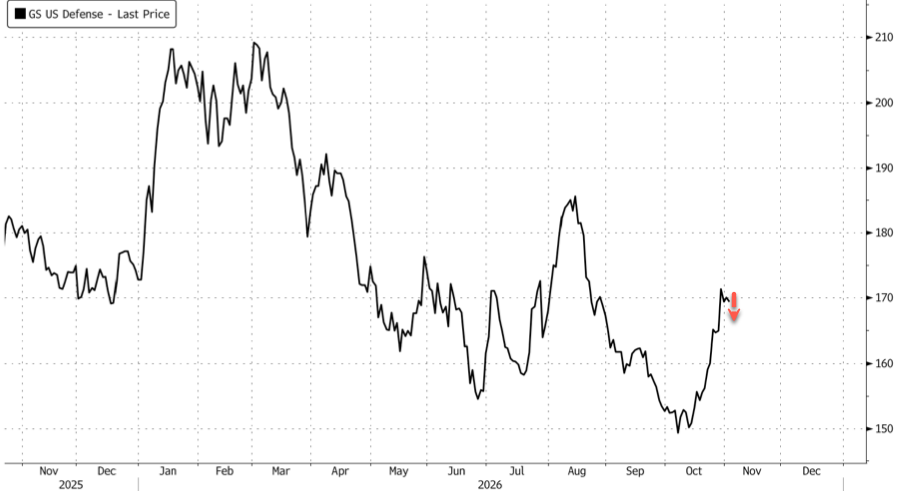
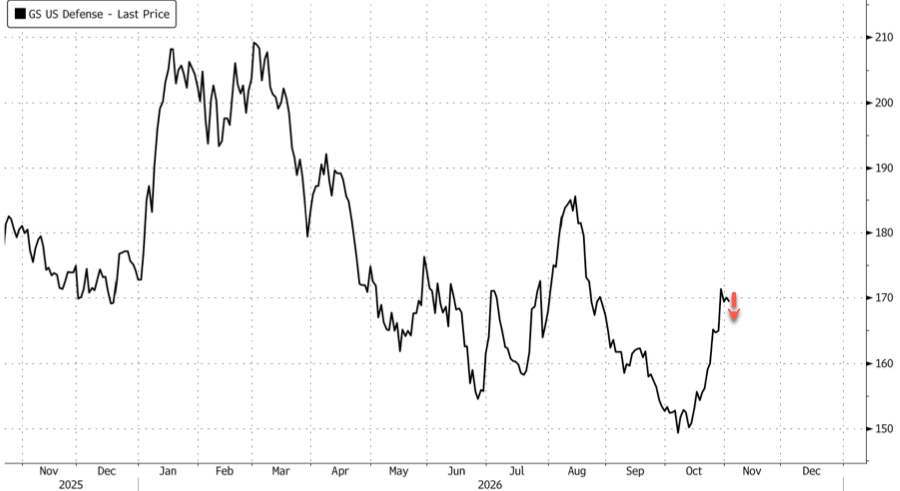
Democrats have won majorities in the House and Senate. It’s not just data centers and reindustrialization that will be under threat, but also the rearmament cycle, as defense stocks sink in US premarket trading and tumble in Europe’s cash session.
The larger-than-expected majorities will give Democrats much greater leverage in negotiations with the White House and will become a headache for the defense industry.
Traders on both sides of the Atlantic sold defense stocks on Wednesday, with Lockheed Martin and Northrop Grumman tumbling 3% in premarket trading.
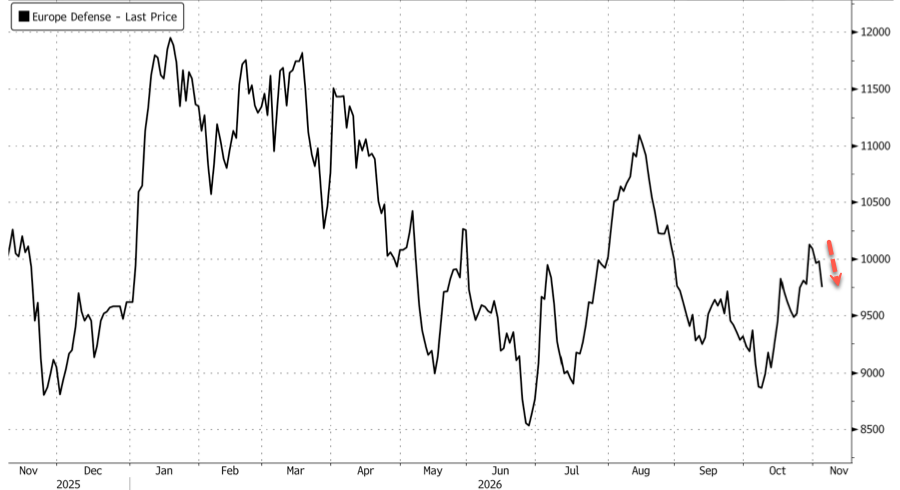
A Goldman Sachs basket of European defense companies slid as much as 4.1%, its biggest intraday decline in more than four months.
TD Cowen policy analyst Roman Schweizer called the Democratic sweep the “toughest outcome for defense spending” and said the incoming Democratic-controlled Congress would likely seek to compel President Trump to end the war, potentially attracting enough Republican support to override a presidential veto.
“In theory, the midterms should not (and typically would not) drive a major change in USA foreign policy but may in this case,” Schweizer wrote in the note to clients earlier today.
Schweizer warned:
Biggest change is the 2-3 year outlook for defense topline and Admin’s ability to execute major defense initiatives – not the underlying requirement for defense investment. We could move closer to a flat/LSD FY27-FY28 spending assumption – the variable is appetite and leverage with both Trump and Dems to reach a budget deal. NDAA & appropriations by EOY, but calendar is tight and could be consumed by last-ditch GOP priorities. GOP now has stronger incentive to use limited floor time to move reconciliation while they still control both chambers. Given the magnitude of the drubbing, attendance could be more of an issue than expected. NDAA & appropriations could slip, increasing the likelihood of addt’l CRs and pushing major legislation into early 2027 (which Dems may want anyway). We’ve been optimistic GOP will succeed with Reco 3.0 – we should know in 2-3 weeks if there’s any shot. Current CR expires Dec 11. Another CR looks more likely than full-year appropriations, to us, and a shutdown remains possible if Trump + Dems cannot reach a deal.
IRI becomes a bigger congressional fight. We fully expect a Dem Congress to seek another War Powers Resolution on IRI and/or use the NDAA & appropriations process to restrict, condition or increase oversight of IRI-related spending. That does not necessarily prevent military action, but it creates more friction for Admin & could complicate supplemental funding. While veto override is still a high hurdle, it becomes more conceivable based on final House-Senate end-state and remaining GOP considering ’28 cycle.
Dem sweep not necessarily bad for key priorities. If FY27 lands closer to ~$858B than $1.5T (i.e., no Reco 3.0 and a full-year CR), we expect cuts to current expectations across nearly every investment area. The better question is what is least at risk? We think: strategic nuclear modernization (B-21, Sentinel and Columbia); Virginia-class submarines; and munitions replenishment. Northrop Grumman, Huntington Ingalls, Lockheed Martin and RTX. Space and unmanned/cUAS remain priorities, but could fall well short of expectations without a broader ~$1.0T-$1.15T budget deal.
Trump “branded” programs are dead. Golden Dome, Golden Fleet (i.e., Trump-class battleship) & other signature efforts will be curbed, particularly where requirements remain immature or funding depends heavily on reconciliation. Golden Dome was already attracting bipartisan concern over the lack of detailed cost, schedule, performance and architecture information – although we still think some elements (i.e., space-based tech and domestic cUAS) continue.
Expect a lot more oversight, which could become a real execution issue. Dem Congress will have ability to investigate SecWar Hegseth (Lame Duck impeachment pending), DepSecWar Feinberg & other senior officials, while challenging Admin policy through subpoenas, hearings, authorizations & appropriations. NDAA also becomes an important battleground for Right-to-Repair, capital distribution restrictions, acquisition reform and reversing the DoW name change. Right-to-Repair remains the industry issue we would watch most closely – Sen. Warren (D-MA) will have more leverage on SASC to push final outcome.
The Democratic sweep introduces new policy uncertainty across both data centers and defense, with tighter oversight clouding the outlook for the investment supercycles.

