

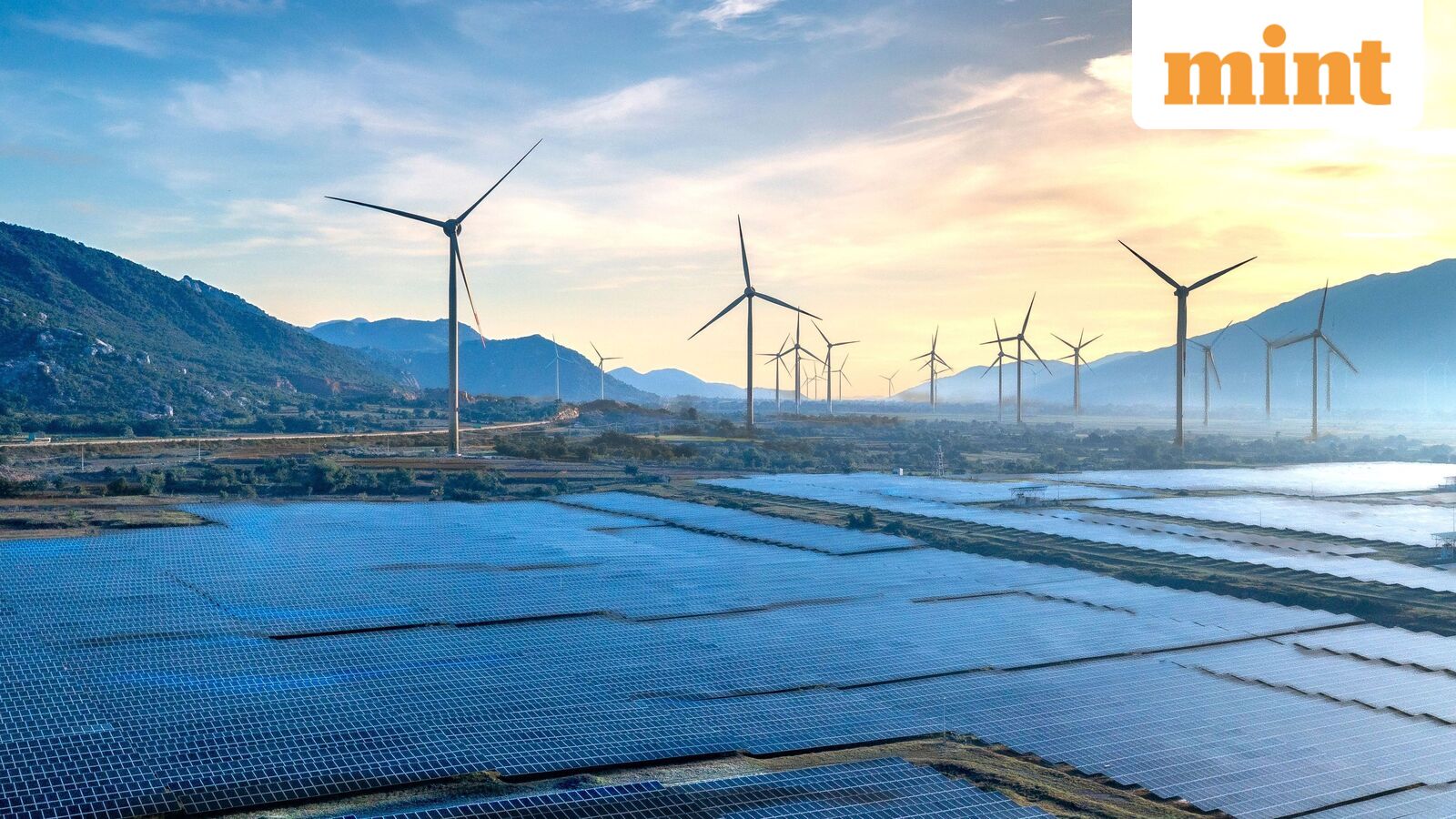
As India accelerates its clean energy transition, here are five undervalued renewable energy stocks for your watchlist.

Summary
As India accelerates its clean energy transition, here are five undervalued renewable energy stocks for your watchlist.
Renewable energy has been an investment theme for some time now — but what’s different today is that the numbers are no longer just promising, they’re proving themselves.
India’s clean energy transition has moved past the “potential” stage and into the delivery stage, and that changes the investment conversation. New and renewable energy and consumer affairs minister Pralhad Joshi has said India now ranks third globally in renewable energy installed capacity, according to the Renewable Energy Statistics 2026, moving ahead of Brazil in the process.
The minister highlighted several landmark achievements. In July 2025, India hit its highest-ever renewable energy share in electricity generation, with renewables meeting 51.5% of the country’s total electricity demand of 203 GW — a historic milestone.
As of 31 March 2026, a total of 283.46 GW of capacity from non-fossil fuel sources has been installed across the country.
Further, the non-fossil capacity addition in 2025–26 stood at 55.29 GW — the highest single-year increase ever recorded, nearly doubling the previous record of 29.5 GW set in 2024–25.
For a while, renewable stocks were priced on hope. Now they’re being tested against real capacity additions, real grid integration, and real policy execution.
With that in mind, here are five undervalued renewable energy stocks to watch. Some of the companies that we have chosen also generate power from other sources.
#1 NTPC.
NTPC is a leading power company in India. In the renewable energy space, NTPC was among the first global energy companies to declare an Energy Compact at the UN High-Level Dialogue on Energy, committing to measurable outcomes aligned with Sustainable Development Goal 7 (SDG7).
The company has set an ambitious target of achieving 60 GW of renewable energy capacity by 2032.
This expansion is being driven by subsidiaries such as NTPC Green Energy Ltd (NGEL), NTPC Renewable Energy Ltd (NREL), THDC, and NEEPCO, which are developing a diversified portfolio spanning utility-scale solar, floating solar, wind power, ultra-mega renewable energy parks, energy storage systems, and green hydrogen applications.
According to the company’s Q4FY26 earnings call, NTPC Group added 4,738 MW of renewable energy capacity during FY26, including 4,225 MW by NGEL, compared to 2,977 MW added in FY25.
The group further added 490 MW of renewable capacity in FY27 till 23 May 2026, taking its total installed renewable energy capacity to 12,068 MW.
From a valuation perspective, NTPC is currently trading at a P/E ratio of 12.97x, significantly below the industry average of 28.96x, according to Screener.
Going forward, the company plans to add 8,237 MW of renewable energy capacity in FY27, followed by 8,135 MW in FY28 and 8,408 MW in FY29. A majority of these additions are expected to come through NGEL and other subsidiaries.
#2 NHPC
NHPC is a Navratna public sector enterprise and one of India’s leading hydropower companies, with nearly five decades of experience in the sector.
As India accelerates its clean energy transition, NHPC is expanding beyond hydropower and building a diversified renewable energy portfolio.
The company is developing solar parks, floating solar projects, pumped storage projects, and green hydrogen initiatives across multiple states.
To strengthen its renewable energy presence, NHPC has established NHPC Renewable Energy (NHPC REL), a wholly owned subsidiary focused on renewable energy, small hydro, and hydrogen-based projects.
It has also formed Bundelkhand Saur Urja Ltd (BSUL), a joint venture with UPNEDA, to develop renewable energy projects in Uttar Pradesh.
NHPC has partnered with Andhra Pradesh Power Generation Corporation through the joint venture APGENCO NHPC Green Energy (ANGEL) to develop pumped storage, solar, floating solar, and wind energy projects.
The company has also been designated by the Ministry of New and Renewable Energy (MNRE) as a Renewable Energy Implementing Agency (REIA) and a Battery Energy Storage System (BESS) Implementing Agency.
From a valuation perspective, NHPC is currently trading at a P/E ratio of 19.84x, significantly below the industry average of 28.96x, according to Screener.
Going forward, NHPC plans to commission the 1,200 MW Jalaun Solar Park in Uttar Pradesh, being developed through its subsidiary Bundelkhand Saur Urja Limited (BSUL) under the Ultra Mega Renewable Energy Power Park (UMREPP) scheme. The project is expected to be commissioned by March 2028.
#3 KPI Green Energy
Founded in 2008, KPI Green Energy has emerged as a prominent player in India’s renewable energy sector. The company serves as the renewable energy arm of the KP Group and is engaged in the development, ownership, and operation of renewable power projects under its ‘Solarism’ brand.
KPI Green Energy operates through two key business segments. Under its Independent Power Producer (IPP) model, the company develops, owns, and operates renewable energy assets, generating clean power for sale to third parties.
Through its captive power producer (CPP) segment, it provides customized renewable energy solutions to commercial and industrial customers looking to reduce energy costs and meet sustainability targets.
The company offers a diversified portfolio of renewable energy solutions, including solar, wind, hybrid power projects, and Battery Energy Storage Systems (BESS). These solutions are designed to improve power reliability and address the intermittency challenges associated with standalone renewable energy generation.
The company has already established a cumulative power evacuation capacity of 3.59 GW and has built a total renewable energy portfolio of 6.26 GW, reflecting its strong growth trajectory in the clean energy sector.
From a valuation perspective, KPI Green Energy is currently trading at a P/E ratio of 16.81x, significantly below the industry average of 28.96x, according to Screener.
Going forward, KPI Green Energy is focused on expanding its renewable energy footprint, with an ambitious target of achieving 10 GW of capacity by 2030.
#4 Waaree Energies
Established in 1990 and headquartered in Mumbai, Waaree Energies is one of India’s leading clean energy companies with a growing international presence.
The company entered the solar sector in 2007 and has since built a diversified business spanning solar manufacturing, EPC services, energy storage, and green hydrogen solutions.
With advanced manufacturing facilities in India and the United States, Waaree has executed more than 10,000 projects and exports its products to over 24 countries.
The company is India’s largest solar PV module manufacturer and has developed a strong position in the global renewable energy market.
From a valuation perspective, Waaree Energies is currently trading at a P/E ratio of 22.3x, significantly below the industry average of 27.64x, according to Screener.
Going forward the company plans to expand its footprint across the energy value chain with an aim to capture a S$4 trillion (tn) opportunity by 2035.
#5Waaree Renewable Technologies
Waaree Renewable Technologies (WRTL) is a leading player in India’s solar EPC sector, providing end-to-end renewable energy solutions.
Headquartered in Mumbai, the company specializes in the development, construction, ownership, and operation of solar power projects.
A subsidiary of Waaree Energies, WRTL benefits from the broader group’s strong presence across the renewable energy value chain.
The company delivers clean energy solutions through rooftop solar installations, ground-mounted solar projects, and open-access solar farms, catering to a diverse range of commercial and industrial customers.
With India’s renewable energy capacity continuing to expand, WRTL is well-positioned to benefit from increasing demand for solar infrastructure and execution services.
From a valuation perspective, Waaree Renewable Technologies is currently trading at a P/E ratio of 21.16x, significantly below the industry average of 27.64x, according to Screener.
Going forward, the company plans to expand its project execution capabilities.
Conclusion
India’s renewable energy sector is entering a phase of accelerated growth, supported by strong policy backing and massive capital investments.
The country is expected to invest more than US$360 bn in renewable energy and related infrastructure by 2030, with an estimated US$190–215 bn required to achieve its target of 500 GW of renewable energy capacity.
At the COP26 Summit in Glasgow, Prime Minister Narendra Modi pledged to expand India’s renewable energy capacity to 500 GW and meet 50% of the country’s energy requirements through renewable sources by 2030.
As the nation moves closer to these goals, companies across the renewable energy value chain—from power generation and solar manufacturing to EPC services and energy storage—are likely to benefit from rising demand and increased investments.
Investors should evaluate the company’s fundamentals, corporate governance, and valuations of the stock as key factors when conducting due diligence before making investment decisions.
Disclaimer: This article is for information purposes only. It is not a stock recommendation and should not be treated as such.
This article is syndicated from Equitymaster.com

