

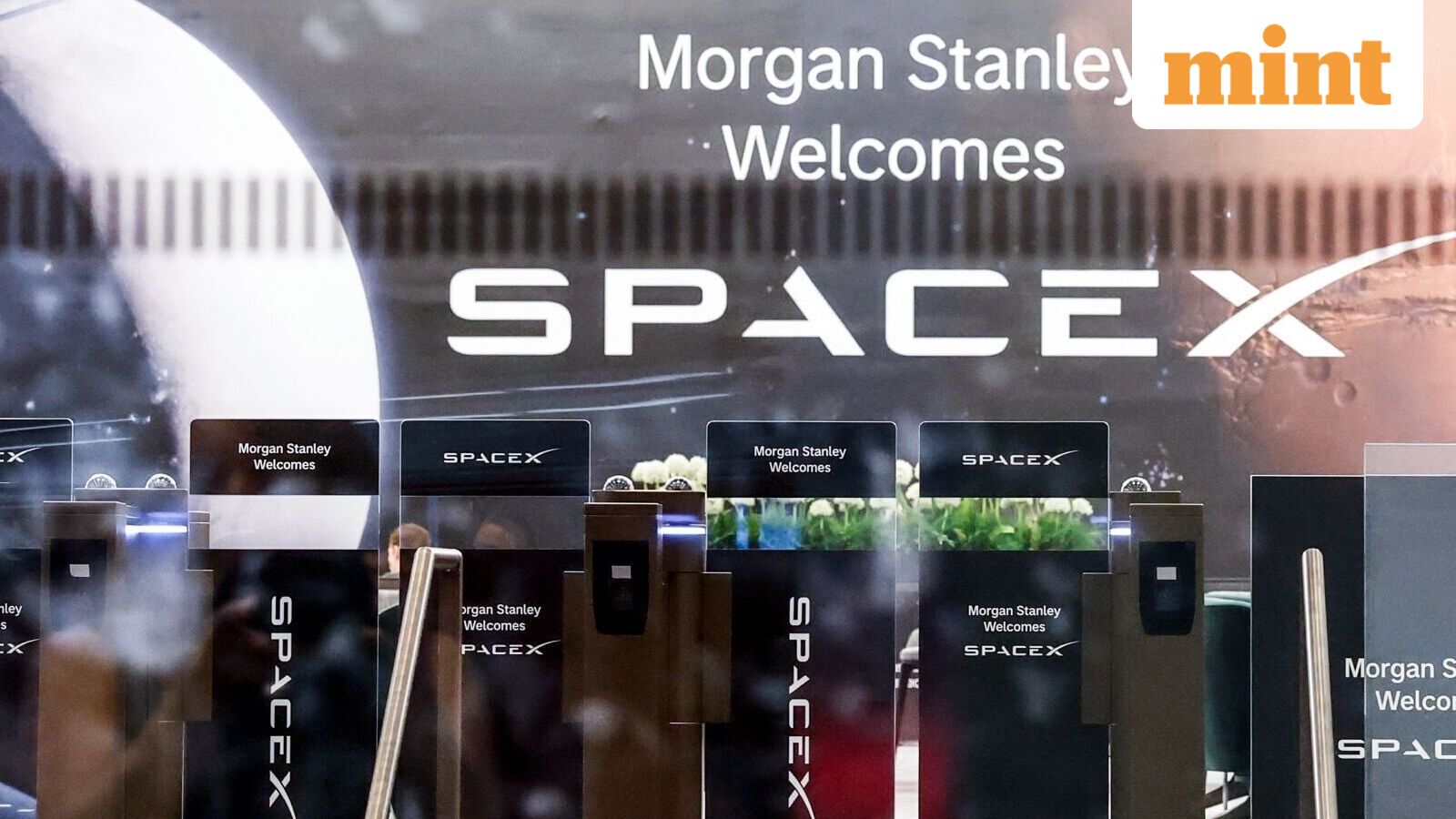
In the end, the space company’s debut was relatively mundane.

Summary
In the end, the space company’s debut was relatively mundane.
The SpaceX initial public offering was expected to deliver exciting twists and turns, fireworks, and flare-ups—the kind of drama usually reserved for a summer thriller. Instead, it proved to be something far more disappointing: rather ordinary.
The public debut of SpaceX—officially Space Exploration Technologies— portended different things to different investors but was significant for all. To some, it was an example of terrible corporate governance and a sign of irrational market exuberance. To others, it represented a gateway to an artificial intelligence-fueled utopia, in which SpaceX is worth trillions. For others, it represented the dream of an American manufacturing renaissance paired with cutting-edge AI.
It will take time to settle the bull-bear debates. By most measures, SpaceX’s IPO was a success. Trading went off without a hitch, and the stock gained 19% from its offering price of $135 to finish the day at $160.95. There were lots of it, too, with a whopping 500 million-plus shares changing hands. But SpaceX, which beat OpenAI and Anthropic to be the first AI company to go public, couldn’t answer the one big question investors have been asking: Is AI a bubble?
It’s hard to overstate the hype entering Friday. SpaceX pioneered reusable rockets and built Starlink, a space-based broadband service poised to revolutionize mobile connectivity. The lead-up to its IPO became a cultural event, with a reach extending well beyond the stock market. On Wednesday, there were almost twice as many searches for “SpaceX IPO” as for “Iran war,” despite the U.S. military striking new Iranian targets.
The hype also took its toll on other space-related stocks, which ran up into the IPO then fell off a cliff on Friday. Shares of launch-services provider Rocket Lab closed down 10.8%, while AST SpaceMobile, which is building a communications satellite constellation, fell 15.5%. Other space stocks, such as Firefly Aerospace, Intuitive Machines, Voyager Technologies, and Redwire, dropped 11% to 19%.
In the end, though, SpaceX’s debut was relatively mundane. Shares opened at $150 and never looked back, trading as high as $176.52 before resting near $165 for much of day. It made for an orderly one-day post-IPO rise. A 10% to 30% pop for a large tech IPO is normal and shows that the deal was priced well and the market was ready to accept the terms offered. Major brokerage firms—with the exception of Robinhood Markets, which experienced technical issues due to high traffic—said the day went as planned.
By the session’s close, SpaceX was valued at $2.1 trillion—roughly 60 times estimated 2026 sales of $35 billion and 33 times estimated 2027 sales of $64 billion, according to FactSet. The valuation is also 210 times SpaceX’s estimated 2026 earnings before interest, taxes, depreciation, and amortization of $10 billion and 91 times estimated 2027 Ebitda of $23 billion.
SpaceX will have to show growth that exceeds estimates to keep the stock in orbit. Eventually, it plans to put AI data centers in space, leveraging its low launch costs to gain an advantage over Earthbound data centers. Lower costs are dependent on SpaceX’s huge, fully reusable Starship rocket system. That isn’t fully operational yet. Because Starship enables better Starlink and AI computing, getting that ship consistently into orbit and operating properly will be a key catalyst for shares.
Wall Street has its opinions. In the immediate days before the IPO, SpaceX got its first Buy rating and $190 price target. Soon after its debut, SpaceX earned its first sell rating from CFRA Research, which put a $115 target on the stock. The analyst cited the company’s growth plan, which was described as ambitious, but risky, and the shares’ high valuation. By day’s end, the average analyst price target sat near $174. That is from only five analysts; there will be closer to 50 covering the stock in a matter of weeks.
None of that matters all that much to the big winners of Friday’s trading: The 2o-plus bankers involved in the IPO. They might not get a pat on the back from everyday Americans, but the pricing and trading of something as complicated as SpaceX was nothing short of impressive. The IPO of Facebook, now Meta Platforms, another highly anticipated event with a celebrity CEO, didn’t go nearly as well. Trading was challenged, and the stock spent most of the day trying to stay above the $38 IPO price. The SpaceX bankers were rewarded with $500 million in fee income for their job well done.
The IPO will likely also give a big boost to Republican politicians, given how wealthy some of the party’s top donors, such as Peter Thiel and Antonio Gracias, just became. The biggest beneficiary of the IPO, of course, is CEO Elon Musk himself. His ownership stake has made him the world’s first trillionaire.
Whether the investors who bought the IPO do as well remains to be seen. Now that initial trading is over, SpaceX needs to show that despite the mundanity of its debut, it can deliver a science fiction-like future.
Anything else would be a disappointment.
Write to Al Root at allen.root@dowjones.com

