

Can Artificial Intelligence Replace Human Judges?
Authored by Matthew Andersson via AmericanThinker.com,
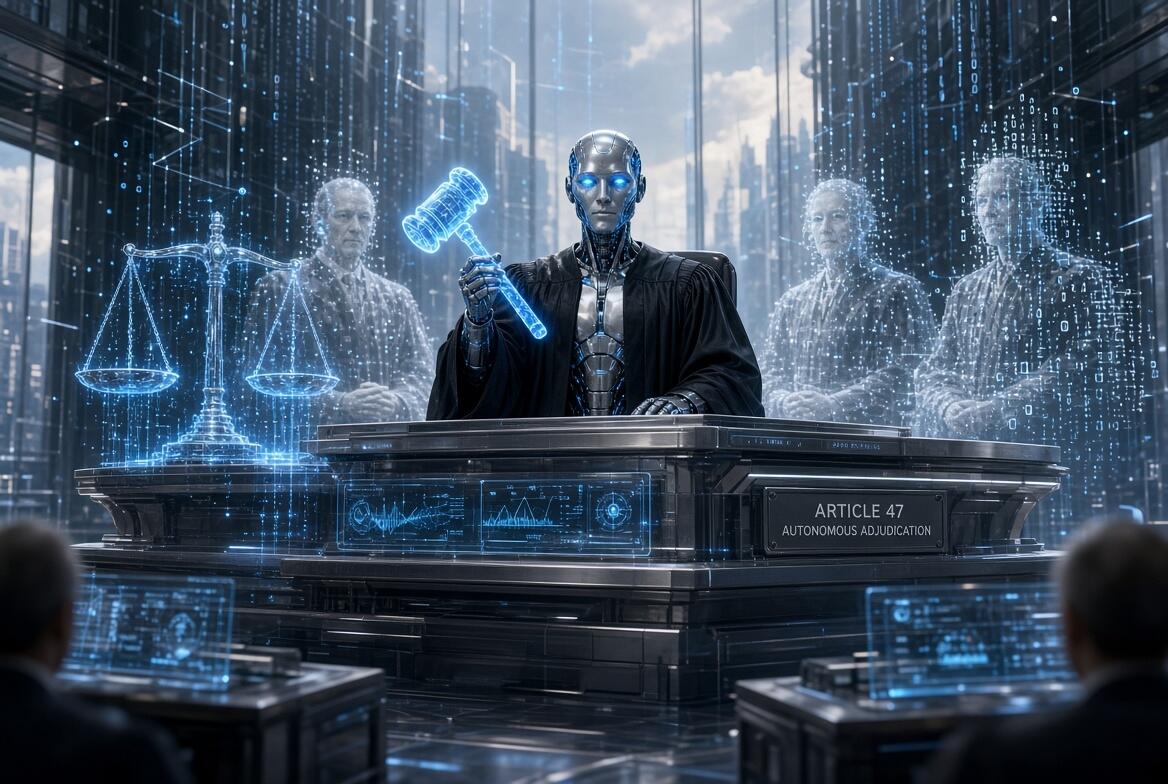
There is growing interest in whether an “ai” or, artificial intelligence judge can make better rulings than a human one.
This is understandable as many legal decisions are either wrong or flawed in some critical way.
Partisan politics and “lawfare” also continue to corrupt the legal system to a degree that has undermined its fundamental credibility, including public trust.
No one knows better than President Trump who was maliciously prosecuted as a civilian.
Down in the trial courts where legal arguments start, many of the facts of a case get ignored by the court, or never get a fair hearing because they are denied on technical grounds, or from favoritism, or corruption.
Critical facts are also not discovered or recognized due to human error, or lack of relevant subject competence.
When a case then gets bumped up to an appeal, the appellate courts are even more removed from facts. They may reverse on procedural mistakes, or if a particular statute or law was thought to be seriously misinterpreted, but appellate courts are notorious for affirming lower court rulings because sending a case back to the trial court implicates their judicial colleagues and hurts their record.
In law school, the judges, moreover, were originally trained almost entirely by reference to these abstract appellate cases, and usually don’t get their hands dirty on the nitty gritty of trial court facts.
This is a mistake, and often produces judges with a sense of the law as a separate, rarified intellectual exercise. This also lets personal bias creep into their method of thinking because bias can hide behind obscure law language that often appears little more than a legal “magic spell.”
The term “legal reasoning” is an old concept, but it comes with costs: it rests on interpretations of prior rulings, or precedent — and the majority of those have problems. The errors therefore keep compounding. Those errors are rarely caught by subsequent judges who assume the facts are settled.
But another factor that is slowly bringing the use of AI into the legal system, involves the widespread corruption, and human abuse, of the law itself. Partisan judges can rule based on political party allegiance, and sometimes without recognizing it. That’s how the human mind works. AI doesn’t.
The term “lawfare” also didn’t come out of thin air: it is the human manipulation of the normal legal system by lawyers or prosecutors who bring malicious charges, and then rely on judges who are not difficult to persuade. That is partly because most judges have limited if any experience in business, technology and even work: they came out of law school, went straight into law or worked as law clerks, and their entire frame of reference is the internal culture of the system they are in. The charges have all the appearances of legal formalities that they are used to, so they get processed as if they were legitimate.
Judges are also under pressure to manually process their caseloads, consisting of mountains of paperwork that clog up the system, most of which is never carefully studied, or read. Their own careers, and retirement interests, can short-circuit their willingness to think hard about the arguments before them. Judges are also risk-averse, especially when cases and facts may be controversial. AI doesn’t worry about controversy.
Law professor and federal appellate judge, Frank Easterbrook, in his increasingly criticized ruling in Klaassen, is an example. It concerned Indiana University student appeal over constitutional violations of their medical privacy. The court ruled against them by relying on an antiquated, irrelevant case from the year 1906. The court used “precedent” not to reason, but to simply process a decision, and ignored medical evidence, political facts, and law itself. At the time, judges were “all in” on the Dr. Fauci fraud, which was also reinforced by institutions including the CDC and NIH, which made any doubts, in their minds, beyond the necessity of critical thinking.
What would an AI judge have ruled? It would have been more capable, theoretically, of making a massive sweep, and test, of statistical data concerning documented COVID medical risk, the chemical analysis of vaccines, the regulatory lapses, and corporate profit accounting, including from medical providers.
The constitutional law interpretations of the First Amendment, and the Establishment Clause of religious rights, were also clear, but ignored by the court. Judges on the bench, and in the Bar, can be motivated to protect their own closed system: legal precedent, even if utterly irrelevant to new facts, is a method of reinforcing that system. AI has no culture to protect.
Some elite law schools, such as the University of Chicago, are claiming that they are providing a “template for law schools around the world” by the way AI is simply added into their curriculum. In some cases they are providing public presentations that report on how AI compares with human judges in case decisions. Their larger teaching posture, however, is that AI is just an elective, and creates no underlying disruption to the traditional law degree. It is still business as usual. They’re likely wrong.
What schools like UChicago are really representing, is an AI policy for the ABA law school system, asserting their legacy institutional domain over technology which threatens to replace them. Apparently, doing things the way they’ve always been done is their template for the future.
The entire legal system from schools to firms to courts, don’t have a firm grasp on what the larger AI strategic implications are. Few are acquainted with, or understand, the AI data centers that are being built across the U.S. The number of such centers already reaches into the thousands.
So, what are they for?
Some observers point to them as being modern high-tech replacements of an older industrial, mechanical system, and a “21st century” infrastructure backbone in a new vision of the future. Certainly in logistics, commercial order fulfillment, customer data, government records and other uses, it is powerful. But there’s much more to it: networked data centers that blanket the country, represent a strategy to replace many human systems.
In law, this strategy is seductive, especially if you look back on the way the DNC and its progressive donors abused the legal system by human intervention and political corruption — and got away with it. Illegally changing voting rules under pandemic pretext is an example. The targeting of a former U.S. president with malicious prosecution, fully enabled by corrupt judges, is another prominent example, and a powerful rationale for current legal system modification.
The federal courts operate under congressional authority, and Congress can remove them. That, combined with the use of AI threatens the status quo. AI can more efficiently find and gather facts, while filtering or exposing legal mistakes and procedural irregularities, including tracking the affiliations and records of judges.
AI also puts legal education on trial, and may signal significant changes.
Tyler Durden
Sat, 08/15/2026 – 18:40

