

China Economic Growth ‘Downside Risk’ Looms; Goldman Warns After July Macro-Miss-Fest
China’s July activity data weakened from June, missing market expectations across the board, and signaling a soft start to Q3 amid continued divergence between resilient exports and subdued domestic demand.
Originally slated for publication late last night (US time), the data release was delayed for five hours after the statistics agency revised its schedule in a break with recent practice.
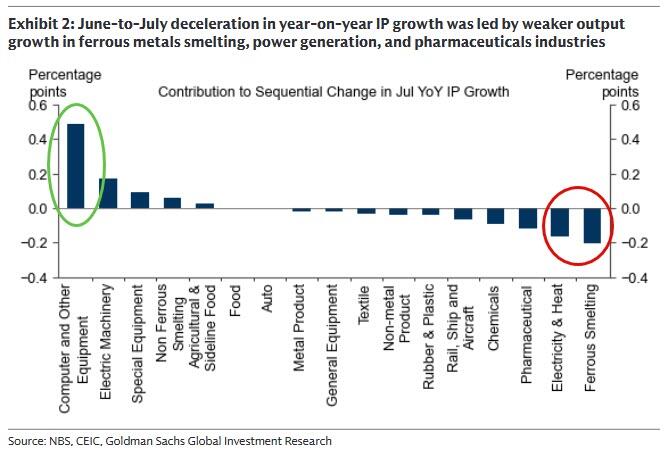
Industrial production (IP) growth slowed to 4.5% yoy in July from 5.3% yoy in June, reflecting slower export growth and weaker output growth in ferrous metals smelting, power generation (fell 0.1% y/y to 943.9b kwh), and pharmaceuticals industries.
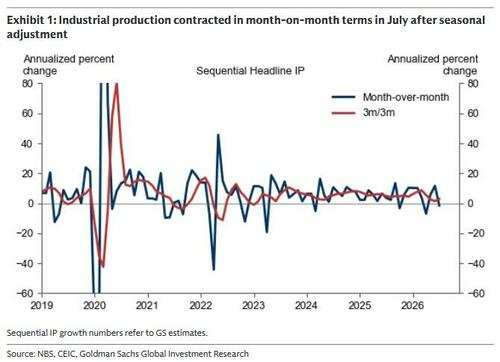
In sequential terms, IP contracted 0.3% mom non-annualized in July (vs. +1.0% mom non-annualized in June), broadly consistent with last year’s pattern of softer quarter-start momentum.
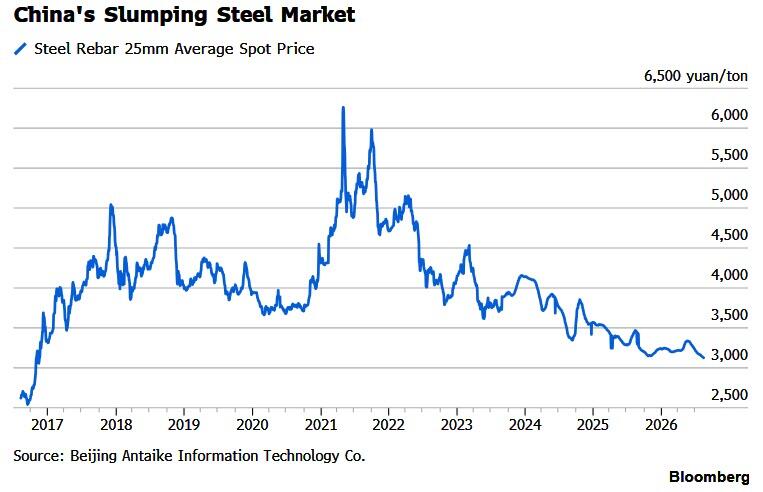
One stand out from Chinese steel production tumbled last month, putting the industry on track for the lowest annual total this decade as mills adjust to much weaker demand.
The seasonal lull in consumption has been compounded by worsening conditions in the wider economy.
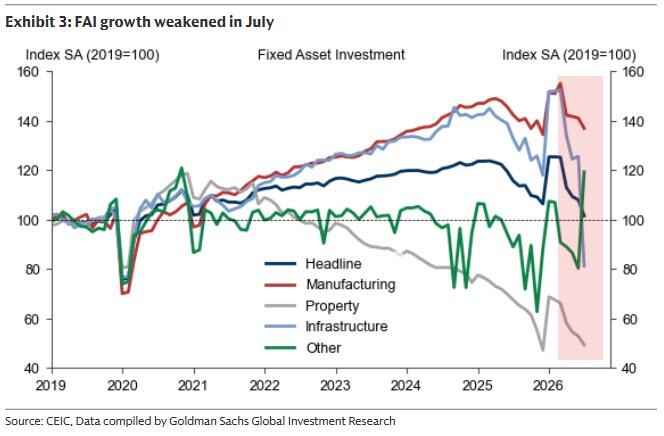
The contraction in construction activity has deepened, according to the latest purchasing manager index, while fixed-asset investment has fallen dramatically, the data from the statistics bureau showed.
Fixed asset investment (FAI) growth fell to -12.8% yoy in July from -9.3% yoy in June on a single-month basis despite a low base, as unfavorable weather and slow government spending continued to weigh on investment activity.
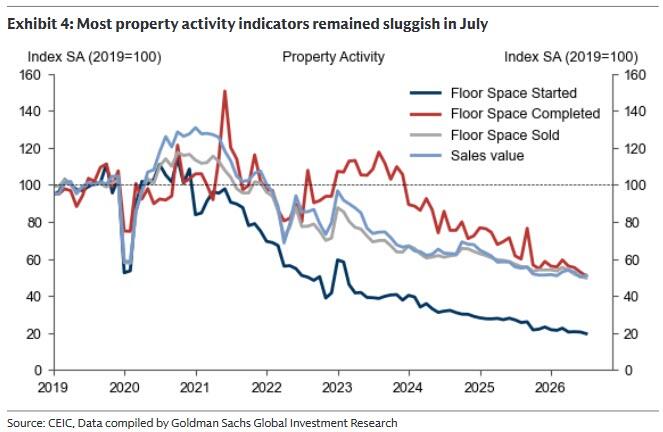
Property activity remained sluggish in July despite recent green shoots in some large cities. Property sales fell 13.5% yoy in volume (floor space) terms and 8.8% yoy in value terms in July (vs. -14.2%/-13.9% in June). Growth in new home starts and floor space under construction weakened to -27.8% yoy and -12.7% yoy, respectively, in July from -26.0% and -12.5% in June. New home completions remained soft at -18.7% yoy in July, though less negative than -25.0% yoy in June. NBS and private-sector data suggest nationwide home prices remain under downward pressure, even as some large cities show early signs of stabilization.
Retail sales growth eased to +0.6% yoy from +1.0% yoy in June despite favorable base effects, mainly dragged down by goods sales.
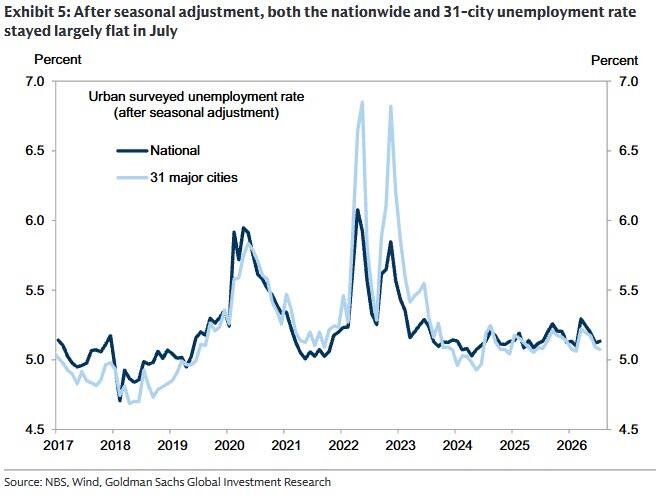
Labor market indicators were broadly stable and in line with seasonal patterns in July. The nationwide and 31-city unemployment rates, both not seasonally adjusted, edged up to 5.2% in July from 5.0% in June. On a seasonally adjusted basis, we estimate both rates were unchanged from June at 5.1%.
Finally, the Services Industry Output Index – which is reported in real terms and closely tracks tertiary GDP growth – also slowed to 4.3% yoy in July from 4.7% yoy in June.
Societé Generale SA economists including Wei Yao said the country’s growth momentum is “collapsing” outside tech.
“China’s economic data continue to disappoint, with an increasingly K-shaped pattern: strong tech, weakness almost everywhere else,” they said in a report.
In a stunningly honest statement, the NBS said that while the economy has remained “stable” so far this year, the external environment is “complicated and volatile” and domestic demand has stayed weak.
“Some companies are facing operational difficulties, and the foundation for the economy to stabilize and improve still needs to be consolidated,” it said in a statement accompanying the data release.
Finally, July activity data combined with Goldman’s high-frequency tracker for the first half of August suggest a soft start to Q3 – unfavorable weather conditions (e.g., recent Typhoon Dolphin) and the ongoing global energy shock continue to weigh on activity, while government spending has yet to pick up meaningfully despite stronger easing signals from the July Politburo meeting.
“Economic momentum slowed further in the early third quarter ahead of the late-July Politburo meeting, with all major July indicators falling short of even our low expectations,” said Bloomberg’s Chang Shu and David Qu.
“On the demand side, private consumption softened modestly, while the contraction in investment deepened sharply. This suggests fiscal spending has yet to pick up from its sluggish pace in the first half.”
Against this backdrop, Goldman sees downside risk to their Q3 real GDP growth forecast of 4.6% yoy (vs. 4.3% yoy in Q2).
They continue to expect the government to accelerate the pace of bond issuance and proceeds spending in coming months, speed up implementation of the new policy-based financial instrument, and keep the door open to additional easing later this year if growth slows further and the full-year growth target of “4.5-5.0%” comes under pressure.
Professional subscribers can read Goldman’s full note here at our new Marketdesk.ai portal
Tyler Durden
Mon, 08/17/2026 – 09:20

