

“Doom Loop” Engaged: US Debt Hits $40 Trillion As Treasury Enters The Endgame
It took the US 200 years to reach its first $1 trillion in debt. It took 95 days to add its last.
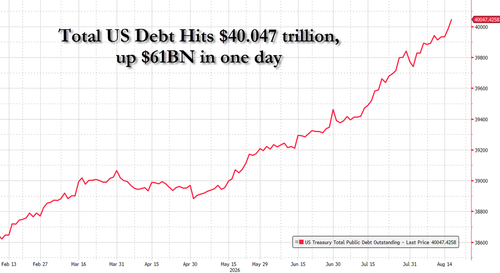
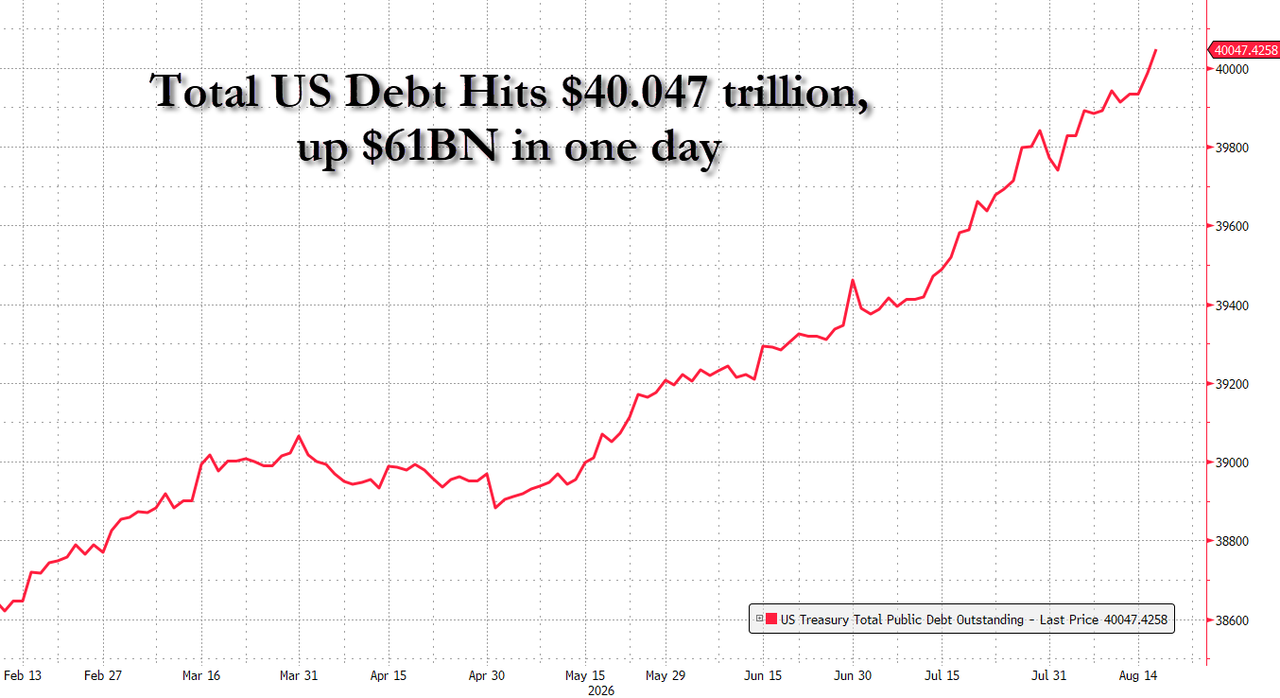
After several weeks of build up, today the Treasury announced that total public debt surpassed $40 trillion for the first time, after jumping by over $60 billion in one day, and has now surged by $1 trillion in just over three months, and by a third of the total in less than five years, as US lawmakers continue to ignore calls to contend with historically wide fiscal deficits.
The largely expected news came just hours after Treasury Secretary Scott Bessent unexpectedly announced the Treasury’s latest attempt to rein-in long-term borrowing costs from multi-year highs, the most important component of the growth in debt. The Treasury stunned the market when it said, just two weeks after the latest Refunding Announcement where it should have made this change, that it was ramping up the support for longer-dated securities by “increasing, by at least double, the size of liquidity support buyback operations for longer-dated nominal coupon securities (the 10-year to 20-year sector and the 20-year to 30-year sector).”
The announcement that sent yields plunging, if only for the time being.
Remarkably, it was less than 5 years ago that US debt hit $30 trillion back in January 2022, illustrating the rapid growth in federal borrowing needs. And there’s no end in sight.
As Bloomberg notes, “Republicans have long opposed revenue-raising tax increases,” while Democrats are best known for spending like drunken sailors to maximize socialist central planning, and both parties are loathe to sign on to politically toxic cuts to healthcare and retirement benefits for seniors. Many observers anticipate Congress and the administration of the day will only act if forced by a financial-market disruption.
That won’t stop them from talking about it all the time, though, as both parties at least pretend to understand that the US is on a catastrophic collision course should debt growth continue at this pace, and if the AI bet – which is now an all-in for virtually everyone – fails to dramatically boost productivity. Bessent, for one, said a key reason he got involved in politics was to help tackle deficits running at a pace unprecedented for times outside of major wars, pandemics or depressed job markets. So far he has failed catastrophically, and worse, he is doing precisely the kind of activist issuance “Twisting” for which he bashed his predecessor, Janet Yellen.
Economists, the Congressional Budget Office and Wall Street all see little or no progress in coming years for the deficit-to-gross domestic product ratio.
“Optically, I’m sure crossing thresholds like $40 trillion will focus attention on the issue in the near term,” said Matthew Luzzetti, chief US economist at Deutsche Bank AG. “But it does not represent a magical threshold for debt dynamics, and projections have anticipated this outcome for some time.”
More important, Luzzetti said, is the climb in US Treasury yields, which is steadily increasing the cost of servicing the record debt load. Last Thursday, the department’s latest 30-year bond auction resulted in the costliest such sale in a quarter century. A 10-year auction a day earlier drew the highest financing cost at that tenor since 2007, and only today’s announcement which sent yields tumbling prevent today’s 20Y Treasury auction from pricing at the highest yield on record.
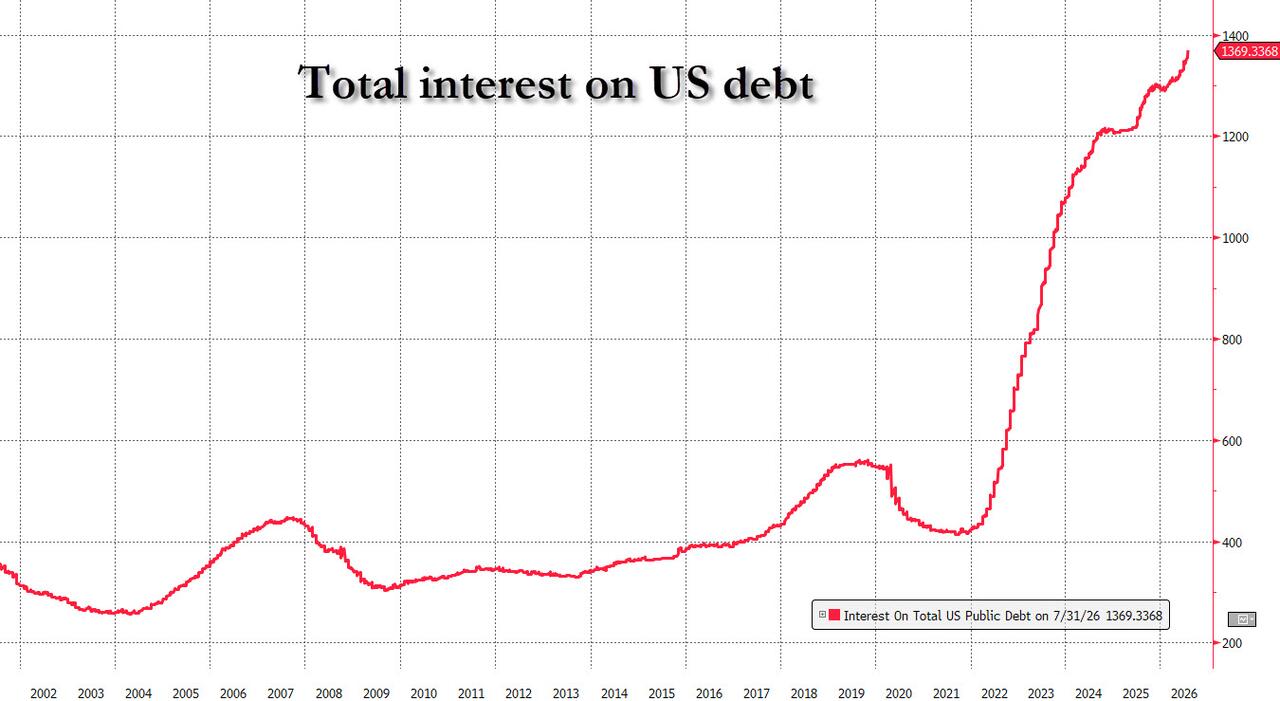
As buyers demand higher yields, that in turn drives up the Treasury’s borrowing needs. With two months left to go in the fiscal year, the government’s tally for interest costs so far for 2026 is $1.37 trillion – a 20% increase on the same period a year before. That in turn adds to the debt, potentially fueling further investor calls for higher rates, in a pattern known as a “doom loop.”
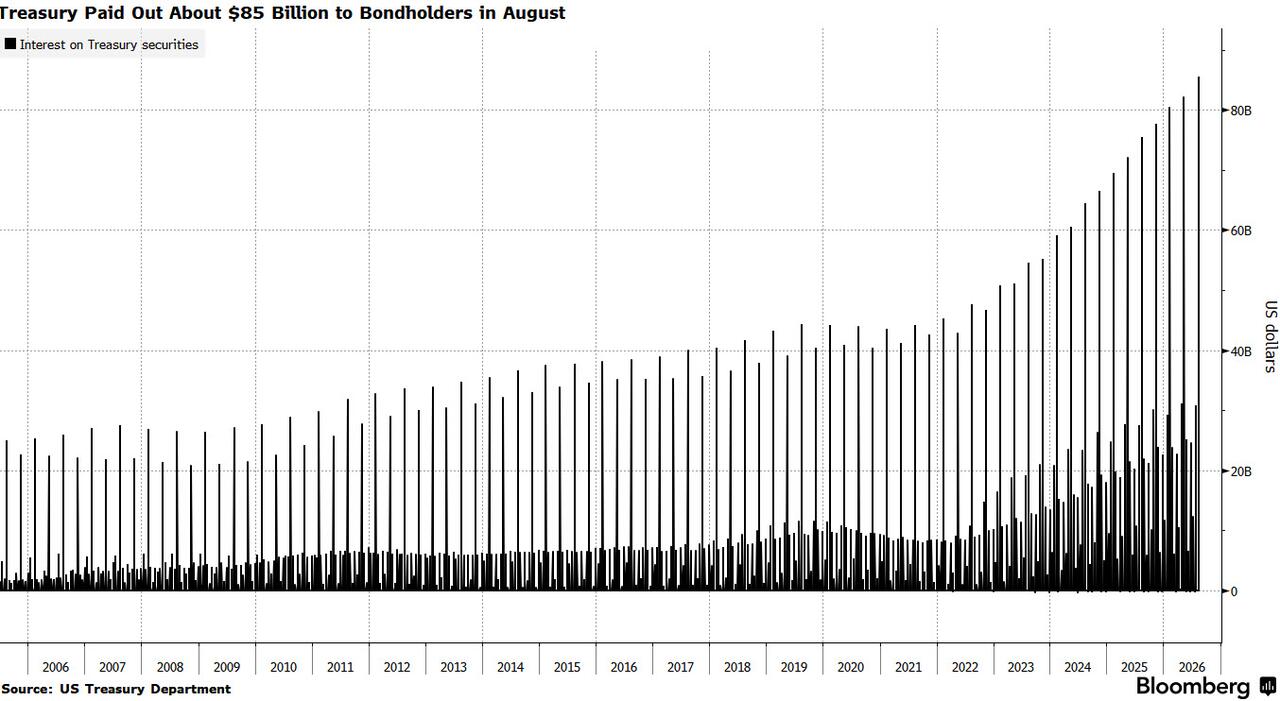
For a visual of said doom loop, consider that the Treasury paid out about $85 billion to bondholders in its semi-annual coupon payment on Monday, the largest on record. For comparison, the Treasury paid out $75 billion of interest at the mid-month settlement period in August 2025 and about $80 billion on Feb. 17.
Interest costs are now the third-largest part of the budget, surpassing healthcare and just behind Social Security. However, at $1.6 trillion, Social Security will be topped by gross interest no later than 2026.
It gets worse: thanks to the AI bubble – and specifically the AI debt bubble which we correctly spotted one year ago and which the market is only now starting to freak out about – the record debt issuance to fund capex is now starting to crowd out of demand for US paper. This means that very soon, the US government will have to decide: keeping the electorate happy, or funding data centers so they can buy the latest massively overpriced memory chips needed to run the latest chatbot. Incidentally, those soaring memory costs are now adding about 0.5% to core PCE, a number which the admin will soon realize is very politically unpopular, and will lead to a historic crackdown on hyperinflationary memory and semiconductor prices.
“The federal budget is the enemy within,” Douglas Holtz-Eakin, president of the American Action Forum and a former director of the CBO, wrote in a note Monday. “It is the greatest threat to the foundations of economic progress, U.S. international economic standing, and national security. The only reason for optimism should be material actions to rein in the sea of red ink. There are no such material actions.”
He is right, of course: the only time there can be material actions, is when the bond vigilantes crash the market, yet actions such as those by Bessent today assure that said day was just punted several weeks or months into the future, again and again.
But wait, because there is even more: all of the above assumes no recession, no crises, no emergencies for the foreseeable future. Well, consider that US debt exploded higher during the most recent economic downturns tied to the global financial crisis and the Covid pandemic. During those periods, revenue slid as tax-paying workers lost jobs, and assistance payments jumped. One can only imagine where US debt will be after the next recession/pandemic/hot war.
Going back to Bessent, the current Treasury secretary came into office in 2025 touting a budget deficit target of around 3% of GDP by the end of President Donald Trump’s second term, which concludes in January 2029. It’s not clear how that will possibly happen: as of July the ratio is 6% and rising… and will keep rising the longer the AI bubble drains demand for US long-dated paper.
Meanwhile, according to recent reports, Trump is seeking to galvanize support ahead of the November midterm elections, and is looking at new tax-cut promises in addition to increases in defense spending, both of which will supercharge the deficit and lead to even more debt. Meanwhile, the Elon Musk-led 2025 Department of Government Efficiency effort, which sought to slash discretionary spending including on contracts and government buildings, failed to cut outlays as much as DOGE’s own estimates projected.
And then there is the next round of political theater: the current pace of debt accumulation…
We’ll take the over https://t.co/Gw0yfjylXR pic.twitter.com/Abq2dtPtrx
— zerohedge (@zerohedge) August 19, 2026
… means that the government has about 4 or 5 months before it again hits the debt ceiling of $41.1 trillion. Hitting that marker is expected to trigger another in the series of partisan showdowns in Washington over the years to head off a potentially devastating US payments default.
“The government has not taken meaningful actions to address the large general government fiscal deficits,” Fitch said. “Spending pressures will mount over the next decade due to an aging population.” The country will be “vulnerable to future economic shocks” as debt levels increase, the rating company said.
For Fitch, talk is cheap: instead of downgrading the US credit rating, one week ago Fitch reaffirmed the US at AA+, assuring that absolutely no remedial step will be taken, and that the next debt crisis will be cataclysmic.
“Hitting this big round number will hopefully send a wake up call throughout Washington,” said Michael Peterson, who chairs the Peter G. Peterson Foundation, a research group, in regard to the $40 trillion. “It will hurt everyday affordability across the country if we don’t get our debt under control,” he said.
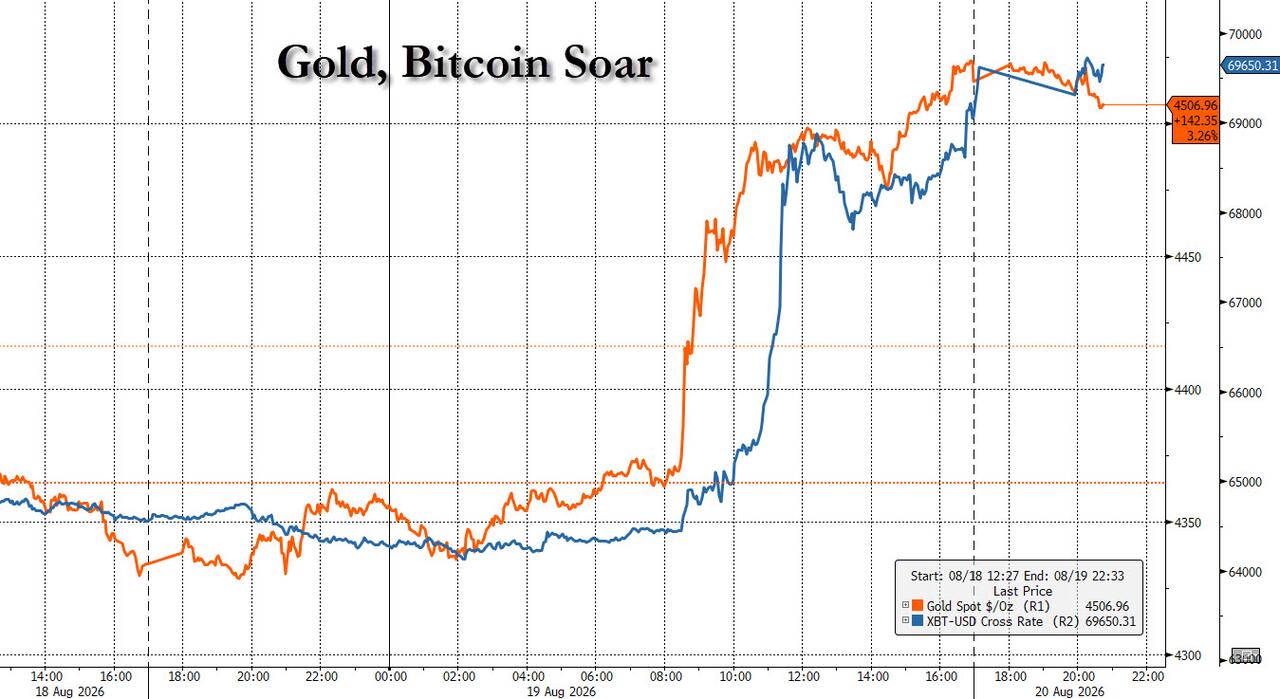
He is wrong: everyone knows that the US is on a historic collision course with destiny. The only wake up call was for gold and bitcoin algos, both of which finally woke up from a bizarre slumber, sending both real and digital gold soaring.
Tyler Durden
Wed, 08/19/2026 – 21:10

