

Q2 GDP Grew At Modest 1.5% According To Latest Revision, As Expected
While far less relevant than the rest of today’s data barrage, including the core PCE report and Durable Goods data which showed a mixed real-time picture of the economy as core prices rose more than expected while core CapEx missed expectations, the BEA also reported its second revision of Q2 GDP data – yes, for the quarter ended June 30 or almost two months ago – and which came in at 1.5%, right on top of expectations, and unchanged from the previous estimate.
According to the BEA, contributors to the increase in real GDP in the second quarter were increases in consumer spending, exports, and investment that were partly offset by a decrease in government spending. Imports, which are a subtraction in the calculation of GDP, increased.
Compared to the first quarter, the deceleration in real GDP in the second quarter reflected a downturn in government spending and decelerations in investment and exports that were partly offset by an acceleration in consumer spending. Imports increased more in the second quarter than in the first quarter.
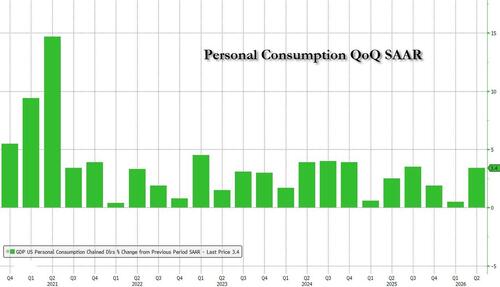
As shown in the chart below, virtually all growth in Q2 GDP came from personal consumption, which added 2.31% to the bottom line 1.5%, GDP print, or more than all of it. On an annualized basis, personal consumption rose 3.4% q/q, beating the 3.2% median estimate and also advance reading.
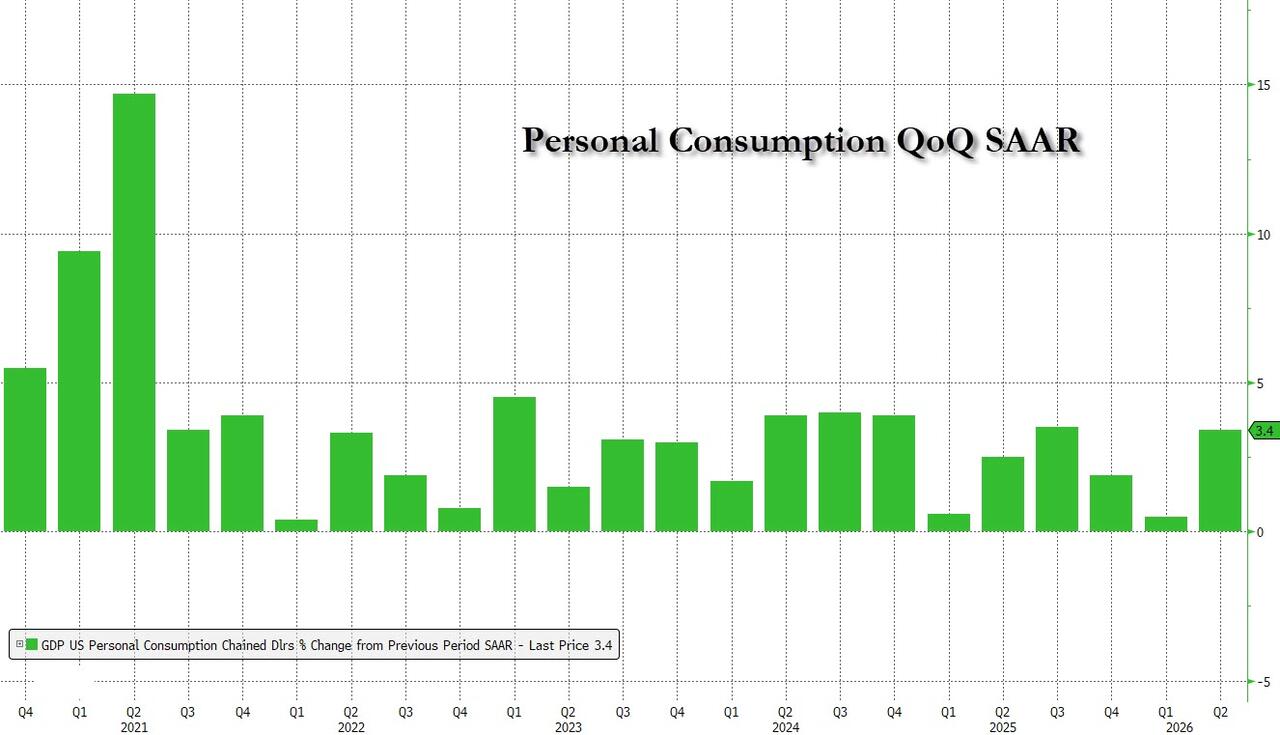
Another 1.2% came from Fixed Investment, all of which was the result of non-residential construction (data centers and intellectual property products). On the other end, Net Exports subtracted a total of 1.14% from the bottom line GDP print while the change in private inventories detracted another 0.72%. Finally government erased another 0.16% from the GDP print.
There was some better news when it comes to real gross domestic income (GDI) which increased 2.2% in the second quarter, compared with an increase of 1.2% in the first quarter. The average of real GDP and real GDI increased 1.8%, compared with an increase of 1.7%.
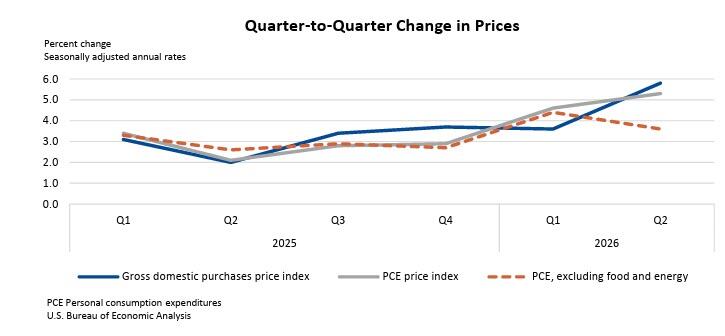
And while it is especially irrelevant in light of today’s much more up-to-date core PCE data, the price index for gross domestic purchases increased 5.8% in the second quarter, revised up 0.1% point from the previous estimate. The personal consumption expenditures (PCE) price index increased 5.3% revised up 0.2%, and the PCE price index excluding food and energy increased 3.6%, also revised up 0.2% point. However, as noted previously, this is for a quarter that ended 2 months ago so ignore all of the above.
Finally, profits from current production (corporate profits with inventory valuation and capital consumption adjustments) increased $400.9 billion in the second quarter, compared with an increase of $74.4 billion in the first quarter
Tyler Durden
Wed, 08/26/2026 – 08:45

