

The Mother Of All Mean Reversions: Commodities Have Never Been This Cheap Versus Stocks
Across Wall Street, from Barclays and UBS to HSBC, JPMorgan and Goldman Sachs, a common view is taking shape: physical scarcity is emerging across multiple commodity classes, driving prices sharply higher and signaling a broader hard-asset squeeze.
Last week, UBS strategist Sagar Khandelwal issued a similar call heard across Wall Street, telling clients to “position for a commodity upcycle.”
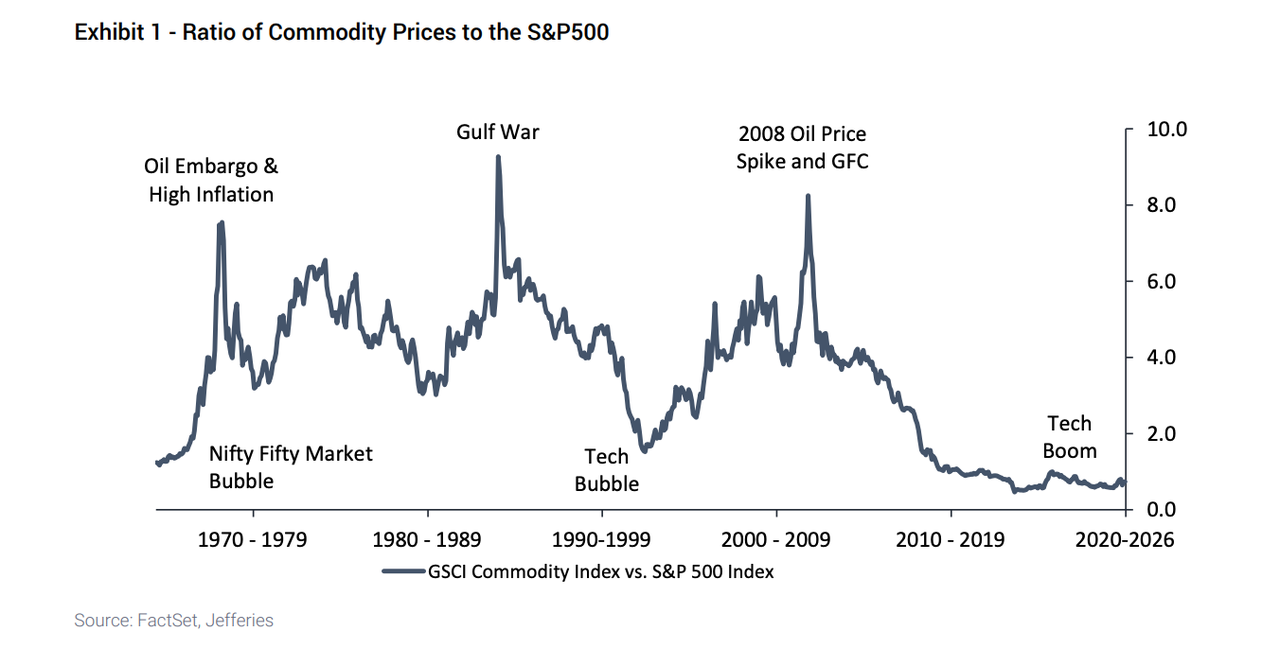
On Saturday, Christopher LaFemina, who heads Jefferies’ global metals and mining research and is one of Wall Street’s veteran commodity experts, told clients that commodities remain historically cheap relative to US stocks.
LaFemina compared the S&P GSCI with the S&P 500, showing the ratio hovering near its lowest level in more than five decades. Similar troughs emerged during the Nifty Fifty and dot-com bubbles before commodities sharply outperformed stocks.
Previous upcycles in the ratio coincided with the 1970s oil embargo and inflation shock, the Gulf War, and the 2008 oil-price surge. Today’s depressed reading comes as retail and institutional investors remain bullish up to their eyeballs on hyperscalers and memory stocks while remaining highly concentrated in a handful of other AI names. And really, what could go wrong if the AI boom begins to deflate?
The trough in the ratio comes as traders ignore commodity markets, where the theme of scarce physical resources is rearing its ugly head:
- Got Hard Assets? UBS Says “Position For A Commodity Upcycle” As Global Scarcity Emerges
- Barclays Warns Next Commodity Shock Is Taking Shape: What You Need To Know
- “Buffers Running Down Quickly”: HSBC Warns Next Global Food Shock Brewing
- The AI Boom Runs On Tungsten, But Global Supplies Are “Running On Empty”
Agricultural prices are soaring; copper is trading above $14,000 per ton in London; tungsten is above $3,000 per ton; uranium is back above $90 per pound; and many other critical materials (seen as the building blocks for the AI boom) are surging as demand accelerates. Electrification, AI buildout demand, rising power consumption, geopolitical fragmentation, including China’s weaponization of export supplies (tungsten and germanium), and years of underinvestment are colliding to create a perfect storm of constrained supplies across energy, metals, and other raw materials.
Agricultural commodities have just broken decisively above nearly 20 years of resistance.
And this is happening while:
▪️Diesel prices approach all-time highs
▪️Mortgage rates hover near 7%, with housing already deeply unaffordable
▪️Wealth inequality stands near historic… pic.twitter.com/rgJfZgUPBC— Otavio (Tavi) Costa (@TaviCosta) August 29, 2026
“The 10-year rolling change in the US dollar remains one of the most important macro developments in the world today,” Azuria Capital’s Otavio Costa wrote on X.
The 10-year rolling change in the US dollar remains one of the most important macro developments in the world today.
We are likely witnessing the beginning of a secular decline in the dollar — a necessary adjustment to the significant trade deficit the US economy faces today.… pic.twitter.com/uWqXcX3QUr
— Otavio (Tavi) Costa (@TaviCosta) August 30, 2026
It’s time to focus on “scarcity in the physical world,” according to veteran commodities strategist Jeff Currie, who also warned, “The illusion of abundance is likely behind us.”
Tyler Durden
Sun, 08/30/2026 – 16:20

