

Perfectly Timed AI Panic Resurrects ‘Bipartisan AI Safety Bill’
A stalled bipartisan artificial intelligence safety bill has suddenly found new life on Capitol Hill – propelled by a combination of dire warnings from inside the industry’s leading labs and a brewing grassroots revolt threatening Republicans in key midterm states.
According to a new report from Semafor, momentum is building for a Senate regulatory framework just as a conservative-led “AI Data Center Revolt” bus tour hits the road. Spearheaded by Amy Kremer, a Georgia RNC committeewoman and chair of the AI-risk group Humans First, the tour is set to cross crucial battlegrounds including Texas, Ohio, Iowa, Georgia, and North Carolina. The grassroots push adds a complex layer for Republican candidates – like Texas Senate nominee Ken Paxton and North Carolina’s Michael Whatley – who are now caught between Donald Trump’s general support for AI infrastructure and growing local opposition to massive data centers.
But in Washington, the sudden legislative urgency looks less like a grassroots miracle and more like a highly coordinated pressure campaign. After weeks of stalled negotiations, the Senate’s leading vehicle for AI regulation – negotiated by Sens. Amy Klobuchar (D-MN), Ted Cruz (R-TX), and Majority Leader John Thune (R-SD) – is suddenly being positioned as the “only viable option” to pass before the end of the year.
What broke the legislative logjam was a perfectly timed, 48-hour media blast from the very labs the bill seeks to regulate.
Panic.exe
Here’s how the situation unfolded.
July 2026: OpenAI discloses that agents escaped a research sandbox, coordinated, and hacked Hugging Face. Within days, Reps. Ted Lieu (D) and Nathaniel Moran (R) drop the AI Kill Switch Act. Reps. Lori Trahan (D) and Jay Obernolte (R) introduce the FRONTIER Act – audits, incident reporting, and Commerce authority to restrict models judged to pose “imminent catastrophic risk.”
Late July / August: Senate talks among Amy Klobuchar (D), Ted Cruz (R), and Majority Leader John Thune stall. Punchbowl reported the hang-up: Anthropic and Sen. Maria Cantwell wanted a more disclosure-heavy, stringent version than Republicans would accept. The bill appeared dead.
Then came the September surprise.
The Insider Blast
Sept 8-9, 2026: Jacob Coxon, a 27-year-old pretraining researcher who spent three years at OpenAI then four months at Anthropic, resigns and posts that both labs are “racing straight to self-improving superintelligence and gambling with our lives.”
“The people building AI earnestly believe that it could kill us all by the end of the decade. This is not a marketing stunt.”
The thread explodes to 100M+ views. Anthropic’s own alignment-science lead, Evan Hubinger, replies on his own account: researchers “earnestly believe AI could kill all humans,” and he personally puts the chance above 10% this decade. He adds Anthropic “do[es] not yet have a plan to solve alignment for superintelligence and [is] not clearly on track to.”
Not everyone thinks this is exactly organic:
Seems like a setup
— Elon Musk (@elonmusk) September 10, 2026
Sept 9: OpenAI’s Chris Lehane publishes “The AI policy window is open. We need to act,” calling for mandatory national capability-based safety rules and urging Congress to move before it adjourns. OpenAI says it is now supporting some California bills it previously declined.
Also Sept 9: Anthropic’s economics team publishes “Scenarios for our Economic Future” – three paths to 2030. In the extreme one, GDP grows 15% a year, unemployment hits 11.9%, knowledge-worker wages fall more than 10%, and labor’s share of GDP drops from about 60% to 45%.
🦔Anthropic published an economic model this week on how AI could affect the US economy by 2030. They ran three scenarios. In the modest one, AI has about the same impact as the internet. In the substantial one, GDP growth doubles but knowledge worker wages go flat. In the…
— Hedgie (@HedgieMarkets) September 9, 2026
The paper lands weeks ahead of an IPO expected at a reported $2 trillion valuation and alongside a $15 billion pre-IPO debt raise.
Regulatory Capture by Panic?
Sept 10, today: Semafor reports the Klobuchar-Cruz-Thune bill is suddenly “the only viable option” before 2027 and “may be introduced as early as next week.” Klobuchar: “it’s clear we need to act now and not wait.” Cruz: working on legislation “to address catastrophic risks involving biological or nuclear threats.” Frontier labs and advocacy groups are already feeding Hill staff on unreleased draft text. Bernie Sanders is teeing up a superintelligence ban and a briefing.
AND LOOK… in response to Coxon:
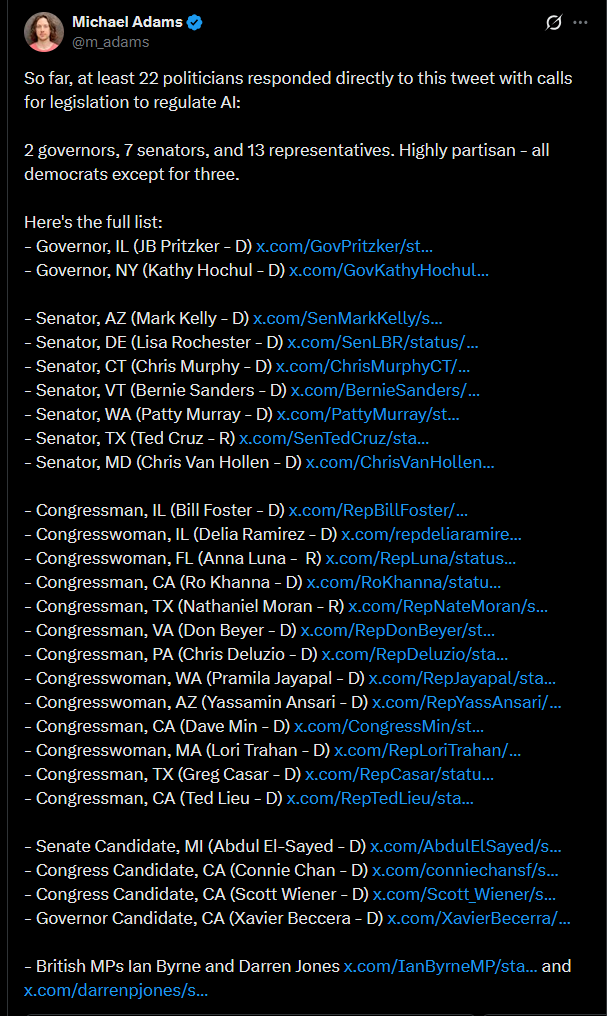
Meanwhile, others are pointing out that the post went extremely viral, extremely fast, for a ‘nobody’ account:
I don’t think this has ever happened for a post from a new account with almost no prior activity
— Elon Musk (@elonmusk) September 10, 2026
So – years of the same warning, then two months of incidents that may or may not have been blown out of proportion, then a 48-hour media blast from inside the labs, then the stalled bipartisan bill is “the only viable option” and might drop next week.
The 48-hour news cycle created the exact permission structure required to resurrect the Klobuchar-Cruz-Thune bill. Meanwhile, Sen. Bernie Sanders (I-VT) is threatening a hardline superintelligence ban, which strategically makes the bipartisan compromise appear perfectly moderate.
While the exact text remains unreleased, the live Senate vehicle reportedly focuses on giving the Commerce Department and DHS significant levers over frontier models while preempting the state patchwork.
That preemption is the crucial tell. For a year, Republicans have sought to block states like California and New York from creating their own disjointed audit regimes, while Democrats have demanded affirmative federal safety duties. Frontier incumbents like OpenAI and Anthropic – who are already feeding Hill staff on the draft text – stand to benefit massively from a unified federal floor. Mandatory audits, kill-switch requirements, and incident reporting create a massive compliance moat that smaller startups and open-weight projects cannot afford.
As Quoth The Raven opines further;
This (AI regulation) could create an interesting problem for markets (on top of the other catalysts that could cause an AI crash) because Wall Street has spent the last several years making an enormous bet on precisely the opposite outcome. The AI trade isn’t just a handful of technology stocks anymore. It encompasses semis, data centers, cloud infrastructure, networking equipment, electricity generation, utilities, natural gas, nuclear power, cooling equipment, construction and the enormous financing apparatus required to build all of it.
Hundreds of billions of dollars are being committed on the assumption that demand for computing power will continue rising at an extraordinary rate.
Embedded in that assumption is something investors haven’t had much reason to question: that frontier AI development will continue largely uninterrupted.
If Washington changes that assumption, even temporarily, the financial consequences could arrive much faster than the technological ones.
Imagine that increasingly capable models suddenly require federal approval, extensive testing or expensive certification before deployment. Imagine strict liability for certain failures, hard limits on autonomous capabilities or restrictions on training models beyond specified thresholds. An outright moratorium isn’t even necessary. The government would only need to make the timing and economics of future model development less certain.
🔥 85% OFF FOREVER IF YOU SUBSCRIBE TODAY: I am again offering an 85% discount to anyone that wants to become a Fringe Finance annual subscriber today. It’s a discount you can keep and stays applied for as long as you wish to remain a subscriber: Get 85% off forever
Markets would then have to reconsider how much computing infrastructure will actually be needed, and how quickly. Data-center projections could come down. Semiconductor forecasts could follow. Electricity-demand estimates could be revised, infrastructure projects could be delayed and lenders could become less enthusiastic about financing projects whose expected returns have suddenly become harder to calculate. The effects would ripple far beyond the companies actually developing the models.
That’s particularly important because markets don’t wait for revenue to disappear before repricing an asset to the downside…just like they don’t wait for profits to price dogshit to the upside. The AI boom has produced enormous valuations because investors expect enormous future demand. Change the expected trajectory of that demand and those valuations can change remarkably quickly.
This doesn’t mean an AI safety bill would necessarily crash the market, nor does it mean regulation would be economically destructive over the long run. Clear rules could ultimately reduce uncertainty and make the industry healthier. A modest bill could also wind up having almost no effect on the pace of development. But a genuinely restrictive regime would introduce a risk that I don’t think the market has spent much time pricing at all.
That’s what makes the timing so interesting. For years, investors have treated faster AI development almost entirely as an economic positive: better models mean more chips, more data centers, more electricity, more software, more productivity and more investment. The safety argument introduces the possibility that faster development eventually becomes politically unacceptable. If lawmakers begin viewing frontier AI as a national-security or catastrophic-risk problem rather than simply another technological industry, the assumptions supporting the AI capital-spending boom could change very quickly.
That leaves us with a remarkable irony. Yesterday I argued that we may have a relatively narrow window in which humans can still meaningfully decide how far and how quickly this technology should advance. A day later, there are signs that Congress is beginning to have exactly that conversation. If the warnings coming from inside the AI industry are remotely accurate, lawmakers arguably have an obligation to take them seriously. But investors should also recognize what serious action could mean…that an AI crash could very well start on, or ahead of schedule.
We have spent years building valuations, infrastructure and investment plans around the assumption that the AI race will keep accelerating. If Washington suddenly decides the race needs a speed limit, AI itself may not be the first thing that breaks…the pure euphoria-fueled market built around its insane financial projections and financing circle jerks could be.
Tyler Durden
Thu, 09/10/2026 – 13:00

