

NY Lawmaker Launches $30 Million Effort To Coordinate Democrat Control Of AI
New York Assemblymember Alex Bores is launching a $30 million effort to unite Democrats behind a common artificial intelligence regulatory agenda ahead of the 2028 elections, taking the issue that defined his unsuccessful congressional campaign to a national stage.
His congressional run was bankrolled by Anthropic’s political money, a PAC funded with $20 million from the company and $401,250 from its employees, and his new group has not said who is funding it.
The organization, “Who Decides,” is launching Tuesday with Bores and his former chief of staff, Anna Myers, leading an effort to “build the winning Democratic answer to AI.” Its objective is to turn concerns about the technology into a shared platform for Democratic candidates, from presidential contenders to candidates further down the ballot.
“Who Decides’ goal is that by 2028, Democratic candidates from the top of the ticket on down run with a common AI safety agenda,” the group’s launch announcement states. “That means addressing the harms people already see and the broader danger that increasingly powerful and out-of-control systems could destabilize our economy, our democracy, and our safety.”
The group plans to concentrate on 11 states it identifies as important to the 2028 presidential primary and general election: South Carolina, Nevada, New Hampshire, New Mexico, Michigan, Virginia, Arizona, Georgia, North Carolina, Pennsylvania and Wisconsin. Its plans include quarterly state and national polling, national conferences and partnerships with local organizations, Politico reports.
Those partnerships would bring together labor unions, parents, educators, civil-rights organizations, faith groups and other constituencies. The organization says it will work with those groups to develop AI policy positions and put them before candidates through questionnaires, forums, endorsements and briefings.
“We don’t let five people write the laws for hundreds of millions of Americans,” Bores says in the announcement, referring to the concentration of decision-making among AI executives. “There is no reason to let them write the rules for AI.”
An Organizing Push Ahead Of 2028
The launch follows a series of warnings from within the AI industry and competing political responses over how aggressively Washington should intervene. Former Anthropic and OpenAI researcher Jacob Coxon warned last week that increasingly powerful AI could threaten humanity. Leaders at Anthropic and OpenAI subsequently called for slowing development so safety measures could keep pace.
Former President Barack Obama has urged Democrats to make AI a central political issue, with plans addressing both safety and the technology’s economic consequences. His comments included a call for the party’s 2028 presidential candidates to focus on the issue.
The launch comes days after AI techbros agreed that a ‘pause’ in development was needed along with new oversight (something Beijing won’t agree to). In a Saturday essay which set off the calls to slow down, Anthropic CEO Dario Amodei proposes governance that lives largely inside the industry: third-party evaluators embedded in the labs on terms the labs set, with the right to publish their findings; coordination among frontier companies on safety standards, enabled by a narrow antitrust waiver from Washington; and, only later, agreements with foreign governments. He calls federal regulation of every frontier lab the most effective approach but argues that passing laws takes time. Who Decides starts from the premise that “a few executives inside a handful of companies are making all the decisions,” and it refuses their money. The two efforts want many of the same rules, including published safety plans, incident reporting and independent testing of frontier models, and disagree about who should write them and how soon. The industry’s safety wing has already bet on Bores once: Public First Action, a PAC funded by a $20 million Anthropic donation, spent $450,000 supporting him in the primary.
President Trump pushed in the opposite direction Monday, rejecting calls for additional restrictions and arguing that existing government powers were sufficient. He also warned that slowing American development could benefit China.
Incest Is Best?
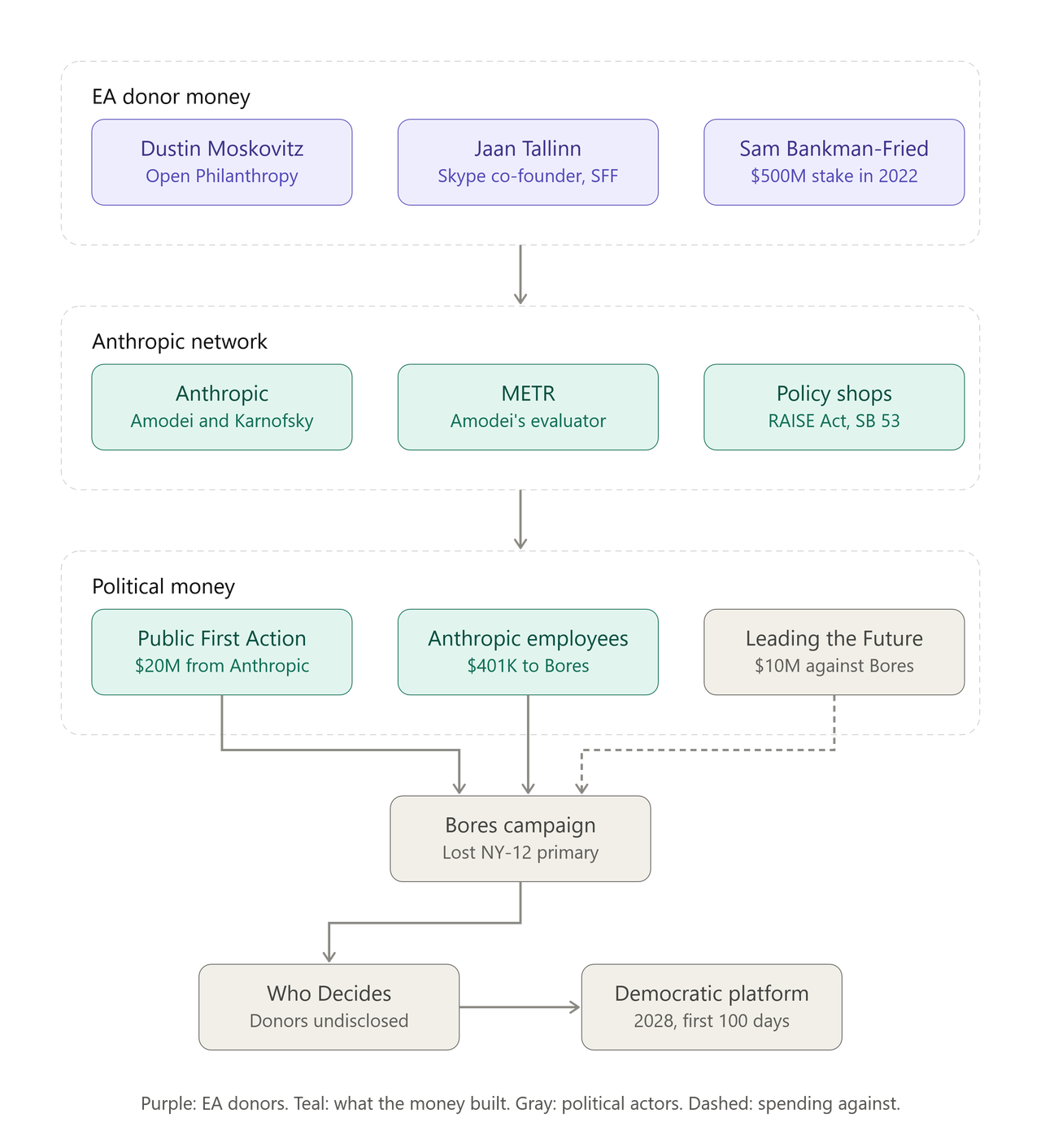
Bores’ new group grew out of a campaign funded by Amodei’s network – which runs through Effective altruism. The same network produced METR, the evaluator Amodei’s essay names as his preferred watchdog – which itself was bankrolled largely by Facebook co-founder Dustin Moskovitz. Its most famous adherent, Sam Bankman-Fried, is in prison for fraud, and his $500 million stake in Anthropic, bought in 2022 with FTX customer funds, was liquidated in the exchange’s bankruptcy. Anthropic grew up inside that world: Moskovitz and Skype co-founder Jaan Tallinn funded its early rounds; Dario Amodei was an early signer of the movement’s giving pledge; his sister and co-founder Daniela is married to Holden Karnofsky, the Open Philanthropy co-founder who joined Anthropic last year; and the trust with power over the company’s board includes the CEO of the Centre for Effective Altruism.
Bores’ new group grew out of a campaign funded by Amodei’s network – which runs through effective altruism, a left-wing ‘movement’ that began with global poverty and animal welfare, preaches earning as much as possible in order to give it away, and over the past decade made preventing an AI catastrophe its central cause, bankrolled largely by Facebook co-founder Dustin Moskovitz. The same network produced METR, the evaluator Amodei’s essay names as his preferred watchdog. The movement’s most famous adherent, Sam Bankman-Fried, is in prison for fraud, and his $500 million stake in Anthropic, bought in 2022 with what prosecutors said were FTX customer funds, was liquidated in the exchange’s bankruptcy. Anthropic grew up inside that world: Moskovitz and Skype co-founder Jaan Tallinn funded its early rounds; Dario Amodei was an early signer of the movement’s giving pledge; his sister and co-founder Daniela is married to Holden Karnofsky, the Open Philanthropy co-founder who joined Anthropic last year; and the trust with power over the company’s board includes the CEO of the Centre for Effective Altruism.
The same network reached Bores. Anthropic’s $20 million gift to Public First Action, which backed him, sits alongside $401,250 that Anthropic employees gave to campaigns supporting him. Who Decides’ pledge bans frontier-lab executives and corporate money – but doesn’t bar the philanthropies that fund the AI-safety field. The group won’t say who supplied the $10 million it has reportedly raised. The movement has tried electoral politics before: in 2022, Bankman-Fried’s super PAC spent more than $10 million on Carrick Flynn’s House primary in Oregon (which Flynn lost).
Who Decides, meanwhile, is calling for an AI agenda that a future Democratic president could act on during the first 100 days in office.
From A Congressional Defeat To A National Campaign
Bores made AI regulation a central issue in his congressional primary campaign after helping pass New York’s RAISE Act. The legislation requires major frontier AI developers to publish safety plans and report critical safety incidents. Although he lost the primary, Bores and Myers describe the campaign as the foundation for their new organization.
“The lesson Bores and Myers took from those fights was that confronting the AI industry is fertile political ground and that public demand for answers on AI policy exists but remains scattered,” the announcement states.
The organization says it will reject “corporate money or contributions from senior executives at frontier AI companies.” Its website directs prospective donors to a Givebutter fundraising page.
The $30 million figure refers to the overall effort, rather than an established amount already raised. A New York Times report summarized by Techmeme says the nonprofit has raised $10 million and plans to seek another $20 million in 2027.
For Bores and Myers, the stated task is to turn separate concerns about AI into a coordinated political program.
“What’s missing is a coalition capable of turning that energy into a governing consensus before the technology, the economic dislocation, and the partisan battle lines harden,” the launch announcement says.
Tyler Durden
Tue, 09/22/2026 – 06:55

