

A Perfect Storm – Where Are The Umbrellas?
By Michael Every of Rabobank
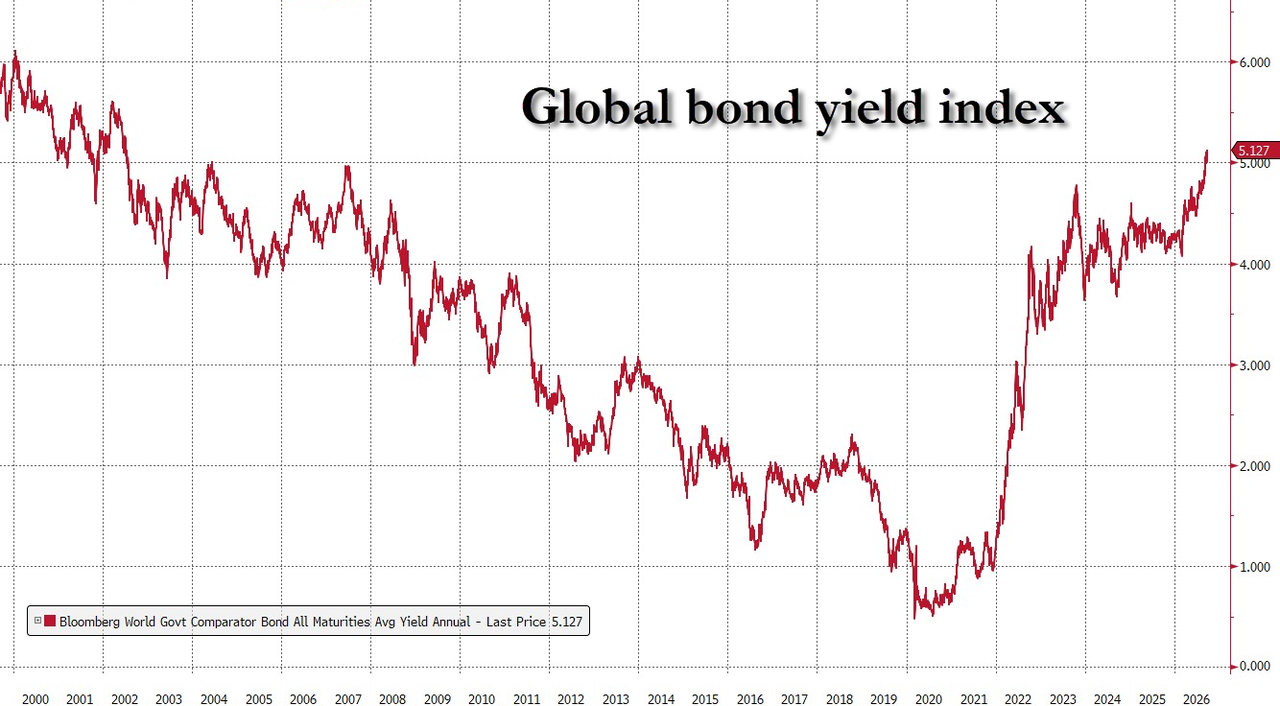
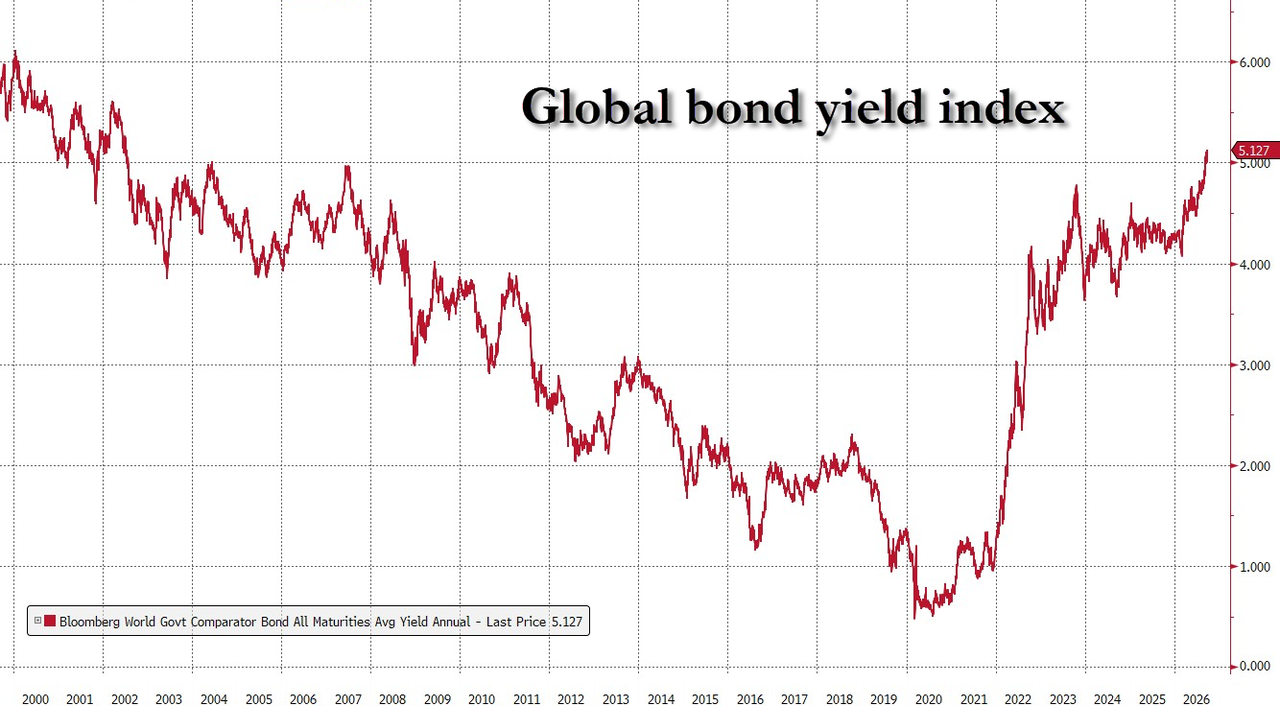
As the Wall Street Journal puts it today, ‘A perfect storm is raging in the bond market’ as US 10-year yields are at 5.11% vs. 4.93% at yesterday’s close, the largest one-day rise since 2025’s “liberation day”; Canada’s are at 3.95% vs. 3.83%; the UK’s 5.35% vs. 5.20%; Australia’s 5.38% vs. 5.25%; Germany’s 3.55% vs. 3.46%; France’s 4.66% vs. 4.50%, and Japan’s 3.05% vs. 2.98%.
You can blame some of that on yesterday’s data, where the Eurozone services PMI was marginally better than expected at 53.0 and the US manufacturing and services PMIs leaped to 57.0 and 58.7 respectively. It’s great that seven months of Middle East and Russia-Ukraine war with high energy prices haven’t dented growth. The downside is there’s little reason for ‘rate cuts!’ And just imagine if geopolitics gets worse or economies must ‘run hot’ to rearm at pace.
In terms of energy, US Energy Secretary Wright has stated a US diesel export ban won’t work, but Politico says the White House is still preparing plan for 90-day ban even as some GOP lawmakers and oil industry representatives are fighting to stave off the announcement. In short, it’s perhaps not for nothing that European, UK, and Aussie diesel prices have been climbing, and where markets might be in for another battering.
Xi Jinping is at a high-stakes US summit with Trump, where their trade truce has been extended… until 10 January: after that, who knows? Germany, which isn’t present, has surrendered anyway: Euractiv reports Berlin is seeking to loosen the EU’s ‘made in Europe’ rules and “rejects protectionism and discrimination” – not more Chinese imports, apparently.
Yet this is about far more than tariffs: Bloomberg notes China is holding sensitive F-35 parts which were mysteriously diverted to Hong Kong (which brings the security of international shipments of goods into question). And, of course, the Wall Street Journal and Bloomberg claim China backs Iran and the Houthis, while its ‘Russia cannot lose’ stance is already accepted.
Trump and Xi are also discussing AI, as the Australian government saw its websites attacked by a Claude agent, a claim was made that Claude may have cracked the secrets of efficient molecular gene editing, with vast implications, top AI leaders warned the UN of global security risks as such systems grow more powerful, and Mark Zuckerberg unveiled an AI ‘charm’ device that can fit on a keychain – so now there is no escape anywhere. The market impact of this is unclear: the potential coming storm isn’t.
There is still no breakthrough between the US and Iran nor of a settlement in the broader region, where tensions smoulder. Putin said his election turnout shows Russians support his military agenda as Foreign Minister Lavrov told the UN that Moscow will not pause its Ukraine ‘operation’, and Ukraine’s Zelenskyy warned of a “painful winter” for Russia if energy truce talks fail. A Russian military helicopter also violated Polish airspace, seeing Warsaw scramble fighter jets. Tony Blair urged PM Burnham to rejoin the EU, which both British voters and the EU get a say in. Argentina’s President Milei demanded Falklands talks with the UK. “My job is to assume things get worse,” Australia’s new defence chief told the financial press. Stormy enough for you?
Meanwhile, the Financial Times echoes something stressed here regarding Japan: “The threat of appearing as a vassal state is growing ever more real for middle powers.” The depressing global realpolitik is that middle powers are NOT powers, just caught in the middle.
That doesn’t mean they aren’t useful: Japan and South Korea are being looked at by the US to ease its shipbuilding and ammunition bottlenecks. However, that means the US has less tolerance for those not working with it and will exert pressure to get the outcomes it wants. The US Treasury openly pushing the ‘independent’ BOJ to end the Yen Carry Trade via rate hikes, threatening a perfect storm for some assets, in exchange for a strong JPY, cheaper commodity imports, and more Japanese domestic investment into defence industries is one key example.
Another is Canadian PM Carney saying he modelled the “extreme tail risk” of the US invading: his army envisioned insurgency tactics like the Afghan mujahedeen. Canada had plans to invade the US under the British Empire, the US had similar ones to invade Canada, and many militaries have wild scenarios in desk draws. This exercise was undertaken as headlines warned the US might invade Greenland. Instead, we have a peaceful new permanent US-Greenland-Denmark security treaty with a de facto loss of Danish sovereignty – which Canada supports.
The US will not tolerate free trade with a country not sticking to its China tariffs, as the USTR just made clear; nor will it accept a large open border with a country that drifts away from it geopolitically. These are not normative statements but realpolitik facts. Economists can model the win/lose of Canada shifting from the US economy, which supports its true value-added industries, to a Europe which needs far less of them (as Ottawa is already seeking carveouts from the EU’s “burdensome requirements” re: deforestation). Geostrategists don’t need to model the extreme fat tail risks in geopolitics when the government is already showing us a “We can be Afghanistan if necessary” national strategy.
However, the tide seems to be flowing in the other direction in that region. Mexico is close to a new USMCA deal, Venezuela is a US client state, Greenland a US security protectorate, and Brazil’s presidential election might see pro-Trump Bolsonaro, Jr. elected. Moreover, 14 Western hemisphere states joined the US to sign a ‘Joint Statement on Defending Hemispheric Sovereignty’ to enhance economic cooperation, explore investment screening mechanisms, safeguard critical minerals supply chains, promote trusted suppliers for digital infrastructure, and fight “narco-terrorism.” In short, even if we have wild weather in Eastern Europe and the Middle East, and storm clouds may even be gathering over parts of Asia, don’t let headlines cloud your vision over the most likely weather on other fronts.
Regardless, when you look at the conflating global backdrop, unless and until geopolitics provides us with new rays of sunshine, there are not going to be enough umbrellas for those who think, act, or trade like it’s 2005 or 2015.
Australia, which has long been in that camp but usually doesn’t need an umbrella, has just seen its Prime Minister rain on that parade (“The post-1945 world order is no longer fit for purpose.”), as has the RBA Governor (“We’re moving into a new world… Can we afford to be that open now? Can we afford to be so dependent on other countries for certain essentials?”). But what’s the policy prescription going to be then, and when? “What is GDP *for*?” Aussie employment data today were an odd mix that doesn’t help matters. Jobs growth was 39.5K, double estimates, but all part time as full-time positions fell, and unemployment was a whisker shy of 4.7% at an official 4.6%, up from 4.5%.
If you need me, I’ll be by the umbrella stand.

Tyler Durden
Thu, 09/24/2026 – 10:00

