

New DRAM Demand Source Could Surge 20-Fold By 2030
Last month, Jason Chen, chairman and CEO of Taiwanese PC maker Acer, offered some relief from the memory shortage, saying chip prices could begin falling in the second half of next year. That outlook challenges the memory cartel, pardon, the Big Three’s claims that prices will keep rising well beyond 2027.
Meanwhile, Chinese memory-chip manufacturer ChangXin Memory Technologies, better known as CXMT, recently said it had begun mass production of advanced memory chips. Goldman analysts are now looking to Samsung’s Oct. 29 earnings report for indications of whether the company expects tight memory-market conditions to persist in 2028.
AI hyperscalers have soaked up the world’s high-bandwidth memory (HBM) for the data center buildout, sending prices soaring and pressuring consumer electronics companies such as Apple, which was forced to raise prices for the new iPhone 18 premium lineup and foldable Duo.
But with CXMT’s supply coming online and major memory giants still warning of tight conditions through next year, we may soon see whether that narrative holds after Samsung’s earnings call. A new source of memory demand could also emerge, this time outside data centers and in physical AI.
Counterpoint Research forecasts that DRAM demand could surge with the coming wave of humanoid robot deliveries, expected to begin next year and continue through the decade.
South Korean newspaper The Chosun Daily first cited Counterpoint’s note, which said DRAM demand for humanoid robots could explode to 172,000 terabits in 2030 from roughly 8,300 terabits this year.
Average DRAM capacity per humanoid robot is set to roughly double, from 19 gigabytes to 39 gigabytes, over the same period.
More sophisticated AI models have increasingly larger and larger memory requirements, and we’re sure those requirements could rise even further. These complex bots process images, video and sound simultaneously and use “world models” to anticipate changes in the surrounding environment, requiring faster processing and greater memory capacity.
Beyond humanoid robotics, memory demand will likely surge for highly autonomous vehicles, which typically require over 200 GB of memory and several terabytes of storage.
Global memory firms are eyeing the robot market. Sanjay Mehrotra, Micron CEO, recently said, “Level 4 or higher autonomous vehicles typically require over 200 GB of memory and several terabytes of storage. Humanoid robots will likely need similar levels of memory and storage.”
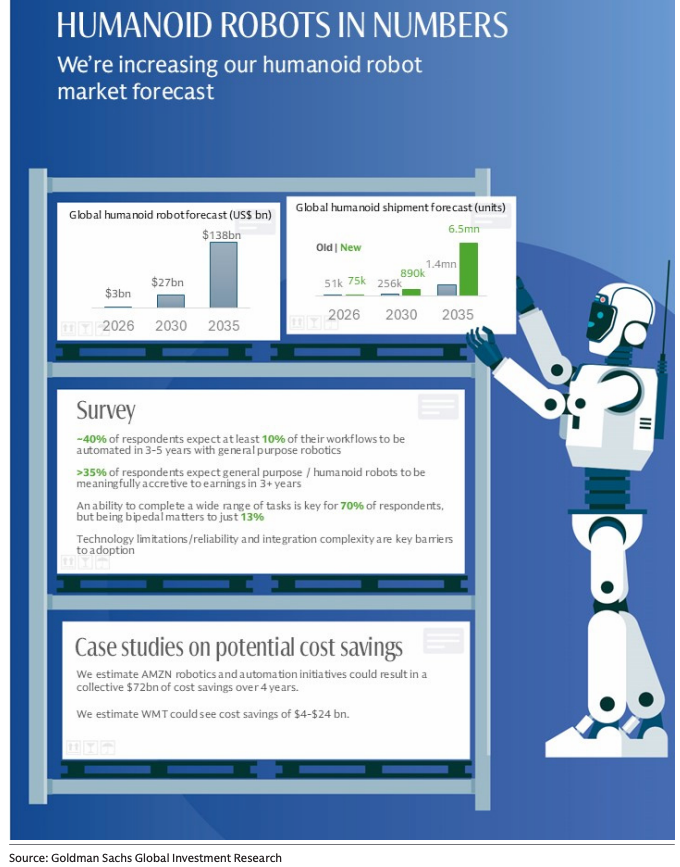
On the demand side of humanoid robotics, Eric Sheridan, managing director and internet/e-commerce equity analyst at Goldman, recently raised his base-case forecast to 75,000 humanoid shipments in 2026, 890,000 in 2030, and 6.5 million in 2035, versus previous estimates of 51,000, 256,000, and 1.4 million, respectively.
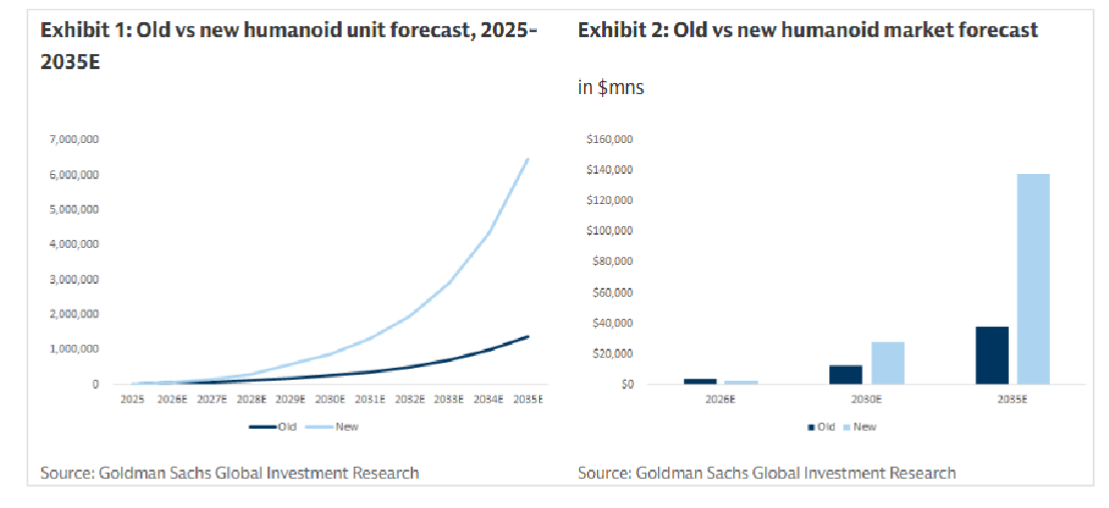
“We are raising our humanoid robot market forecast. The global market is now projected to reach approximately 890,000 units by 2030 and 6.5 million units by 2035 (representing a $138 billion market opportunity),” Sheridan told clients in late August.
It’s not just data centers that will drive memory demand. Physical AI could become the next major source of demand.
Tyler Durden
Thu, 10/15/2026 – 14:35

