

Anthropic Files Updated Its S1: Committed Spend Jumps To $900BN, Only Google Has More
We covered Anthropic’s S-1 filing in full here last week.
Now we get the update, and it’s a lot less rosy…
UPDATE (Nov 2): Q3 Is In, And The Operating Profit Lasted One Quarter
The blank has been filled in. Anthropic just filed Amendment No. 1 to its S-1, adding the third quarter, and the line in the prospectus summary that read “to $ for the three months ended September 30, 2026” now reads $17.0 billion.
*ANTHROPIC 3Q REV. $16.96 BILLION VS. $1.38 BILLION Y/Y
*ANTHROPIC 3Q TOTAL OPERATING EXPENSES $17.5B VS. $4.47B Y/Y
*ANTHROPIC HAD $95.6B OF CASH AS OF SEPT.30
*ANTHROPIC HAD $36.3B OF SHORT-TERM INVESTMENTS AS OF SEPT. 30— zerohedge (@zerohedge) November 2, 2026
The exact number is $16.96 billion, a touch above the $16.8 billion management gave its investor day. That’s up 1,127% y/y and 47% q/q. A great quarter, again, and also confirmation of the deceleration we flagged: Q2 grew 144% q/q. And the S-1/A adds a detail that wasn’t in the investor-day pitch: revenue growth in Q3 was “partially offset by a decrease of approximately $600 million from price reductions introduced as part of new model versions and contractual discounts.” So the treadmill now comes with price cuts.
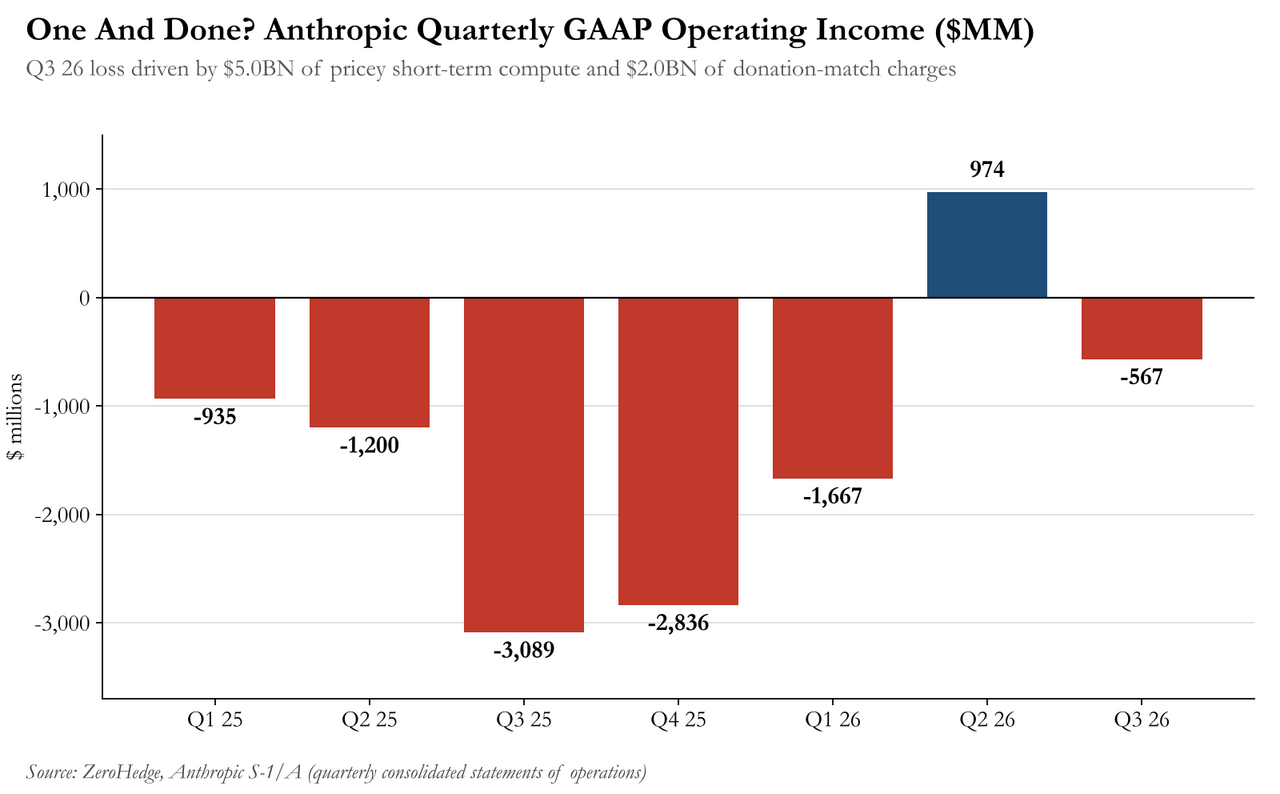
But the real news is lower down the P&L. Two weeks ago we wrote “enjoy the 8% GAAP operating margin while it lasts, probably just one more quarter.” It turns out it didn’t even last that long: Q3 swung back to a GAAP operating loss of $567 million, after the $974 million profit in Q2.
The $5 Billion Rush Order
The S-1/A is unusually direct about why. The loss was “primarily driven by $5.0 billion of compute under short-term commitments and $2.0 billion of non-cash charges related to our donation matching program.”
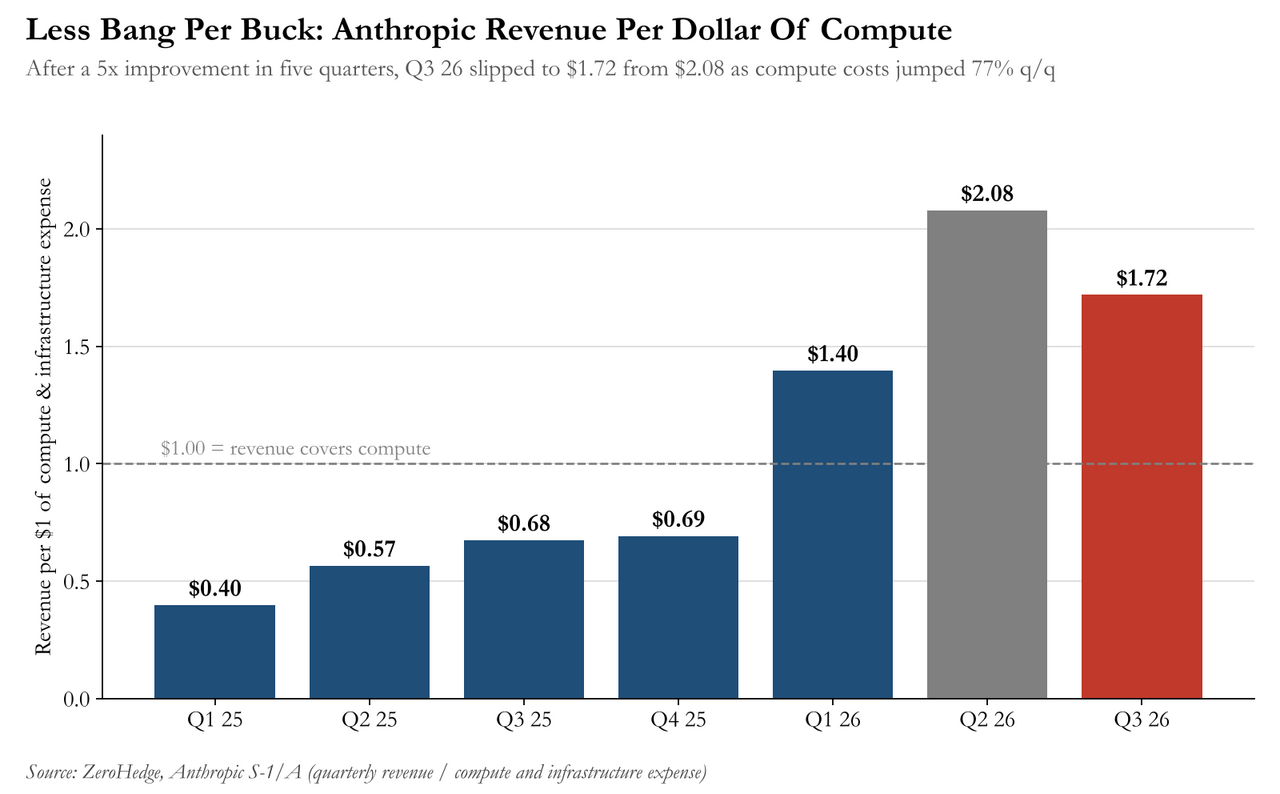
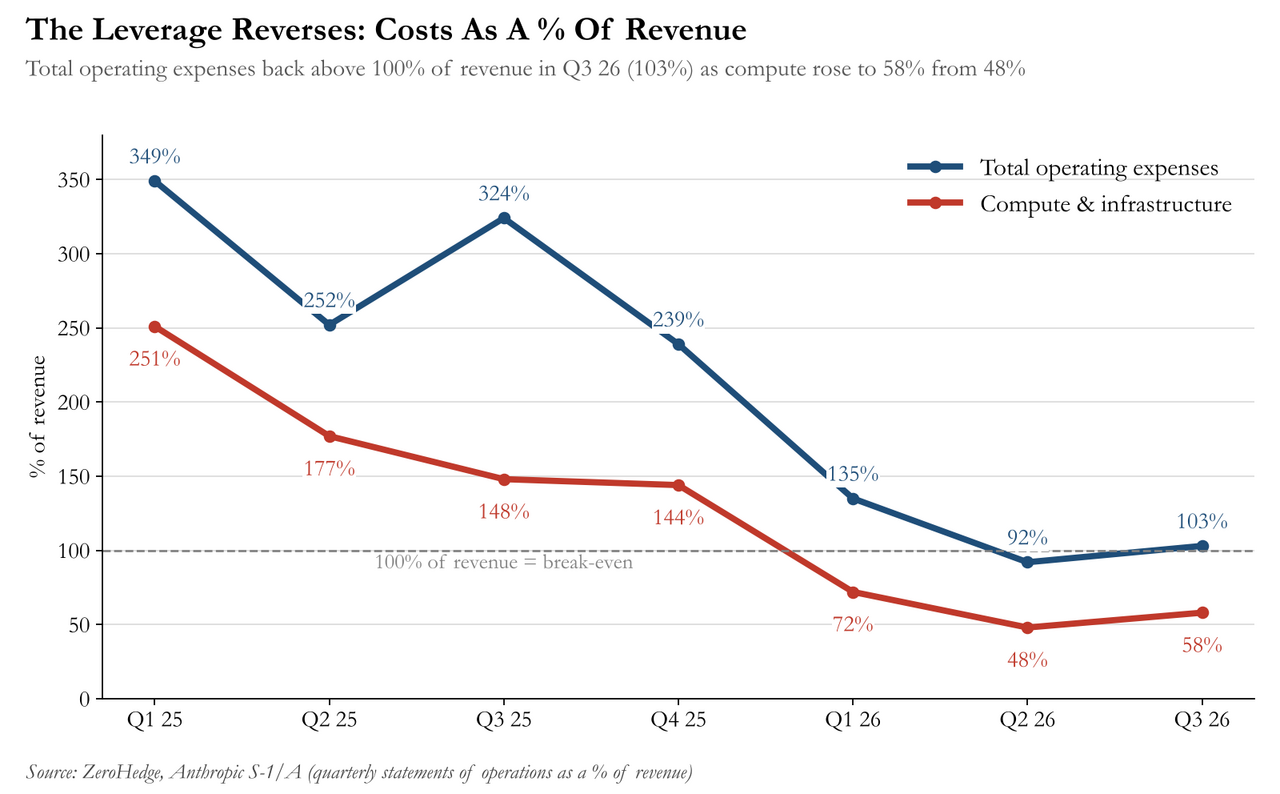
Start with the compute. Compute and infrastructure expense jumped 77% q/q to $9.9 billion, versus 47% revenue growth, and rose to 58% of revenue from 48% in Q2. That $9.9 billion includes $5.0 billion of compute bought on short-term commitments, “which currently costs significantly more than comparable compute procured under our multi-year commitments.” The filing also notes that Anthropic typically procures compute 12 to 18 months ahead, so these costs are “generally fixed in the near term.”
Translation: demand outran the long-term contracts, so the company bought short-term capacity and paid up. It’s good evidence that compute really is scarce right now. It also shows what scarcity costs: half of Q3’s compute bill came at premium prices.
The result is the ratio we called “the bull case in a single chart” back on Oct 26. Each dollar of compute and infrastructure expense generated $1.72 of revenue in Q3, down from $2.08, the first decline in the series. We also warned then that “unless revenue keeps up, that ratio is about to get a lot less flattering.” Well, it didn’t keep up:
And remember, that’s before the big contracts fully kick in. SpaceXAI alone runs about $9.3 billion a quarter once fully delivered in December, roughly equal to Anthropic’s entire Q3 compute bill, and Microsoft’s $44.9 billion starts this month. If the $5 billion of pricey short-term compute rolls off as the long-term capacity arrives, the mix should get cheaper. If it doesn’t, Q4 compute will make Q3 look restrained.
Back Above 100%
The second driver is a $2.0 billion non-cash charge for the employee donation-matching program, versus just $126 million for the whole first half. That’s 12% of Q3 revenue going to charity accounting in a single quarter, and it pushed “other operating and administrative” expense up to $3.6 billion (21% of revenue) from $1.0 billion in Q2. Generous, certainly. It also makes “adjusted” do a lot more work: adjusted operating income for the first nine months is $4.1 billion (a 12% margin), which implies roughly $2.5 billion in Q3 alone, against a $567 million GAAP loss.
Put together, total operating expenses went back above revenue, at 103% after dropping to 92% in Q2:
To be fair, two lines moved the right way. Personnel expense actually fell to $1.7 billion from $1.9 billion as some option awards fully vested (quarterly stock comp dropped to $1.1 billion from $1.3 billion). And sales, marketing and partnerships fell to 14% of revenue from 22% in Q1. The company credits “a decrease in revenue generated from sales through channel partners as a percentage of total revenue and changes in the terms of our channel partner distribution arrangements.” That speaks directly to our “book it gross” point: the hyperscaler cut is shrinking, either because more customers buy direct or because Anthropic renegotiated the toll. Either way, it’s progress.
The stock comp reprieve won’t last, though. Unrecognized SBC on RSUs is still $24.1 billion (plus $2.1 billion on other awards), and most of it hits the moment the S-1 goes effective.
Another $23 Billion “Loss”
Below the operating line, the valuation markup machine kept running. Q3 net loss was $23.3 billion, of which $21.9 billion came from marking up the convertible notes, derivatives and SAFEs, with another $1.6 billion of other expense. That brings the nine-month net loss to $104.0 billion, on $33.2 billion of revenue. The only real offset was interest income of $1.2 billion on the cash pile, about 7% of revenue and more than twice the operating loss.
The balance sheet barely moved, apart from the deficits. Cash, equivalents and short-term investments were $131.8 billion at Sept 30 ($95.6 billion cash plus $36.3 billion of short-term investments), essentially flat from $131.7 billion in June. The accumulated deficit grew to $156.2 billion from $132.9 billion, and total stockholders’ deficit grew to $149.9 billion from $127.6 billion. The $157.5 billion of redeemable preferred holding it all up is unchanged.
The Bill Gets A Number: $895 Billion (And Counting)
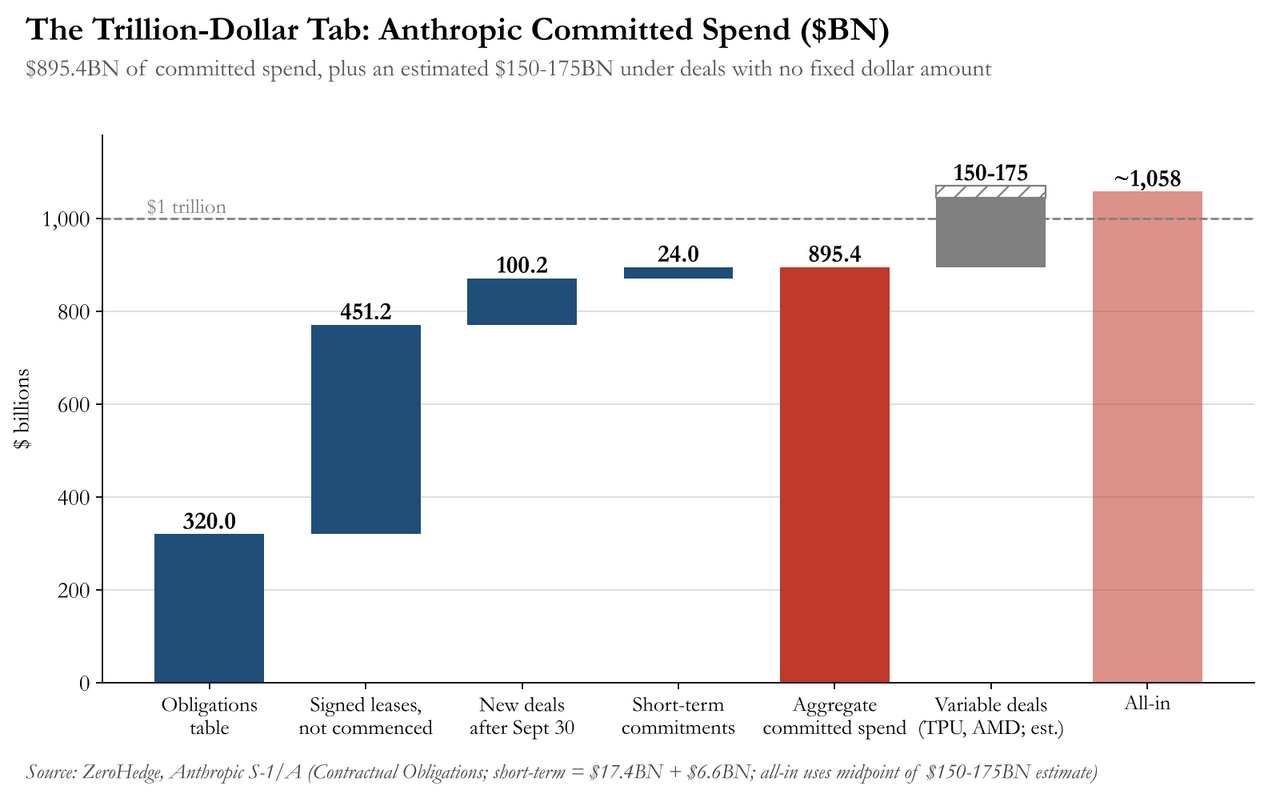
Two weeks ago the S-1’s aggregate commitment total was blank, and we added up the named deals ourselves: about $637 billion fixed, and $780-810 billion including the company’s own estimates for the extra TPU and AMD tranches. The amendment fills in the blank, and it’s bigger. As of (and subsequent to) Sept 30, Anthropic has entered into purchase commitments and leases “with an aggregate committed spend of approximately $895.4 billion, substantially all of which is related to compute and infrastructure.”
Here’s how the filing builds that number:
- $320.0 billion in the formal contractual obligations table (almost all of it, $313.8 billion, non-cancelable purchase commitments, mainly cloud hosting);
- $451.2 billion of leases signed but not yet commenced, mostly starting between 2026 and 2028, with terms of up to 20 years (weighted average about 10);
- $100.2 billion of new commitments signed after Sept 30, “primarily consisting of data center leases” and cloud hosting deals;
- about $24 billion of short-term commitments ($17.4 billion at Sept 30 plus $6.6 billion signed since).
And that still isn’t everything. The table excludes deals “that do not specify a fixed dollar commitment,” for which Anthropic “currently estimate[s] such payments to be approximately $150 billion to $175 billion.” That range lines up with the extra Google TPU tranche ($125-150 billion, 2028-2031) plus AMD’s Helios deal (more than $20 billion), both of which we had already counted in our $780-810 billion estimate. Add them to the $895.4 billion and the all-in tab comes to roughly $1.05-1.07 trillion. Or, in other words, MORE THAN ONE TRILLION DOLLARS!
Two things stand out. First, the pace. $100 billion of new commitments in the five weeks since the quarter ended, while the IPO was being marketed and while the company was running an operating loss. Second, the duration: Anthropic says about $447.5 billion lands before the end of 2030, and “substantially all of the remainder is expected to be incurred between 2031 and 2045.” That’s a 19-year bet on a product line where, as the original S-1 disclosed, over 80% of Q3 revenue came from model versions released in the prior six months.
Of the named deals, only Google changed. Its hosting commitment was amended again through October and now stands at “at least approximately $121.3 billion” from April 2026 to July 2033 (from $114.5 billion in the original S-1), “regardless of actual usage,” with a true-up if Anthropic underspends. The rest are as before: Broadcom $161.2 billion of TPU lease rent, SpaceXAI up to $120.5 billion, Amazon at least $110 billion, Microsoft $44.9 billion, Nscale $44.6 billion and Lambda $41.3 billion. That’s about $644 billion across seven counterparties.
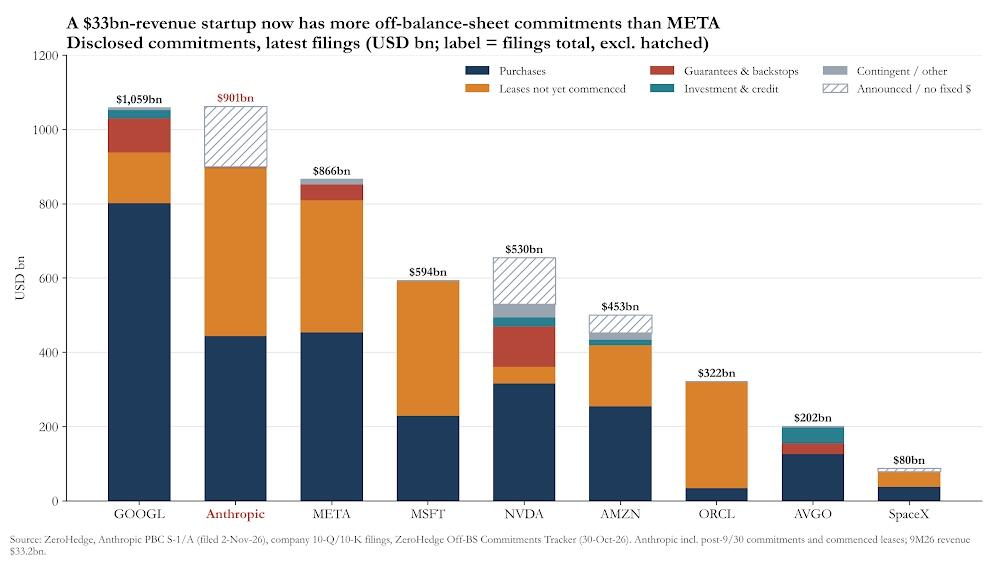
Only Google has greater commitments than Anthropic…
$70 Billion Due In 12 Months
The number that matters most for IPO buyers is the near-term one. Approximately $69.8 billion of these commitments are due in the 12 months after Sept 30. That’s more than Q3’s entire annualized revenue ($67.8 billion), more than half the $131.8 billion cash pile, and about 11x the $6.6 billion of operating cash flow Anthropic generated in the first nine months of the year (roughly $2.7 billion of it in Q3).
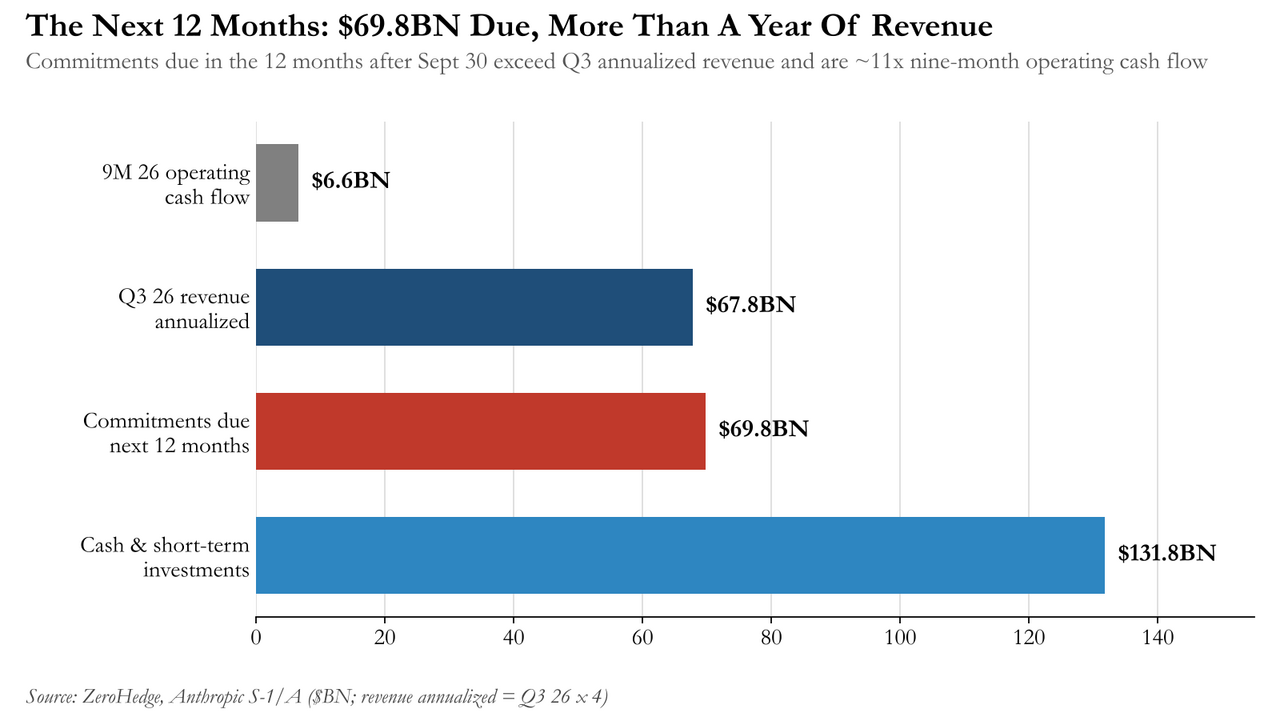
Put simply, next year’s committed bill alone exceeds Anthropic’s entire current revenue run rate, before it pays a single employee. Maybe revenue outruns it: it’s up 45x across the last seven quarters. But at 47% q/q and slowing, with $600 million of price cuts in Q3, the margin for error is shrinking. And part of the IPO proceeds is already spoken for: the pro forma assumes they go toward the tax withholding on the RSU settlement.
The Escape Hatches (And Who Holds Them)
The filing does offer some comfort: about $213.8 billion (24% of the total) “relates to arrangements that are subject to either exercisable termination rights or contingent conditions prior to commencement, such as the counterparty’s ability to secure financing, facilities, or regulatory approvals.” Only $4.3 billion of the next 12 months’ bill has that kind of out.
Look at who carries those contingencies, though. Lambda’s August deal ($34.9 billion of its $41.3 billion) can be terminated by either side “if Lambda does not timely secure the facility lease.” Nscale must use “best efforts to obtain qualifying financing for the NVIDIA GPUs and data center infrastructure.” In other words, the flexibility in Anthropic’s bill comes from the neoclouds’ ability to borrow. If the AI credit window shuts (and CoreWeave CDS suggests it’s narrowing), Anthropic’s obligations shrink, but so does its compute supply. That’s a hedge that pays off exactly when you’d least want to use it.
Meanwhile the vendor financing got more detailed. Broadcom’s $42 billion note facility, which exists “solely to finance quarterly rent payments” on the Broadcom leases, carries 9% interest paid in kind, convertible at 90% of the 30-day VWAP. But if “certain revenue performance conditions are not met,” new notes jump to 13% PIK, converting at 85%. On a change of control, Broadcom can demand 150% of principal. So the supplier lends you the rent, at a rate that rises if your revenue disappoints, convertible at a discount into your stock. Circular financing, now with a penalty rate. Google, for its part, gets an option to buy up to $10 billion of stock in a concurrent private placement at the IPO price, alongside its $20 billion note facility (share issuance under which is capped at 14.99% Google ownership).
Anthropic is clear that the total is a floor: “we expect to continue to enter into additional arrangements to secure compute and infrastructure capacity.” Judging by the last five weeks, $100 billion at a time.
Still Blank: The Price
What the amendment doesn’t fill in: the price range, the share count, and every pro forma line that depends on them. At the $1.5 trillion valuation investors reportedly settled on, Q3’s $67.8 billion annualized run rate puts ANT at about 22x revenue, unchanged from our original math because Q3 came in roughly where management said it would.
The ratings agencies have already done their own math:
*ANTHROPIC MAY NOT SECURE INVESTMENT-GRADE RATING AFTER IPO: FT
you mean the $700BN in unfunded commitments could get in the way?
— zerohedge (@zerohedge) October 30, 2026
So here’s the updated scorecard.
Revenue grew 47% q/q but now carries $600 million of price cuts, and compute grew faster. Half the compute bill was bought on short-term terms at premium prices. The one profitable quarter is now an outlier between two losses. And the committed bill is now officially $895 billion (over $1 trillion all-in), with $70 billion due in the next 12 months, more than a year’s revenue at the current run rate. We asked on Oct 14 whether Anthropic was going public from strength or need. After Q3, we lean a little more toward need, and we suspect the IPO buyers (and the credit market behind them) will too.

