

Futures Rise As Wall Street Moves On From Jensen, Microsoft Outage Drags Into Day Two
US futures are higher as traders move on from the Nvidia leadership shock and shrug off a global Microsoft outage that is now in its second day, while the IEA’s call that the oil market is swinging to a surplus and a rebound in short-dated Treasuries take some of the edge off the week’s bond rout heading into the PPI report. As of 8:00 am ET, S&P futures are 0.3% higher while Nasdaq futures rise 0.1% and Dow futures add 0.2%. On Thursday the S&P fell 0.4%, the Nasdaq 100 slipped 0.3% and the Russell 2000 tumbled 1.7% after Nvidia plunged as much as 14% at the open on Jensen Huang’s ouster before retail dip buyers dragged it back to a 4.3% loss, confirming our post on the record opening retail bid. In premarket trading, Mag 7 stocks are all higher except Microsoft (-2.7%), which is struggling to restore access to Outlook, Teams and Copilot; Nvidia rises 3% and Alphabet 1.1%, while Cerebras jumps 17% on blowout guidance and new deals with Oracle and Microsoft, and Modine soars more than 20% on a report that Samsung is in talks to buy it. The day’s driver is inflation (again): October PPI at 8:30am is expected to rise 0.4% m/m after September’s 1.3% surge, and comes after a hot CPI and a Treasury selloff that left a December hike fully priced. Treasuries are mixed, with the 2Y yield down 4bps to 4.84% as traders trim hike bets on the dip in oil, while the 10Y is little changed around 5.12% after jumping 13.5bps on Thursday; the combined Tuesday and Thursday jump in 10Y yields was the biggest since April 2025. The Bloomberg dollar index steadies after hitting an 18-month high, USD/JPY hovers just under 160 amid more Japanese jawboning and the Aussie slides to its weakest since January. Brent trades near $96 and WTI slips to $88.42 as the IEA’s surplus call offsets Trump saying the US doesn’t need a deal with Iran; gold rebounds to around $3,900 but stays well below $4,000, and Bitcoin is down 3% below $70,000. US economic data slate includes October PPI (8:30am). Fed speaker slate includes Goolsbee (8:30am on CNBC), Collins (9:10am and 10:35am), Logan (9:40am), Bowman (10:50am), Daly (12pm) and Jefferson (7pm).
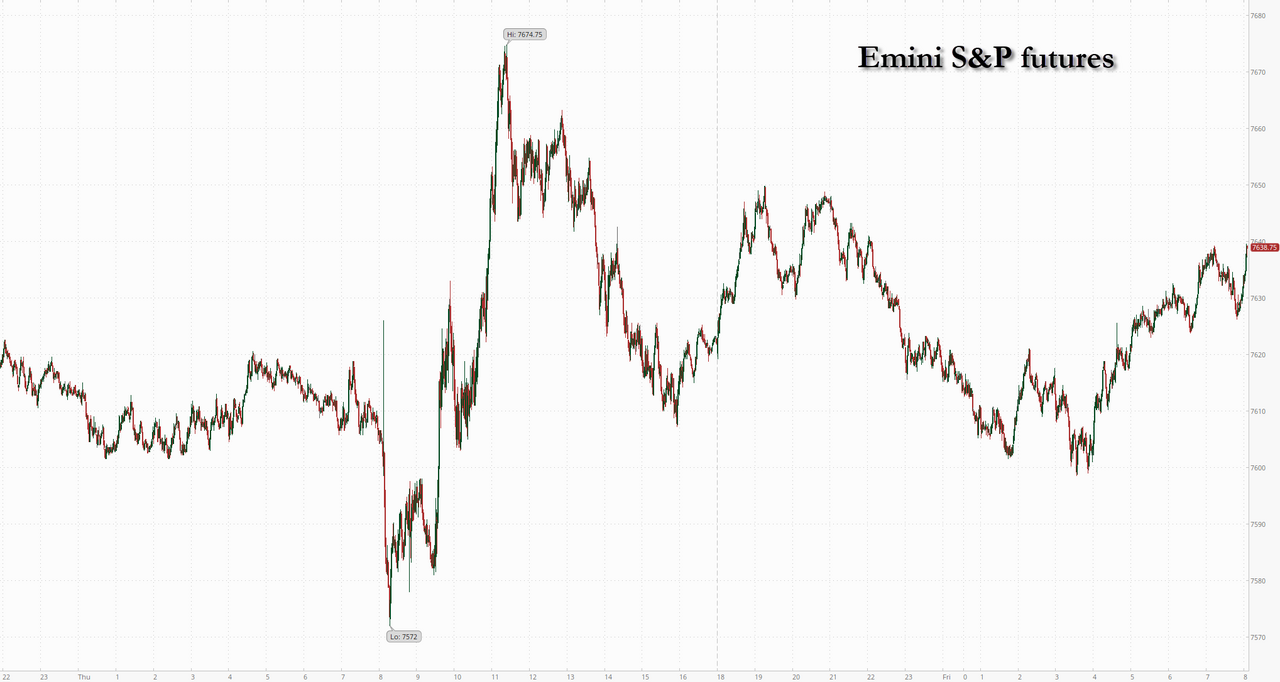
In premarket trading, Mag 7 stocks are mostly higher: (Nvidia (NVDA) +1.9%, Alphabet (GOOGL) +1.1%, Amazon (AMZN) +1%, Tesla (TSLA) +1%, Apple (AAPL) +0.4%, Meta Platforms (META) +0.05%, Microsoft (MSFT) -1.4%)
- Candel Therapeutics (CADL) tumbles 34% after the biotech delayed its application for aglatimagene in prostate cancer to mid-2027 while talks with the FDA continue.
- Cerebras Systems (CBRS) gains 15% after the chipmaker gave a sales guidance well above estimates, while unveiling new deals with Oracle and Microsoft.
- Cisco (CSCO) falls 3% after the networking gear maker’s fiscal first quarter product order growth disappointed. Gross margins are seen coming under pressure in the next few quarters as revenue has become more reliant on AI hyperscalers.
- Flowers Foods (FLO) falls 9% after the packaged bakery foods producer cut its sales guidance for the full year, which missed the average analyst estimates. Sales for the third-quarter also came below Wall Street’s consensus.
- Liftoff Mobile (LFTO) gains 21% after the mobile advertising company’s third-quarter adjusted earnings per share beat the average analyst estimate.
- Lowe’s (LOW) slips 2% after Stifel cut its recommendation on the home improvement retailer to sell and reduced the price target to a Street-low $190 from $195.
- Nu Holdings (NU) rises 4% after quarterly profit that beat analyst estimates as the Brazilian fintech pushes into new markets.
- Palo Alto Networks (PANW) gains 4% after the cybersecurity stock received an upgrade by KeyBanc, which sees security budgets on a material acceleration in 2027 due to more threats caused by AI.
- Sellas Life Sciences (SLS) rises 11% after the drug developer said it expects to report topline results from a late-stage trial of its experimental cancer therapy in November.
In other corporate news, the Nvidia saga keeps giving: a Chinese company founded by Alice Huang, the woman at the center of the scandal, procured smuggled AI chips installed at a Shanghai data center with links to Megaspeed, Bloomberg reports, Commerce Secretary Lutnick has agreed to testify before Congress on Nvidia (NBC), and Singapore charged a fifth person in its Nvidia chip case. Meanwhile, the IPO window could not be wider open: Anthropic’s IPO has drawn about six times the orders for the shares available as it seeks to raise as much as $64.4 billion plus $26 billion in a private placement, SpaceX and Tesla are progressing in merger talks that could produce the biggest deal ever as soon as December, and ByteDance plans to buy back up to $6 billion of shares at a valuation of about $400 billion. Samsung Electronics is in talks to acquire data center cooling maker Modine; Keurig Dr Pepper priced 58 million shares at $34.50; Helen of Troy says Empower’s bid undervalues the company; and Exxon made a final investment decision on its $12.5 billion Longtail development offshore Guyana.
Traders are ending a rollercoaster week, dominated by the firehose of Nvidia/Jensen news and the AI trade, by contending with a global Microsoft outage that has paralyzed government offices, trading floors and businesses, forcing traders onto phones and knocking out email at exchanges including Euronext; Richemont even had to delay its results. Microsoft says it is not aware of any malicious activity. And yet, markets keep doing what they’re not supposed to: Nvidia lost the most famous face of the AI trade, Huang resigned “effective immediately”, and the Nasdaq 100 lost just 0.3%. As Bloomberg puts it, the rest of the AI trade is already moving on, with deals still flowing overnight and Europe’s soft start owing more to oil and yields than to chips.
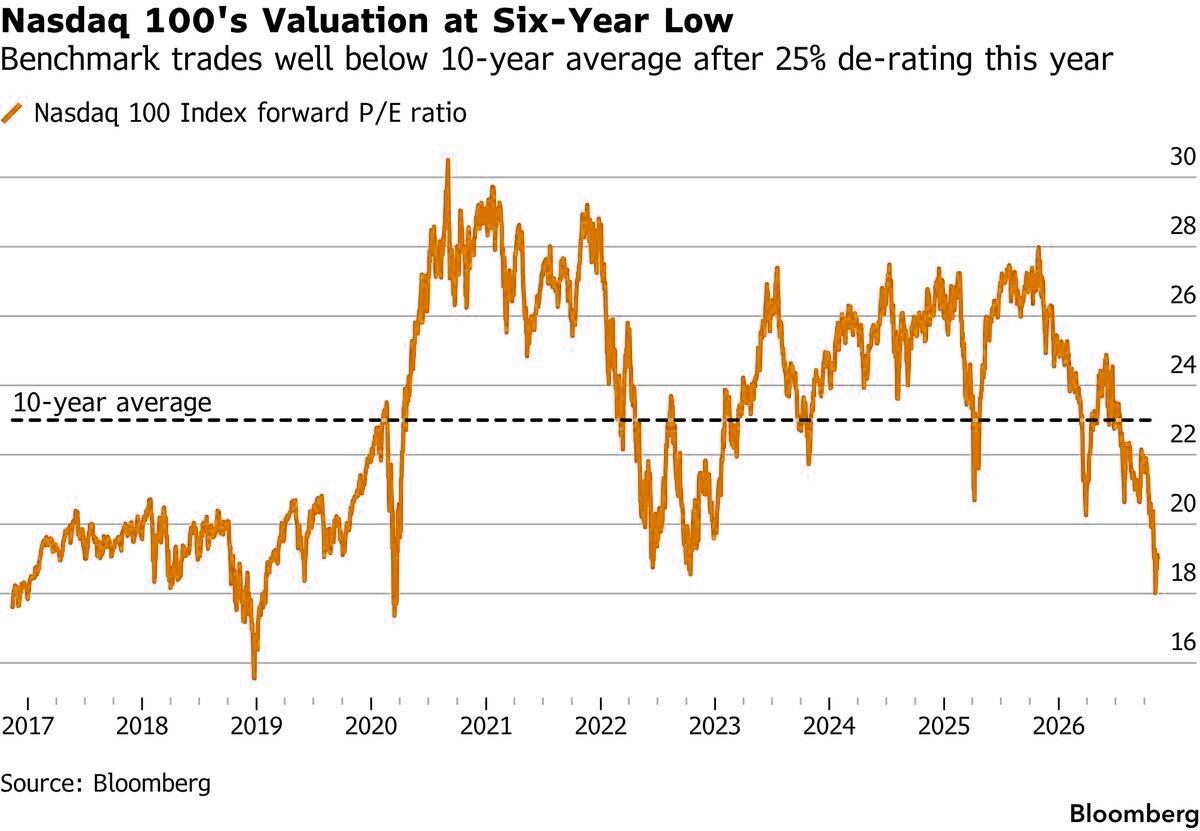
Goldman is leaning into the dip: its strategists issued a bullish outlook predicting the S&P 500 will advance 14% over the coming year after the selloff in the biggest tech companies left their valuations historically cheap. Indeed, the Nasdaq 100 now trades at a six-year low on forward earnings after a 25% de-rating this year. At the same time, Goldman’s 2027 outlook sees the AI investment impulse peaking early next year, with S&P 500 EPS growth slowing to 11% in 2027 from 36% this year, and a 10Y yield of 4.6% by end-2027.
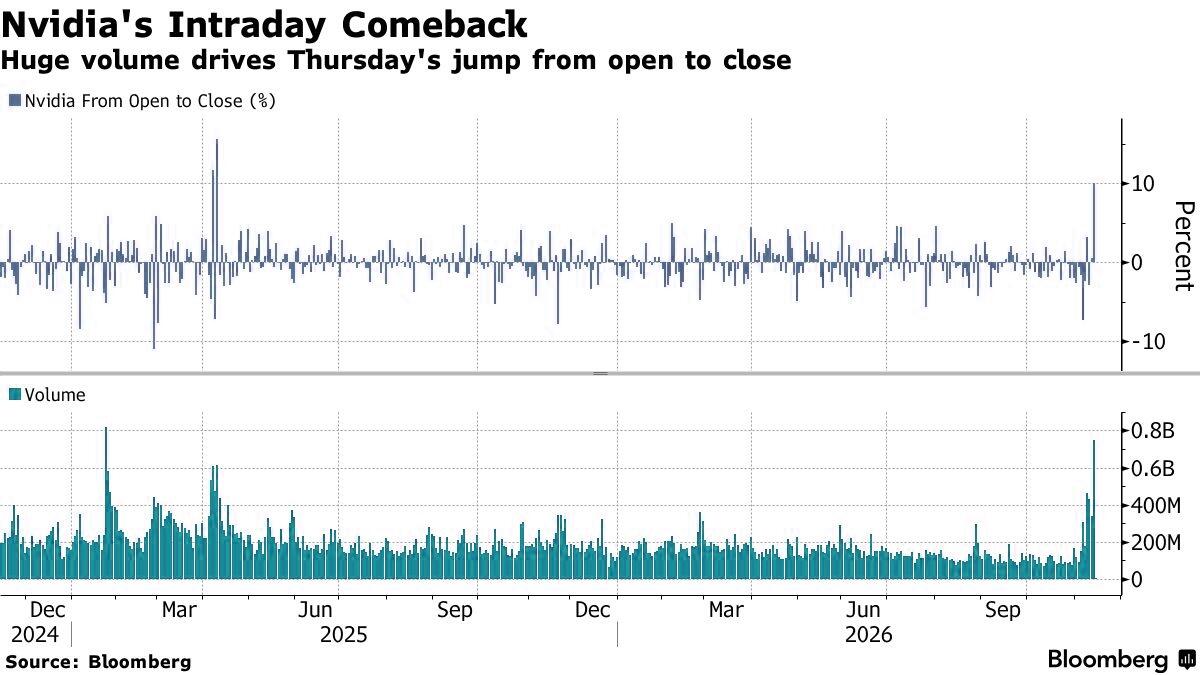
Calamos co-CIO Nick Niziolek told Bloomberg the AI trade is maturing rather than ending, arguing that the demand and the fundamentals remain intact. Direxion’s Bilal Little made a similar point: Nvidia still sits at the center of the AI buildout, and the question is whether the governance shock changes its competitive position or merely the multiple investors are willing to pay.
“Today, I would watch the interaction between producer prices, oil and real yields,” said Florian Ielpo at Lombard Odier Asset Management. “The PPI report will help assess how much of the energy shock is still feeding into prices and squeezing margins, with implications for the amount of tightening the Fed needs to deliver.”
The FX desks are less sanguine. MUFG’s Derek Halpenny warned the Microsoft outage could add to already poor tech sentiment and intensify risk aversion, hurting high-beta G10 currencies against the dollar, while ING’s Francesco Pesole said the dollar’s rally is rooted in hawkish Fed rhetoric and hotter inflation, making a material EUR/USD rebound hard to argue for; he sees a possible test of 1.10.
And BofA’s Michael Hartnett is still telling clients to stay risk-off until the dollar drops, the 10Y yield falls below 4.5% and oil drops below $70, even as global equity funds drew $98.3 billion in the week to Nov. 11, the largest inflow since June, led by $63.6 billion into US stocks.
Goldman’s Rich Privorotsky did not publish overnight (Goldman’s desks are working off backup email due to the outage), but his latest note on Thursday morning remains the best framing of the tape. He found it “quite impressive how much we’ve managed to rally” in the face of the macro backdrop and Nvidia’s increasingly idiosyncratic problems, while noting the move was emphatically not broad based, and that the governance issues are forcing a significant rebalancing of capital within AI. He flagged the SPX vol curve un-inverting, dealer skew flattening and systematic long/short managers posting their best two-day return in nearly three years, and asked whether this is just the mechanical result of light positioning and short covering or the start of something more durable. His list of four tactical AI overhangs (cost of capital, power and permitting, the supply/demand balance going into 2028, and monetization velocity versus capex) leads him to expect episodic, high beta trading rallies rather than pure buy and hold. His bottom line: a durable breakout probably needs lower rates, lower energy and broader leadership, i.e. the market needs oil fixed and rates lower, and the two may well be connected.
JPM’s Market Intel desk under Andrew Tyler says the market “feels coil-sprung to go higher, which is seemingly the pain trade”: higher yields, Nvidia gapping down and AI headwinds could not stop the next leg of the rally, with retail buying in Nvidia running at roughly 9 standard deviations by 10am and more than 5 standard deviations in the Magnificent Seven, even as institutional participation stayed light. The desk notes 2Y yields are up 33.7bps and 10Y yields 26.7bps week-to-date, making equity resilience all the more surprising. Positioning Intel adds that over the past month most of the move was shorts being covered rather than new longs, with short exposure falling from +2.7z to +0.4z. On Nvidia, JPM credit stays Underweight, warning the bigger implications are for GPU financing and infrastructure deals where Nvidia acts as supplier, investor or provider of contractual support, while Harlan Sur cut his target to $215 after stripping China and other shipments from FY28 estimates. Interim CEO Colette Kress has reportedly pushed back on some of Huang’s financing deals, which is exactly the risk we flagged in mapping every circular AI deal that now hangs on Kress.
Goldman’s TMT specialist Sean Johnstone makes the same point: Nvidia has acted as “lender of last resort” to the neoclouds, and the key uncertainty is whether a new CEO will have the willingness or authority to deploy the balance sheet; Nebius fell 17% and CoreWeave 7% on Thursday, while AMD, Broadcom and Arista rallied as money rotated within AI. Goldman’s EMEA trading desk notes Thursday was the 12-month momentum factor’s best day on record relative to 3- and 6-month momentum as the AI trade unwound, with data center basket crowding at the 1st percentile; its high-touch flows were 1.2x better to buy, with long-onlys more than 3x better buyers and hedge funds more than 3x better sellers. The desk also notes a December hike is fully priced, with roughly 13-14.5% odds of a 50bps move, and that a hot PPI print would harden that 50bps tail; Goldman’s own forecast is a softer 0.3% headline and 0.2% core, while JPM’s Feroli expects 0.6% and 0.4%. Our earlier post on record vol protection buying has more on the hedging frenzy.
Europe’s bond story is about energy rather than politics today: Bunds bear steepen as oil firms on doubts about a US-Iran deal, the 10Y Bund yield is up 1bp at 3.36%, French 10Y yields rise 2bps to 4.87% and Italian 10Y yields are 2bps higher at 4.41% ahead of S&P’s review of Italy’s BBB+ (positive outlook) rating after the close. ECB swaps still price 23bps of hikes in December.
Commenting on the overnight action, Charles Elson, founding director of the Weinberg Center for Corporate Governance at the University of Delaware, told Bloomberg Television that “Anytime you move a CEO on, it’s like lifting up a rock. You have no idea what’s under there.”
In Europe, the Stoxx 600 is little changed around 664 after a four-day rally to record highs ran out of steam, with 310 members up and 274 down. Energy and insurance lead, while industrial goods and consumer products lag; Richemont fell as much as 9% after jewelry sales missed in results already delayed by the Microsoft outage, while Wise jumped as much as 9.8% after settling a Belgian money laundering probe. JPM notes Quality and Value are leading while Beta and residual vol lag. Goldman’s Sharon Bell set Stoxx 600 targets of 670, 680 and 700 over three, six and 12 months while cutting banks to neutral and insurance and energy to underweight, and Goldman’s Bastien Brouwer points out that the Euro Stoxx 50 is still about 2.5% below its August highs even as the Stoxx 600 makes new records, with the GS EU defensives basket up 15.5% in a month and a half. Here are the biggest European movers:
- CTS Eventim shares gain as much as 4.2% after third-quarter results, with Citi saying resilient Ticketing performance was offset by weaker-than-expected Live Entertainment.
- Siemens Energy shares rise as much as 1% as Oddo BHF upgrades the energy technology company to outperform from neutral, citing a “convincing” roadmap and plan to improve margins.
- Wise shares advance as much as 9.8% after the UK fintech said it’s reached an agreement with prosecutors in Belgium over concerns of alleged money laundering, without admitting wrongdoing.
- Aviva shares gain as much as 2.9% following the insurer and investment firm’s 3Q trading update. Jefferies says pension risk transfer volumes are surprisingly strong, with full-year volumes now expected to exceed last year.
- Richemont fell as much as 9% after results in its jewelry division missed consensus expectations for the second quarter. Jewelry remains the main driver of the group’s growth, analysts at Jefferies said.
- Eramet shares fall as much as 8.2% after the French mining company announced capital increase.
- Acciona Energia falls as much as 5.7% after the Spanish renewable energy utility said that a $1 billion deal to sell solar and wind assets to Mexico Infrastructure Partners faces delays. Bloomberg previously reported that the deal could be at risk of collapsing.
Asian stocks fluctuated as investors weighed Nvidia’s leadership upheaval against the long-term AI demand outlook, with the MSCI Asia Pacific Index down 0.3% after erasing a gain of as much as 1.1%, though it is still headed for its best week since June. Taiwan’s Taiex jumped as much as 3.2% as MediaTek and TSMC climbed before paring gains, while Korea’s Kospi swung from gains to a 1% loss as SK Hynix and Samsung were sold. Japan’s Nikkei rose 0.5% to 61,142, with Advantest accounting for about 30% of the gain per Goldman, while the Hang Seng fell 1.5% and the Hang Seng Tech index dropped 3% for its worst week since June on worries about tighter US chip curbs on China; Alibaba slid 4.3%. Australia’s ASX 200 fell 0.7%. China’s October credit data disappointed, with new yuan loans contracting by 100 billion yuan, while China posted a record $276 billion current-account surplus and Hong Kong raised its 2026 GDP forecast to 4.8%.
In FX, the Bloomberg Dollar Spot Index is little changed after hitting its highest since May 2025, with the DXY in a 103.05-103.23 range and on course for a weekly gain of about 1.5%. USD/JPY is ping-ponging around 160; Finance Minister Katayama warned of one-sided, rapid moves and PM Takaichi said Tokyo is in close contact with US authorities, and the pair was knocked from above 160 to the mid-159s at around 6:30am London time, prompting (so far unconfirmed) speculation about a little help from the MoF. The Aussie fell 0.4% to 0.6784, its lowest since January, as Australia’s 10Y yield dropped below its US counterpart for the first time in more than a year; EUR/USD is up 0.1% at 1.1067.
In rates, Treasuries are mixed with the curve steepening: the 2Y yield is down 4bps at 4.84% as traders trim Fed hike bets on softer oil, while the 10Y yield is little changed around 5.12% after Thursday’s 13.5bp surge, which followed an ugly, tailing 30Y auction. Newsquawk notes Treasury futures are at a fresh week-to-date low and off more than two points on the week, with the CME pricing an 88% chance of a 25bp December hike and 12% odds of 50bps. Bloomberg’s Aggregate index is back down 1.5% year-to-date after having briefly clawed back to flat last week, and the backdrop is not helped by a record $404 billion October deficit (supply, anyone?). Gilt futures are lower on the energy bid, with traders still pricing 20bps of BOE hikes next month.
In commodities, WTI is down 0.4% at $88.42 and Brent is little changed at $95.88, having traded in a $95.06-96.81 range as the IEA said the global oil market will swing to a surplus for the first time since the start of the Iran war: supply surged 2.3 million b/d in October to 105.4 million b/d on resurgent Gulf flows, while 2026 demand is seen falling 2.7 million b/d, and IEA nations will release 71 million barrels of stocks through February. The bid comes from Trump saying the US doesn’t need a deal with Iran, a “liquefied gas” tanker hitting a mine east of Hormuz and the IRGC claiming it destroyed a US radar in Bahrain. Dutch TTF topped €97/MWh overnight before fading toward €93. Gold is up 0.6% at around $3,899 but remains far below $4,000, capped by rising global yields.
US economic data slate includes October PPI (8:30am). Fed speaker slate includes Goolsbee (8:30am), Collins (9:10am and 10:35am), Logan (9:40am), Bowman (10:50am), Daly (12pm) and Jefferson (7pm). Revvity hosts an investor day, JPMorgan holds its US opportunities forum in Miami, and Anthropic livestreams an investor event with Dario Amodei and Jamie Dimon.
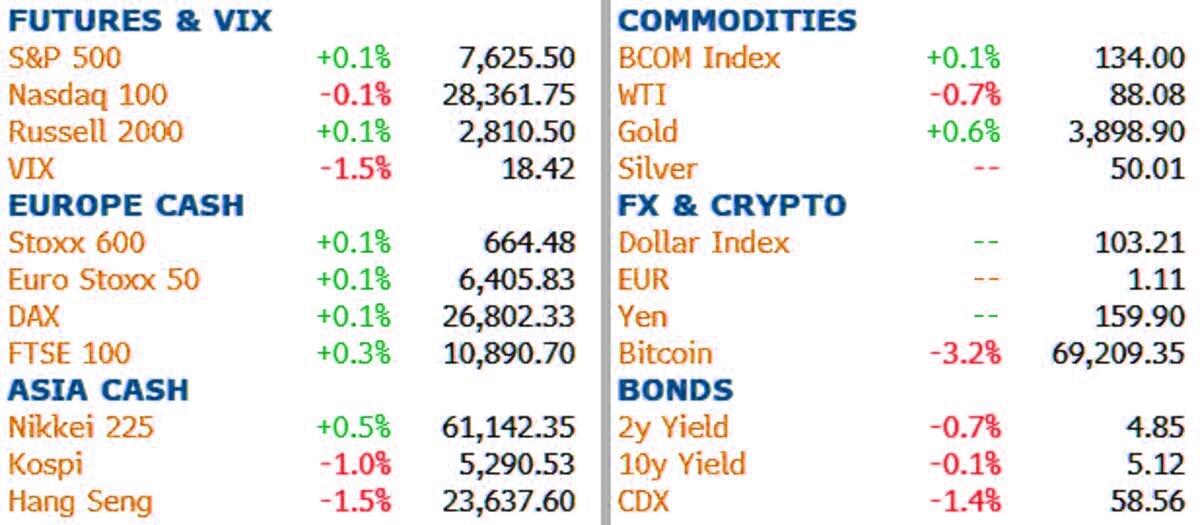
Market Snapshot
Top Overnight News
- President Trump said the US doesn’t need a deal with Iran, helping Brent add 3.3% on Thursday to about $96: BBG
- Ukraine’s Zelenskyy hailed progress after meeting US envoys in Dublin, with a prisoner swap agreed and Europeans promised a place at the next talks, though Russia and Ukraine remain far apart on territory: BBG
- The IEA said global oil markets will swing to a supply surplus for the first time since the start of the Iran war as Persian Gulf exports recover: BBG
- US Senate Democratic leader Schumer said he has the votes to continue as Democratic leader: Newsquawk
- Trump is weighing a military campaign to free Cuba before leaving office, saying in a radio interview “I want to get Cuba done before I leave”: Epoch Times
- Commerce Secretary Lutnick agreed to testify before Congress on Nvidia: NBC
- Microsoft said it is not aware of any malicious activity related to its global outage, now in a second day, which has knocked out email at exchanges including Euronext: BBG
- Anthropic’s IPO is said to have drawn about six times the orders for the shares available: BBG
- SpaceX and Tesla could announce the biggest deal ever as soon as December, according to people familiar: BBG
- Samsung Electronics is in talks to acquire Modine Manufacturing, a maker of data-center cooling systems: BBG
- ByteDance plans to buy back up to $6 billion of shares from investors at a valuation of about $400 billion, a 20% uptick from a year ago: BBG
- China’s credit expansion fell short of expectations in October, with loans contracting for the third time this year: BBG
- India’s trade deficit widened to a one-year high in October as festive-season demand and higher oil prices pushed up imports: BBG
A more detailed look at global markets courtesy of Newsquawk
APAC stocks traded mixed following the choppy and ultimately negative performances stateside in the fallout from Nvidia and co-founder Jensen Huang’s resignation. ASX 200 declined with nearly all sectors subdued, while only energy and telecoms showed resilience. Nikkei 225 rallied back above the 61,000 level with mixed price action seen in tech stocks following the Nvidia fallout, as Jensen Huang’s exit and the appointment of an interim CEO reduced some uncertainty. KOSPI swung between gains and losses amid tech headwinds and as the latest Export and Import Prices from South Korea slowed from the previous, but continued to show double-digit percentage growth. Hang Seng and Shanghai Comp were lower amid some concerns regarding China’s future access to NVIDIA chips in the fallout from Huang’s extramarital affairs scandal, while downside in the mainland was somewhat cushioned after the PBoC injected liquidity via both overnight and 7-day reverse repo operations.
Top Asian News
- Japanese Finance Minister Katayama said seeing one-sided, rapid forex moves, adds will communicate with the US Treasury and respond accordingly. Confirms they decided to bring forward utility subsidies for winter, tapping reserve funds.
- Japanese PM Takaichi said won’t comment on FX but stated they are in close contact with US financial authorities on FX and will work to maintain an orderly forex market.
- Hong Kong revises its 2026 GDP Forecast to 4.8% (prev. 3.5-4.5%).
- Japan is reportedly looking at JPY 60tln defence spending for the five year period from 2027-2031, Kyodo reported citing sources.
- Japanese PM Takaichi said consumption tax cut will be reflected in product prices.
- Goldman Sachs sees China 2027 GDP growth at 4.5%.
- China’s Ministry of Foreign Affairs said President Xi to attend 33rd APEC Economic Leaders’ Meeting, according to Xinhua.
- Japan approves JPY 652bln reserve fund use for winter subsidies.
European bourses (STOXX 600 U/C) are flat/firmer, conforming to the mostly subdued action seen in the APAC session. Focus remains on the AI situation, following Huang’s resignation from Nvidia, with major tech names such as SK Hynix (-3%) and Samsung Electronics (-1%) falling in Korean trade. Over in China, the magnitudes are to a larger extent, with woes growing about the US potentially slapping China with more stringent chip-related bans. The likes of Tencent (-3%) slipped overnight, whilst smaller companies such as MiniMax (-8%) were also hit. European sectors are mixed. Energy tops the pile, with oil prices a little firmer today; Optimised Personal Care and Food Beverage & Tobacco complete the top three. To the downside resides Consumer Products (hit by Richemont post-earnings), whilst Basic Resources is pressured by the selling in underlying metals. Key Movers: Richemont (-6.9%, sales rose Y/Y but gold costs weighed on underlying gross margin), Generali (-1.3%, reported EUR 1.5bln disaster hit), Acciona (-6%, lifted 2026 EBITDA outlook but asset rotation missed target. Elsewhere, Bloomberg reported that its USD 1bln Mexico infrastructure deal is seen at risk). US equity futures are mixed, following the sentiment set out in Europe. The NQ (U/C) remains the slight underperformer this morning vs ES (+0.2%), with focus still on the fallout from Huang’s resignation from Nvidia. However, shares are currently firmer by c. 2.2% in pre-market trade, finding some reprieve after recent selling pressure. Attention ahead will turn back to monetary policy with US PPI scheduled, and also a few Fed speakers.
Top European News
- Germany’s 2027 budget provides for total spending of EUR 561bln and investment of EUR 62bln.
- Britain’s tech sector emerges as a key driver for UK economic growth and is expanding at its fastest pace in nearly half a decade, according to FT analysis of official statistics.
- US Treasury Secretary Bessent said Chinese AI models are dangerous and have no guardrails, adds Chinese models were involved in the commercial refrigerator hacker attacks in Europe.
FX
- G10s are mixed against the flat USD. EUR and GBP both hold steady, whilst the Antipodeans are the slight underperformers, given the risk tone. However, the risk tone is not quite displayed fully, with the typical havens (CHF and JPY) also posting mild losses this morning.
- DXY trades within a 103.05-103.23 range and is set to end the week firmer by c. 1.5%. The index caught a bid earlier in the week following hawkish commentary from the Fed’s Waller, who indicated his openness to a 50bps hike; the subsequent hotter-than-expected CPI report also helped DXY move higher. The days following were a bit more quiet from a US-standpoint, but the geopolitical environment remained volatile. The US-Russia-Ukraine talks yielded no significant progress (but were touted to be productive), whilst Iranian officials warned that distant US bases could become a target should they attack Tehran again.
- Next up for the USD will be the US PPI report (13:30 GMT), which will help forecasters in predicting the PCE report due later this month. Also on the agenda are a few Fed speakers, dotted throughout the day. Since Waller, none of his colleagues have expressed their openness to a larger 50bps hike in December; markets will await whether anyone else will join him.
- The week has also seen USD/JPY breach beyond the 160.00 mark, with the pair up 1.2% WTD. Pressure in the JPY was largely attributed to this week’s USD strength, and the subsequent widening of yield differentials between the Fed and BoJ. The latest leg higher in the pair has brought some Japanese officials out of the woodwork, to offer some renewed verbal intervention – albeit to no avail. Yesterday, top currency diplomat Mimura mentioned that the JPY’s recent fall is too rapid, reminding the market of the aggressive action taken in the summer. Today, Japanese PM Takaichi said that they are in close contact with the US authorities regarding FX, whilst Finance Minister Katayama explicitly mentioned that they are seeing one-sided and rapid FX moves and will communicate with the US Treasury accordingly.
- Jawboning which ultimately failed to push the USD/JPY back lower. An interesting move was seen today at around 06:30 London time, which saw the pair get whacked from above the 160.00 level to the mid 159.00 mark. Traders may speculate that this was the MoF/BoJ defending the level to some small degree.
Central Banks
- Fed’s Williams (voter) said AI investment levels can respond to changes in interest rates and noted evidence shows a K-shaped economy.
- Fed’s Williams (voter) said the economy has been resilient and growth has been strong, adds US economy is getting stronger but not overheating and that inflation is too high. Inflation is stubbornly persistent and high. Fed has been in a steady cadence of collecting data. Fed will need to take actions over time to get inflation back to 2%. Fed still has work to do to get monetary policy to the right place.
- NY Fed said the Fed made no FX market intervention in Q3, while the US Treasury bought Japanese yen in FX markets over the same period.
- BoJ Deputy Governor Himino said hard to predict BoJ’s profits in general and there is no significant market impact from ETF sales so far, adds not planning a further review of ETF sales at this time.
- ECB’s Schnabel said the issue facing Europe is a lack of scale.
- PBoC injected CNY 300bln in 7-day reverse repos and CNY 364bln in overnight reverse repos.
- PBoC set USD/CNY midpoint at 6.7152 vs exp. 6.6756 (prev. 6.7174).
- NBP’s Janczyk said they may keep rates unchanged in December.
- NBP Governor said that they must remain independent as political pressure could make reaching price stability more difficult.
- Polish Central Bank’s Janczyk said it is possible that Poland will not change rates in December.
- CNB Minutes (Nov): The Bank Board assessed the risks and uncertainties of the outlook for the fulfilment of the inflation target as inflationary overall. There was a consensus that domestic demand was resilient for now and there were no visible signs of a cooling due to the higher energy prices. In a discussion of domestic inflation, Jan Kubíček drew attention to the repeatedly slightly higher-than-expected core inflation readings.
Fixed Income
- In short, a bearish start to the final session of the week for fixed income, awaiting US PPI for further insight into PCE after the week’s CPI release and commentary from Fed’s Waller, who added 50bps into the discussion around December.
- Into that, USTs are at a 105-07 WTD low, off by over two full points on the week as a whole. Amidst this, the 10yr yield is at a 5.135% high, the highest since October 21st. PPI is the day’s main event, before a handful of Fed speakers, with pricing via the CME for December fully implying a hike, with an 88% chance of 25bps and a 12% chance of 50bps.
- Bunds also lower, holding around a 121.92 base with downside of around 50 ticks. Also at a WTD base, and just over 100 ticks lower for that period as it stands. Specifics today are a little light, final inflation measures not moving the dial while ECB speak hasn’t been too pertinent for policy, as we approach an expected December hike.
- Gilts in-fitting, and under pressure as such. 85.14 is today’s base, also a WTD low and off by about 150 ticks vs Monday’s open. Specifics also somewhat light this morning, awaiting a signal from the US events. For the UK, next week is significant as the Milburn NEET review hits, and will be scoured for what (if any) welfare adjustments PM Burnham makes; and, potentially more pertinently, the Labour Party’s opposition to such moves. Also, Burnham has a key speech on Monday ahead of his visit to the EU on Friday; the latest reads suggest the details are still being finalised, but there should be some progress on relations with the bloc.
- Australia sold AUD 1.0bln in 1.0% November 2031 bonds, b/c 4.03, avg. yield 4.8193%.
Commodities
- Crude contained, as the overnight updates were pertinent but not sufficient to move the dial vs the intervention by US President Trump via Truth on Thursday. Now, we await a US response to the latest Iranian action, and an update on the touted Vance-Rezaei talks post-Trump’s post.
- Brent was essentially unchanged, in USD 95.06-96.81/bbl parameters. Upside was seen overnight and then again in the early hours on Iran targeting a radar site, and an energy tanker hitting a mine in Hormuz, respectively. However, neither update has been sufficient to move the benchmark out of the range that has held since mid-APAC trade. More recently, some modest pressure has emerged sending Brent back towards the mentioned low, but without a specific driver behind it.
- Dutch TTF supported, eclipsed EUR 97/MWh overnight, but has since faded back towards the EUR 93/MWh handle, though still firmer. Upside on the above geopols, lack of concrete Ukraine-Russia progress as Russia places the onus on the EU to pick a single representative to speak for the bloc, and as the region’s forecasts turn colder once again.
- XAU firmer, holding around USD 3.9k/oz. Benefitting from the breather seen in the USD, but capped by the ongoing climb in global yields. Awaiting the US PPI data and session’s Fed speak for insight into the December Fed. Otherwise, the general risk tone is mixed/tepid.
- IEA Oil Market Report – November 2026: World oil demand is forecast to fall by 2.7mln bpd in 2026, to 102.3mln bpd, before rebounding by 2mln bpd in 2027. Global oil supplies surged by 2.3mln bpd to 105.4mln bpd in October, lifting output by an extraordinary 5.3mln bpd since August.
- Iranian Oil Minister said that the amount of gas lost by the South Pars platform has been compensated by other platforms; all the employees of the platform that was caught in the fire were rescued, will soon continue work on this platform.
- Qatar set December Marine Crude OSP at Oman/Dubai USD -10/bbl; land crude OSP at Oman/Dubai USD -9.5/bbl.
- US pressure has cut Cuba off from global oil supplies, forcing it to rely on US fuel, according to Wall Street Journal.
- ExxonMobil (XOM) made a final investment decision for its Longtail development offshore Guyana, planning an additional USD 12.5bln investment, with the project expected to include approximately 45 subsea wells.
Trade/Tariffs
- An Indian trade official said exports to the US in Apr–Oct 2026 rose to USD 59.52bln (prev. USD 51.99bln Y/Y).
- MOFCOM said China and the EU discuss preparations for the next round of trade talks.
- US Commerce Secretary Lutnick agreed to testify before Congress, according to a spokesperson cited by NBC.
- Malaysia Trade Ministry said Malaysia has never authorised Megaspeed International and its Malaysian affiliate Speedmatrix. Speedmatrix brought servers and AI chips into the country, with Customs reviewing potential re-exports. Exploring additional control measures while working closely with Singapore and US authorities.
- Chinese official said China is very concerned regarding EU’s protectionist measures, while China urges Belgium and Luxembourg to play an active role in ties.
Geopolitics: Middle East
Geopolitics: Ukraine
- Russia hits a cargo vessel in the Black Sea, according to the Russian Defense Ministry.
- US envoy Kushner said regarding Russia-Ukraine talks that both sides have now agreed to expand the next round of negotiations to include our European partners, we are also working towards what would be the largest prisoner exchange of the war.
- Drone debris causes fire at an industrial facility in Russia’s Volgograd.
- Ukrainian President Zelensky said American side made progress with regards to Europe and we will work on closest time for the next meeting with all the negotiators. Europe will have a seat at the table of the next meeting. We will have more meetings and hope to work on de-escalation and ceasefires.
- US envoy Kushner said had good discussions with Zelensky and very intense talks over the last three days, adds had detailed and productive meeting with Russian President Putin and finalized POW exchange with Putin and Zelensky. Russian President Putin is willing to give Europeans a seat on the table. Cannot conclude a deal without Europeans at the table.
- Talks between Ukrainian President Zelensky and US envoys Witkoff and Kushner have ended.
Geopolitics: Other
- China conducts unannounced Pacific drills in a ‘silent intimidation’ of Taiwan, according to officials cited by Reuters.
Crypto
- Bitcoin and Ethereum both extend lower, with the former falling beneath the USD 70k mark, and the latter beneath USD 2k.
Geopolitics: Iran
- Iran’s General Izadi said “our strikes will not only be in the region and on occupied Palestinian land, but also outside the region”, Al Mayadeen reported.
- The IAEA is reportedly concerned that Iran has not let it examine information or inspect Isfahan uranium enrichment plant declared in June 2025.
- Iran’s Advisor to the Commander of the Revolutionary Guard said that “distant American bases are on our target list”.
- US President Trump said in an interview with Stephen A. Smith that maybe the Iran war was unpopular because of gas prices and that gas prices seemed to have the biggest impact on the midterms. Ending the Iran war a little bit more ‘civilly’ and doing it the long way at the request of some nations, with Qatar, UAE and Bahrain preferring a waiting period.
- Source on X noted that following US airstrikes on Sirik, two large explosions have been heard in Bandar Lengeh, southern Iran, with an air defence site reportedly targeted.
- IRGC Navy said a carrier carrying “liquified gas” hit a sea mine east of Hormuz and exploded, while it warned ships against entering restricted Hormuz routes.
- IRGC said it destroyed a US early‑warning radar on Bahrain Island in retaliation for an attack on a telecom tower in Sirik.
US Event Calendar
- 8:30am: Oct PPI Final Demand MoM, est. 0.4%, prior 1.3%
- 8:30am: Oct PPI Ex Food and Energy MoM, est. 0.3%, prior 0.7%
- 8:30am: Oct PPI Ex Food, Energy, Trade MoM, est. 0.4%, prior 0.5%
- 8:30am: Oct PPI Final Demand YoY, est. 6.6%, prior 6.3%
- 8:30am: Oct PPI Ex Food and Energy YoY, est. 5.0%, prior 5.0%
- 8:30am: Oct PPI Ex Food, Energy, Trade YoY, est. 4.8%, prior 5.0%
Central Bank Speakers
- 8:30am: Fed’s Goolsbee Speaks on CNBC
- 9:10am: Fed’s Collins Delivers Opening Remarks
- 9:40am: Fed’s Logan Gives Opening Remarks
- 10:35am: Fed’s Collins Appears on Bloomberg TV
- 10:50am: Fed’s Bowman Speaks in Virtual Address on Supervision and Regulation
- 12:00pm: Fed’s Daly Speaks in Moderated Discussion
- 7:00pm: Fed’s Jefferson Speaks on Technology and Productivity
DB’s Jim Reid concludes the overnight wrap
Assuming there is anyone out there this morning after the global outlook outage, long-time readers of the EMR may remember the whirlwind period when I somehow managed to have three children within two years. Well, in a rather alarming reminder of where the time has gone, Maisie has her first 11+ exam this weekend. Our house is currently impossible to navigate without encountering a mock test paper, rubber or pencil sharpener. To complicate matters, she’s also going for an art scholarship, so the academic debris is now mixed in with paints, charcoal, coloured pens and pencils, and giant sheets of paper. And there’s only another year before we get to do it all again with the twins.
Meanwhile markets are finding their own end of year tests equally challenging. The Santa rally sleigh has been revved up a few times in recent weeks, only for the reindeers to pull up at the last minute, seemingly unconvinced by the aerial conditions. The last 24 hours have seen another aborted attempt, as investors once again grappled with the return of several headwinds. First, energy prices jumped after President Trump said the US didn’t need a deal with Iran. So that meant Brent crude unwound its earlier losses, ultimately ending the day (+3.30%) at $95.82/bbl. And in turn, that inflationary impulse led investors to price in more rate hikes next year, with the 2yr Treasury yield (+14.2bps) surging again to 4.88% (4.45% at the lows towards the end of last week). This backdrop didn’t help equities, with the S&P 500 falling -0.41% as it was also weighed down by Nvidia’s slide (-4.34%), which closed at a 7-month low after Jensen Huang resigned as CEO.
That initial caution yesterday followed President Trump’s post, which said that “We don’t need a deal with Iran. Those days have long since passed. We’ve got their money, Hundreds of Billions of Dollars, and we’ve got their Strait!” So that unwound the optimism since the midterms about some kind of diplomatic resolution. Indeed, it was only the previous evening that the WSJ reported that Trump was open to Vice President Vance restarting talks with Iran. So the post caused an immediate reaction for oil prices, and European natural gas futures (+6.47%) also posted their biggest jump in 3 months, closing at €92.26/MWh.
That backdrop added to the hawkish tone of recent sessions, with fresh concerns about inflation seeing investors price in more rate hikes for the months ahead. For instance, the rate priced in by the Fed’s September 2027 meeting was up +11.7bps on the day, meaning that 91bps of hikes are now priced by then. Bear in mind that stood at just 41bps a week earlier, so it just shows how things have turned thanks to the strong CPI print, the lack of a US-Iran deal, and the pickup in tech stocks from the lows. And with inflation and rate hikes rising up the agenda, that drove a fresh slump for US Treasuries across the curve. Indeed, the 2yr yield (+14.2bps) moved up to a six-week high of 4.88%, having risen by 42bps over the past week. And the 10yr yield (+13.3bps) saw its biggest rise in seven weeks, ending the session at 5.13%.
The US rates repricing supported the US dollar, with the dollar index (+0.25%) rising to its strongest level since April 2025 as the euro fell to 1.1055 against the greenback. By contrast, it weighed on gold (-2.78% to $3,877/oz) and Bitcoin (-3.84%), with the latter falling to its lowest level since August.
The question of Fed hikes will remain in the spotlight today, as the PPI inflation reading is out at 13:30 London time. Normally the PPI print doesn’t get as much attention as the CPI, but it does include several components that feed into the PCE inflation measure that the Fed officially targets. Moreover, Governor Waller’s speech on Tuesday said that a 50bp hike “should be considered” if core CPI was at 0.3% or above. So given that then happened, there’s now a strong focus on any remaining data points that could tip the balance in either direction.
Meanwhile, we had a few further Fed speakers, including Cleveland Fed President Hammack. She dissented in favour of a 25bp hike in October and maintained a hawkish tone yesterday, expecting that the Fed needs to “move to a restrictive stance of policy”. That said, on the question of a bigger hike, she said “I don’t think we’re behind the curve today, but if we get behind the curve, then that might be something that we need to consider”. Later on, while NY Fed President Williams suggested that the Fed will need to take further action as “inflation is far too high”, but that the Fed should also make sure “that we don’t do undue harm to our maximum employment mandate”. Meanwhile, Chicago Fed President Goolsbee said that the Fed was “inching our way into a territory that’s historically a tough spot for any central bank to try to get rid of that inflation”, while San Francisco Fed President Daly said she expected further tightening because of “consistent pressure on inflation”.
Otherwise yesterday, the main market headlines came from the tech space, as Jensen Huang resigned as Nvidia’s CEO. The company said that CFO Colette Kress would be interim CEO until a permanent successor was found. And in separate headlines, the Chairman of the House Foreign Affairs Committee said that Jensen Huang had agreed to testify to lawmakers, whilst Semafor reported that Nvidia faced an antitrust probe from the Department of Justice. In terms of the market reaction, Nvidia’s share price initially slumped over -14% at the open, before recovering the bulk of that to close “only” -4.34% lower. Nevertheless, that was still a 7-month low for its share price and it is now flat over the last 16 months. This also left the company as the worst performer in the Philly semiconductor index both yesterday (-0.54%) and on a YTD basis (-10.89%).
In turn, the NASDAQ (-0.39%) and the S&P 500 (-0.35%) posted similar declines. However, the Mag-7 (-0.05%) saw a slight outperformance in aggregate, in part thanks to Tesla (+1.69%) gaining as Bloomberg reported that it could announce a merger with SpaceX (+0.14%) as soon as December.
Elsewhere, tariffs were back in the spotlight with President Trump saying that tariffs on Mexico would be “immediately doubled” if Mexico did not stop illegal migration into the US. The headlines saw the Mexican Peso hit its intraday low against the US Dollar, although it then recovered to flat on the day by the close, outperforming most EM currencies.
Asian equity markets have largely reversed their early morning gains as tech has seen another reversal. The KOSPI is down -0.70% after rallying more than 3% at the open and the Hang Seng is also -1.22% lower, along with the ASX (-0.71%) and the Shanghai Composite (-0.30%). Chinese related equities seem to be nervous given the Nvidia’s leadership change and possible tighter US restrictions on offshore data center access for Chinese companies that depend on advanced processors. The Nikkei 225 is in the right spot in the region, rising by +0.63%, but down from +1.75% near the open, defying the regional trend. In overnight trading, S&P 500 (-0.04%), Nasdaq (-0.21%) and Stoxx futures (-0.41%) are all lower.
Elsewhere, Japanese Finance Minister Satsuki Katayama emphasised that the Japanese government will take appropriate measures regarding currency fluctuations, reiterating her caution as the yen temporarily surpassed the significant 160 per dollar level for the first time since early September. It’s currently at 159.91 as I type.
Back to yesterday and European equities put in a better performance, with the STOXX 600 (+0.14%) and the DAX (+0.41%) both hitting record highs as they closed before the equity mood soured again later in the US session. However, similarly to the US, there was more weakness for sovereign bonds, and yields on 10yr bunds (+2.9bps), OATs (+6.6bps) and BTPs (+5.3bps) all rose. Moreover, investors also priced in a more hawkish path for the ECB ahead, with the rate priced in by the September 2027 meeting up +3.3bps on the day to 71bps.
Finally, there were a few data releases yesterday, including the latest weekly initial jobless claims from the US. That showed claims at 200k in the week ending November 7 (vs. 194k expected). US existing home sales for October (3.75m annualized vs 3.85m expected), saw their weakest month since 2010 in a sign that higher yields are weighing on housing activity.
Meanwhile, we also had the UK’s Q3 GDP reading, which came in at +0.7% as expected. See my CoTD from yesterday here showing that the UK is almost neck and neck with the US as the strongest G7 economy in 2026.
Looking at the day ahead now, and data releases include the US PPI release for October, along with the second estimate of Q3 GDP for the Euro Area. From central banks, we’ll hear from the Fed’s Collins, Logan, Bowman, Daly and Jefferson, along with the ECB’s Simkus, Schnabel, Zigman and Nagel.
