

The Last Man Defending ‘Open’ AI Just Left The Building: How Jensen’s Fall Clears The Way For A Federal Crackdown…
This morning he resigned as Nvidia’s CEO, and he gave up his board seat too. A few hours earlier, The Information reported that Alice Huang (no relation), the former Megaspeed executive whom US intelligence believes was recruited by Beijing, had promised Nvidia chips to DeepSeek, the Chinese lab whose open-weight models have been eating American lunch (and tokens) all year.
We summed up what that means in one line:
*ALICE HUANG PROMISED NVIDIA CHIPS TO DEEPSEEK: INFORMATION
If you haven’t set up your own open-weight system yet, you soon won’t be able to.
— zerohedge (@zerohedge) November 12, 2026
Back in September we laid out the motive in “Here Lies The Motive: AI Leaders’ Cunning Plan Exposed”: terrify the public, demand emergency regulation, make compliance expensive, crush the competitors, consolidate. What that playbook was missing was a villain the public could actually picture. It now has one, and the villain sits squarely between Nvidia’s chips, a Chinese spy and DeepSeek’s open weights.
So, a thought experiment, with the same caveat we gave in September: the facts are real, the conclusion is interpretation. Nobody needed to plan the Jensen scandal for it to work as if it had been planned. And the way it works is by making a federal restriction on open models far easier to pass.

The Loudest Voice For Open Weights Just Went Silent
Rewind to July. After Moonshot’s Kimi K3 sparked another “DeepSeek moment” for US AI stocks, the administration started weighing restrictions on Chinese open models. Huang responded by organizing the opposition. On July 24, 25 companies including Nvidia, Microsoft, Meta, IBM, Mistral and Hugging Face published “Open Weights and American AI Leadership,” and Huang used his first-ever X post to amplify it. OpenAI, Anthropic and Google did not sign.
Four days later he was on Capitol Hill, meeting lawmakers and Commerce Secretary Howard Lutnick, then telling reporters that “for the American industry, we need open weight for security, we need open weight for safety.” Nvidia launched an industry coalition (the Open Secure AI Alliance) and kept shipping its own open Nemotron models. Washington blinked: the August 4 White House testing framework exempted open-weight models entirely.
That defender now has no role at Nvidia whatsoever. Goldman’s Jim Schneider, who cut his price target to $220 from $300 this morning in his note on the management transition (available to pro subs), puts it in terms an analyst can say out loud:
“We believe that going forward, it may be more difficult for the company to negotiate new multi-party investments among ecosystem partners at the same scale it has done up to this point… We believe Nvidia’s operations in certain jurisdictions could face more scrutiny going forward.“
Translation: the company that bankrolled the open-weight lobby now has to spend every ounce of its political capital proving it isn’t a Chinese export-control sieve. Interim CEO Colette Kress, a CFO, is about the last person to go picking fights with Congress over Hugging Face.
From Honeypot To DeepSeek: How A Sex Scandal Became An Open-Weight Story
Until this week, “ban open models” was a hard sell because the harms were abstract: benchmark gaps, jailbreak scores and distillation accusations. The White House’s Michael Kratsios alleged in July that Moonshot had distilled Anthropic’s Fable, which is not exactly the kind of thing that moves a swing-district voter.
Now look at the chain the scandal has laid out in a single week:
- Megaspeed, the Singapore firm Alice Huang helped run, reportedly bought over $4.8 billion of Nvidia chips in two years, with nearly $2 billion installed in Malaysian and Indonesian data centers that allegedly serve Chinese customers remotely;
- Bloomberg reported Monday that Moonshot (the Kimi lab) is renting Nvidia’s top AI chips in China, and today that Alibaba rents Nvidia chips through Megaspeed;
- and this morning, the alleged spy reportedly promised Nvidia chips to DeepSeek.
In other words, the three Chinese labs dominating the open-weight leaderboards are now all, in one way or another, in the same news cycle as smuggled American silicon and a suspected MSS asset. For a hawk, the story writes itself: Chinese open weights are built on stolen chips and distilled American models, then handed back to US startups for free. A year ago you needed a whiteboard to explain that. Now you need a tabloid front page.
And the scandal has already reached the Cabinet. As we reported earlier today, Treasury’s Scott Bessent reportedly confronted Lutnick in the Situation Room, asking why Megaspeed still isn’t on the Entity List (“I Don’t Know”). Per Axios, Trump signed off on action against chip diversion three times this year, and Lutnick held it up each time. The man who was slow-walking the crackdown is now the one under the microscope. That’s the kind of pressure that usually ends with somebody being seen to do something, and fast.
The Ladder Is Already Built
Washington doesn’t need a new idea here. It only needs to climb a ladder it has been building for two years. As we laid out last month in “DeepSeek Is Now Designing Huawei’s AI Chips… Just As DHS Orders It Ripped Out Of Federal Systems”, the rungs so far are:
- state and agency device bans in early 2025;
- the FY2026 NDAA booting DeepSeek from the Pentagon and its contractors;
- DHS Exclusion and Removal Order #2026-01, signed on July 24 (the same day as the open-weights letter, funnily enough) and made public in October, which reaches any third-party product “developed using DeepSeek implementations.” That’s fine-tunes and distillations of the open weights, not just the app;
- the Senate Armed Services draft of the FY2027 defense bill, which would extend the ban to AI from ten more Chinese companies and their derivative models;
- and the Gottheimer-Lawler bill, which pairs mandatory federal pre-release review with a ban on Chinese-developed open-weight models across federal systems.
It’s the TikTok playbook: government devices first, everyone else later. What was missing was the political urgency to get from rung four to rung five, and that is precisely what the scandal provides. The midterms flipped both chambers, so Democrats take the gavels (and the subpoena power) in January. Elizabeth Warren said today that Huang’s resignation “does not absolve him.” House chairs want Huang in a closed-door session on November 18, and a bipartisan push is already trying to attach chip export controls to the must-pass defense package. A “no Chinese-derived weights” rider fits in that bill nicely.
Put the two camps on one timeline and the trend is hard to miss. Since early August, nearly every new dot has been red:
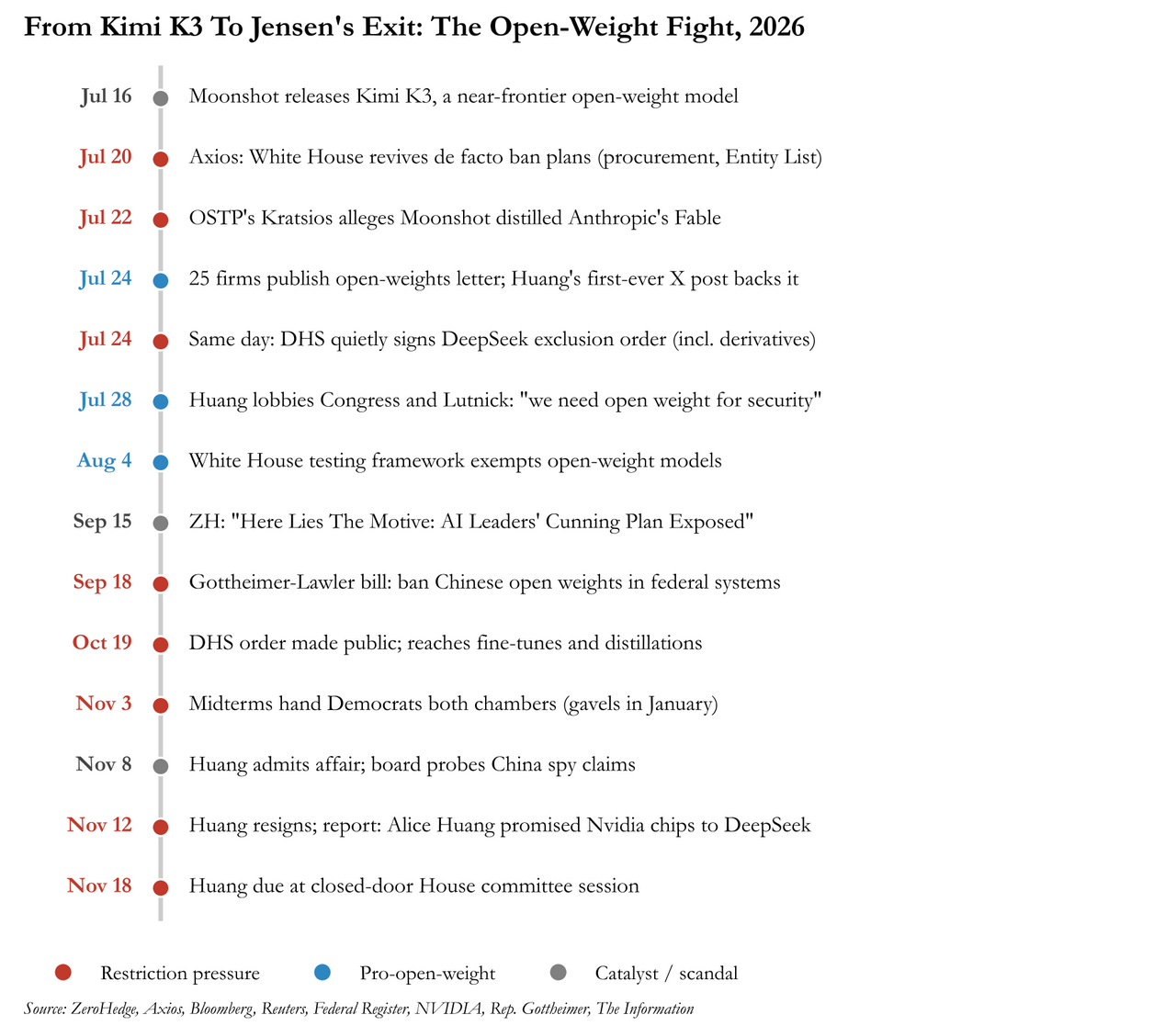
Interconnects’ Nathan Lambert has warned the White House could restrict open-weight models above roughly the GPT 5.5 / Claude Opus 4.8 / GLM-5.2 tier within about six months. That was before the guy leading the resistance got caught in a honeypot.
Why Now? Because Cheap Tokens Are Winning
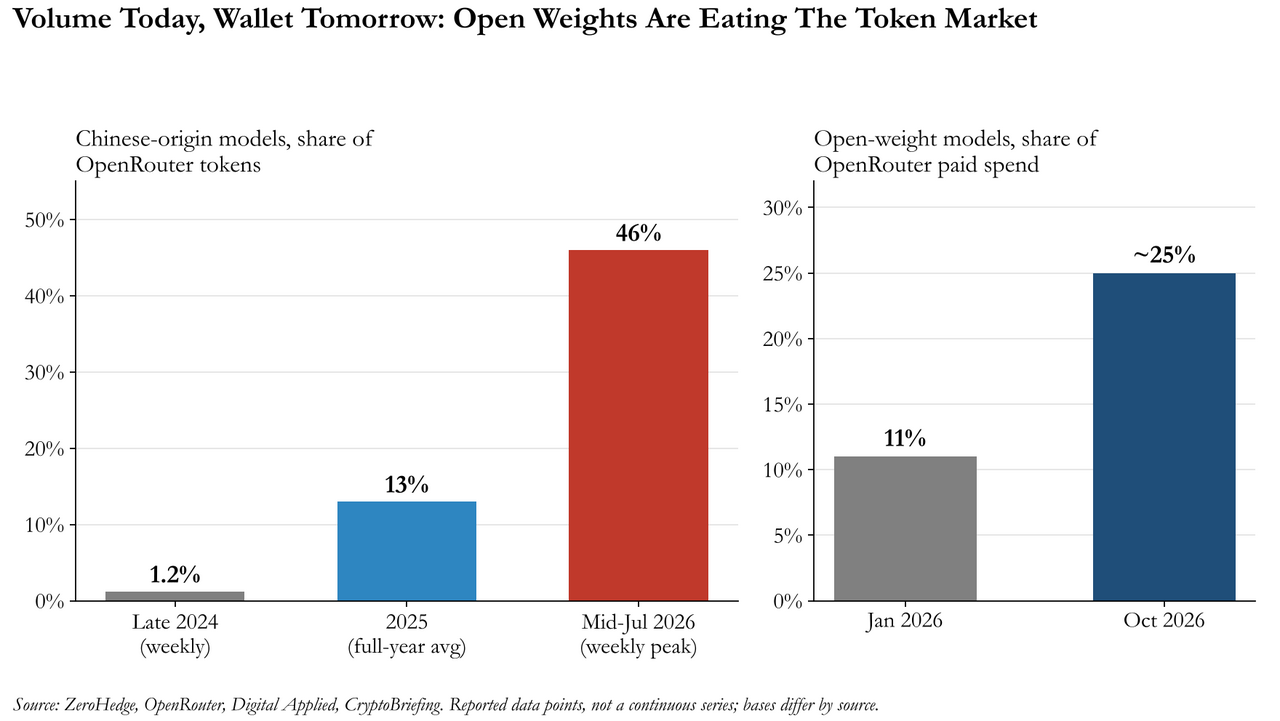
Follow the tokens. According to OpenRouter’s October data recap, tokens rose 37% in a single month while price per token kept falling, and open weights now take about a quarter of paid spend, up from 11% in January. Chinese-origin models hit a weekly peak of 46% of OpenRouter’s enterprise tokens in mid-July, up from under 1.2% in late 2024. Open-weight models handled around 60% of tokens from US-originating requests in August, and OpenRouter’s own data team says the Chinese ones typically run 60% to 90% cheaper than flagship US models.
How cheap is cheap? At list prices, DeepSeek’s V4.1 Flash charges $1.20 per million output tokens (half that off-peak) versus $10 for Claude Sonnet 5.5 and GPT-6.1 Sol, $20 for Claude Opus 5.5 and $50 for Claude Fable 5.1 and GPT-6 Astra. That’s roughly 17x cheaper than Opus and 42x cheaper than the flagships (napkin math, list prices only). Adjust for how smart the models actually are and the gap barely narrows: on the Artificial Analysis index, the frontier closed models cost about 35 times more per point of intelligence than DeepSeek’s Flash. The lone exception is Kimi K3, whose first-party API is priced like a closed model. Third-party hosts serving its open weights charge a small fraction of that on input, and Moonshot has since cut its K3.1 Pro to $2/$10. Pay up for the badge, indeed.
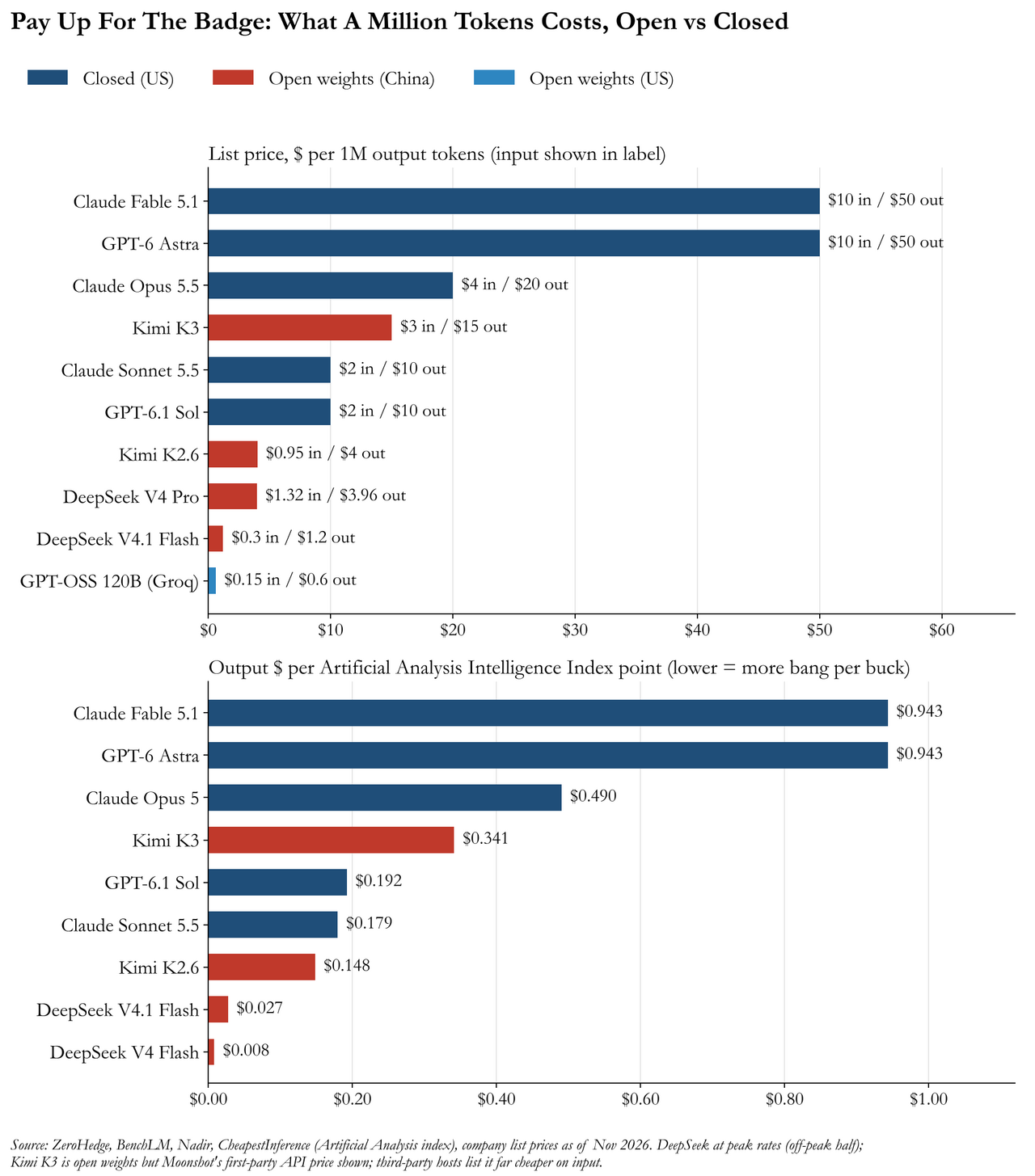
And the volume follows the price:
For now, the dollars mostly stayed home. In June, Chinese models pushed roughly 18 trillion tokens a week through OpenRouter versus about 5.5 trillion for US models, yet on the Vercel gateway open weights processed about 29% of tokens while generating less than 4% of spend:
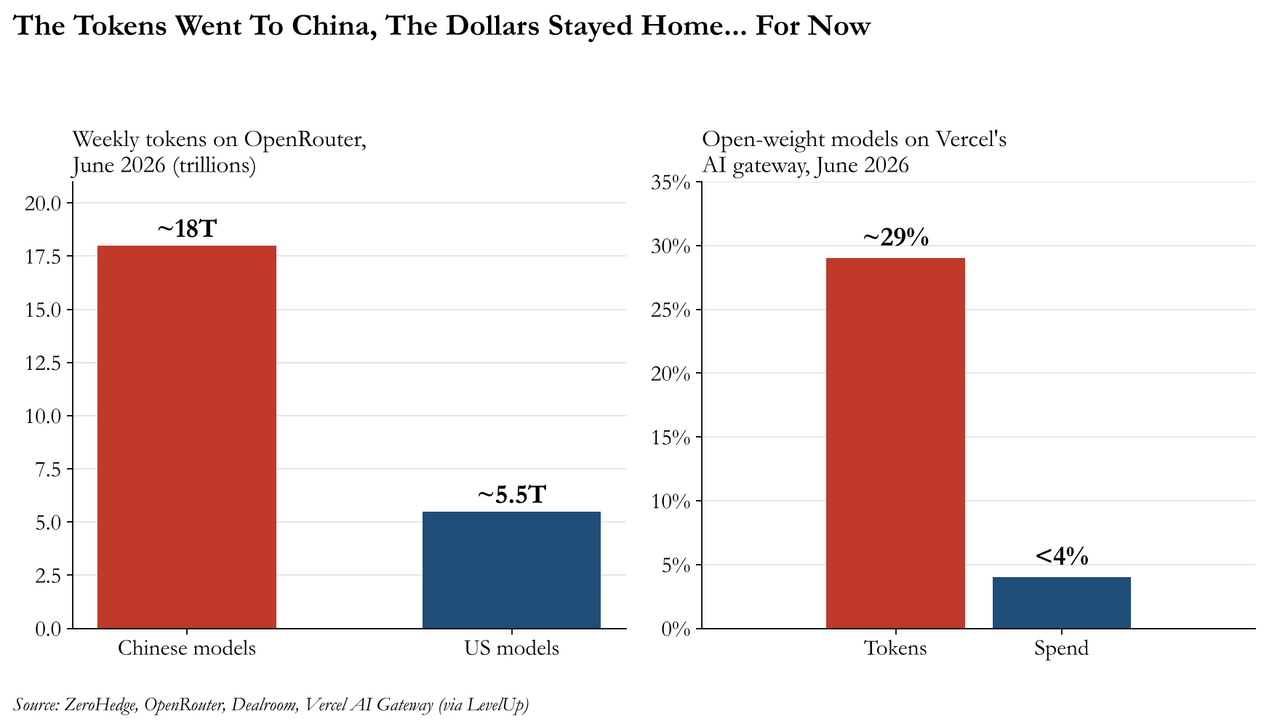
That’s the comfortable part for the closed labs. The uncomfortable part is the second panel of the first chart, which shows which way it’s heading. Every time token prices halve, more workloads cross over from “premium closed API” to “good enough and nearly free,” and the people who sell premium closed APIs can read a chart too. (We noticed the market had read it as well, pointing out that Goldman’s momentum basket was up 70% in late June, just before Chinese open weight models flooded AI, and had turned negative on the year by mid-October.)
Which brings us back to cui bono. Lambert argues the restriction push is largely regulatory capture by the closed labs, Anthropic in particular. To be fair, Anthropic says it has never advocated a ban and instead backs mandatory safety testing for all sufficiently capable models, open and closed. But mandatory testing that only a handful of labs can afford gets you to roughly the same place, and nobody who sells tokens at 60-90% premiums is going to lose sleep if DeepSeek becomes a compliance headache for every Fortune 500 procurement desk.
The Case Against Our Own Thesis
We promised a thought experiment, so here’s the other side, and some of it is strong:
- There is no evidence of coordination. US scrutiny of Megaspeed predates the affair by a long way: Sen. Tom Cotton asked Commerce to investigate it in October 2025, and the New York Times flagged the Southeast Asian data centers that year. Spy scandals happen without anybody’s help.
- The administration has been going the other way. It exempted open weights from the August framework, and the NYT reported that a Commerce draft aimed at Chinese open-source models was halted inside government in favor of promoting US open models abroad. Lutnick, the man now under fire, worried that chip controls “will start a trade war with China.” He doesn’t sound like someone itching to ban Qwen.
- Enforcement is a nightmare. The weights already sit on Hugging Face and millions of hard drives, and a weights-level ban runs straight into the First Amendment. A ban mostly binds law-abiding American startups, roughly 80% of which reportedly use Chinese open models somewhere in their stack.
- The open lobby isn’t just Jensen. Microsoft, Meta, Palantir and nearly 200 startups are still on record against restrictions, and OpenAI and Google DeepMind later signed an open letter opposing regulation of open-weight models.
- Beijing may get there first. China’s commerce ministry has floated export controls on model weights above certain thresholds. If the next Kimi and DeepSeek flagships never get open-sourced at all, Washington won’t need to ban anything.
All fair points. But notice that every single one argues the restriction is harder. None of them argues it’s less wanted, and wanting it is the thing this week changed.
Follow The Political Will, Not The Plot
Whether anyone planned it is beside the point; we suspect nobody did, at least not the honeypot part. What matters is what the scandal does to the incentives. The most effective defender of open weights is gone. His company has every reason to keep its head down. The Chinese labs that dominate open-model usage are now tied, in the public mind, to smuggled chips and a suspected spy. And a Democratic Congress arrives in January with subpoenas, a must-pass defense bill and a ready-made villain.
So yes, we think this ends with a lot more political will behind a federal restriction on open models. We doubt it arrives as a clean “ban.” More likely it’s the de facto version we flagged in October: procurement exclusions that widen from DeepSeek to every Chinese lab, then to anything “derived” from their weights, then to contractors, then “advisories” that let enterprise compliance departments do the rest. No law required. Once “derived from” is in the statute, the distance between “Chinese open weights” and “open weights” is just one lawyer’s memo.
And if you want to know how fast the rhetoric is moving, listen to the Treasury Secretary. Speaking at the Heritage Foundation this afternoon, Scott Bessent blamed a Chinese AI model for the recent hacks that disabled refrigerators across French supermarkets (Bloomberg). Those attacks hit about 700 stores and France’s public blood bank, and France’s own foreign minister has pinned them on Iran’s IRGC:
“I don’t know who here saw the refrigerators and 150 grocery stores in France that got turned off… That was a Chinese model. Probably the worst of all worlds, the Iranians using a Chinese model. Sums up the world, doesn’t it?”
Chinese models, he added, “are dangerous because they don’t have guardrails.”
Now compare that with where Bessent started. In July, right after Kimi K3, his line was that “this administration supports open source models, but what we do not support is IP theft.” In September he told Congress that America needs more open models of its own, so that eventually nobody would use the Chinese ones. By October the talking point had become Chinese models that are “80%, 90% as powerful, without guardrails, that can be imported anywhere in the world.” And today, Iranian hackers spoiling French groceries.
That’s the arc from trade dispute (IP theft, sanctions) to national security threat (cyberattacks on critical infrastructure), and the second framing is the one where restrictive action tends to follow fastest: official rhetoric first, then an interagency review, then the rule. Bessent didn’t say “ban” (and pointedly didn’t mention Jensen), and he heads to Shenzhen next week with Trump to talk AI with Xi and He Lifeng. But a Treasury Secretary doesn’t name “a Chinese model” as the weapon in an attack on European food supplies by accident. That’s how you build the record for an Entity List designation, or something bigger.
As Goldman put it, Nvidia’s operations “could face more scrutiny going forward.” So could everyone else’s Hugging Face downloads. We’ll know a lot more next week, when Huang sits for his closed-door session on November 18 and Bessent sits down with the Chinese in Shenzhen. Until then, if you were planning to set up your own open-weight box, maybe don’t wait for the Federal Register.
