

China’s Record Ship Swarm Around Taiwan Sends Decoupling Alarm To Wall Street
One of our emerging investment themes (beyond nuclear, AI, and “Powering Up America“) is the accelerating US-China decoupling, with a particular focus on companies with robust ex-China supply chains as Beijing increasingly weaponizes exports of strategic materials, including tungsten and germanium.
At the same time, the Trump administration’s expanding sanctions campaign against Chinese entities linked to Iran is adding another friction point to an already deteriorating bilateral relationship. Looking toward 2027, one of the biggest geopolitical tail risks could be a Chinese blockade of Taiwan, which would severely disrupt global trade, semiconductor production, and critical supply chains.
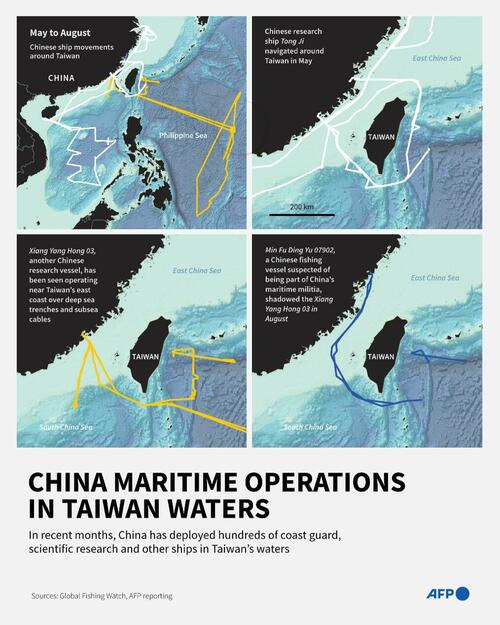
The latest report from Taiwan’s main English-language daily newspaper, the Taipei Times, shows that China deployed a record 244 coast guard, research, and other government vessels around the island.
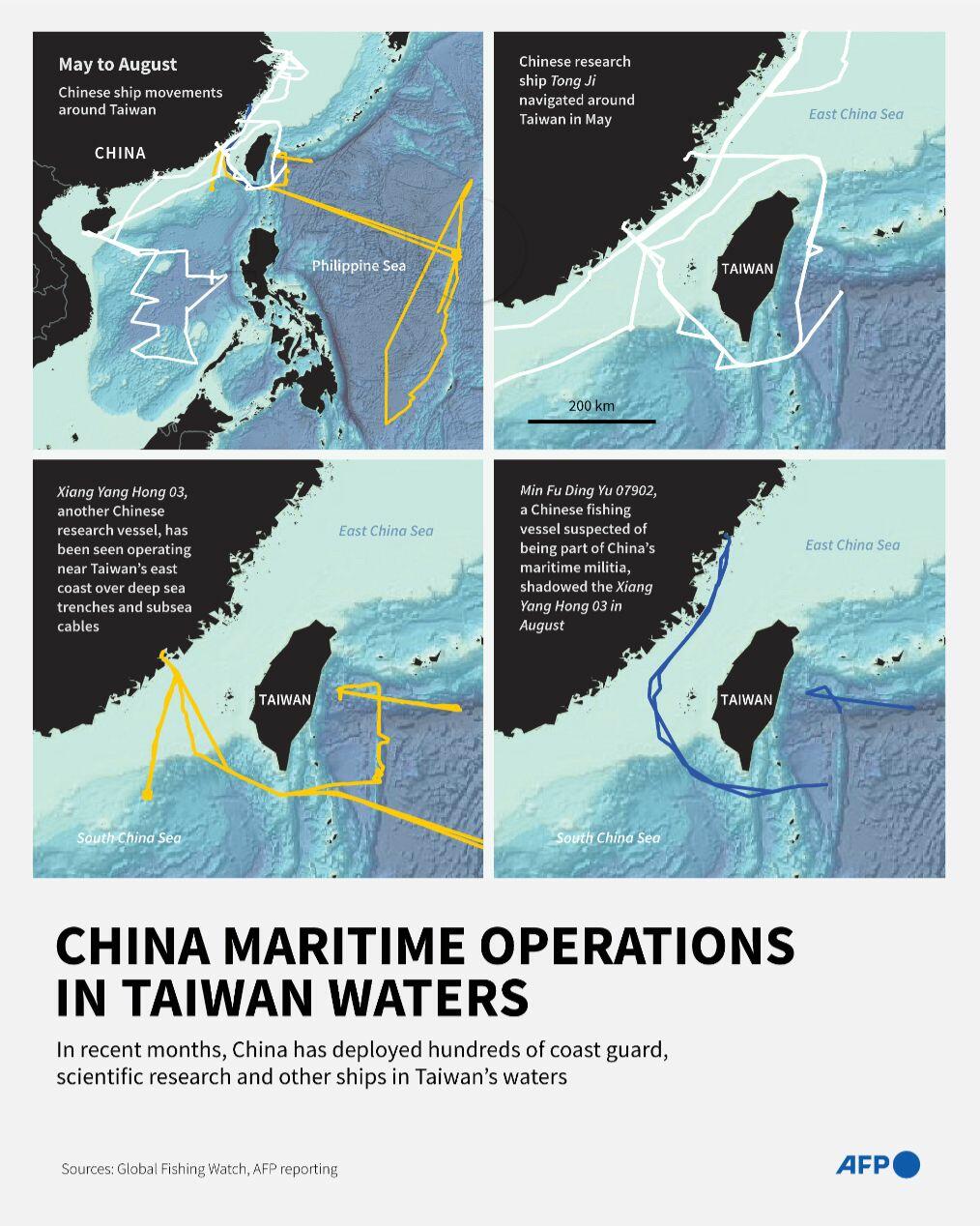
The surge in Chinese vessels surrounding Taiwan, in what may be a mock blockade run, exceeded June’s total of 55 vessels and averaged nearly 8 ships per day. Another 152 were detected during the first three weeks of August.
About 60% of the ships were Chinese coast guard ships, while research and other government vessels accounted for the rest. The figures exclude the People’s Liberation Army Navy warships operating around Taiwan almost daily.
“When we say the situation is becoming increasingly severe, we mean that the number of their government vessels in the waters surrounding Taiwan has increased, and there was a marked increase in July,” a senior Coast Guard Administration official told the local outlet.
The outlet said the Chinese vessels were likely involved in “oceanographic sampling and seabed survey operations,” which could contribute to China’s “anti-submarine warfare databases.”
Ryan Martinson, an expert on China’s maritime strategy at the US Naval War College, told the outlet that “any kind of data/knowledge is highly useful for Chinese naval forces, which will operate in these waters in the event of a conflict.”
In the past couple of months, Martinson said he had observed a “very large increase” in the number of Chinese research ships operating around Taiwan, especially to the east of Taiwan proper.
“This is not a new ‘play’ in its ‘playbook.’ Rather, the novel aspect is that the scale of these operations around Taiwan is unprecedented,” he said.
Overnight news:
Overnight, 3 out of 3 sorties consisting of PLA aircraft, 8 PLAN vessels, and 5 official ships crossed the median line and entered Taiwan’s northern and eastern ADIZ.
-Taiwan’s Ministry of National Defense pic.twitter.com/MTIYAH2Cob
— Open Source Intel (@Osint613) August 30, 2026
What is becoming evident is that China may not even have to fire a shot to isolate Taiwan. However, we do not expect a future quarantine or blockade before Chinese President Xi Jinping meets with President Trump in Washington on September 24.
After the Trump-Xi summit, however, China hawks on Capitol Hill could get their way, as a new Politico report says lawmakers are pressing the Treasury Department to target Chinese banks over Iran.
“Any country complicit in providing an economic lifeline to Iran’s terrorist regime, including China, must be held accountable,” said Rep. Darin LaHood (R-Ill.), a member of the House Select Committee on China.
LaHood noted that sanctions on Chinese banks that do business with Iran would send “a clear message to China and every other nation that enabling Tehran’s malign actions will come at a cost.”
Taken together, the surge in Chinese government vessels around Taiwan appears less like routine maritime activity and more like preparation for a future quarantine or blockade.
For markets, any move toward a blockade would accelerate US-China decoupling and trigger severe disruptions across semiconductors, shipping, energy, and critical-material supply chains.
Decoupling Theme:
- China’s Tungsten Chokehold Turns Almonty Into a Critical-Metal Lifeline
- “BlackDiamonds Are Forever”: How To Profit From The China-Driven Germanium Squeeze
We’re already mapping out critical material supply chains outside China to help readers be well prepared for what seems to be an incoming crisis.
Notably, a blockade or quarantine could be imposed at virtually any time of year and is not weather-dependent. However, a full-scale Chinese invasion has two favorable windows:
- Spring: roughly March through May, with April often cited as the best month
- Autumn: roughly late September through November, with October often cited as the best month
Beijing does not need favorable invasion weather to begin isolating Taiwan. The record number of ships around Taiwan may only suggest that much more is to come.
This also comes as President Trump has declared the Strait of Hormuz a “New U.S. Territory,” complicating matters for China because about 45% to 50% of the country’s crude oil imports normally transit the critical waterway.
The US has also struck the “biggest oil deal in history” by taking a majority stake in Venezuela’s oil industry, cutting into yet another source of cheap crude for China.
Taken together, China might feel more pressure than ever to blockade Taiwan, particularly given that the U.S. military is experiencing a “beyond critical” shortage of missile interceptors and other critical weapons.
Tyler Durden
Mon, 08/31/2026 – 06:55

