

Warsh’s Credibility Test: How The Fed Chair Painted Himself Into A Corner
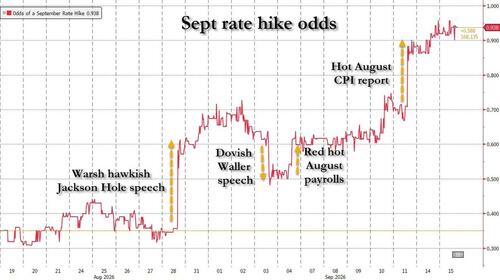
Only about two weeks ago, downside risk to the labor market had been flagged by a negative nonfarm payroll growth number for July, progress was being made on the inflation front, and Warsh had been exceptionally quiet for a Fed Chair. Consequently, markets were pricing in a low probability for a rate hike in September, just over 30%.
Then, as Rabobank’s Philip Marey writes in his FOMC preview note, at Jackson Hole, Warsh surprised the markets with a hawkish speech on inflation. A week later, the new Employment Report erased the negative number for July, replaced it by a positive number, and added an outright impressive positive nonfarm payroll growth figure for August. Then, on Friday, the CPI report showed a larger than expected month-on-month increase in the core CPI, suggesting that progress on inflation was stalling. As a result, markets are now pricing in a near certain probability of a hike in September and 3-4 hikes in total before the end of next year, and then another 2 by next summer.
Looking through inflation
Echoing some of Goldman’s FOMC views (see “Goldman Now Expects A Fed Hike This Week, Not Because It’s Needed, But Because Warsh Doesn’t Want To Disappoint The Market”), Rabobank’s Philip Marey writes that if we look at the economy, downside risks to the labor market have receded for now and GDP growth remains solid. Therefore, the Fed can focus on inflation. It is clear that inflation is too high at 3.4% headline CPI year-on-year and 2.4% core CPI year-on-year in August. However, much of the excess inflation can be attributed to supply shocks, most notably the war with Iran. Since monetary policy is aimed at the demand side of the economy, the central bank cannot do much about supply shocks. Therefore, the academic literature suggests that central banks should look through the temporary episodes of inflation caused by supply shocks and focus on the underlying inflation trend, provided that long-term inflation expectations remain anchored.
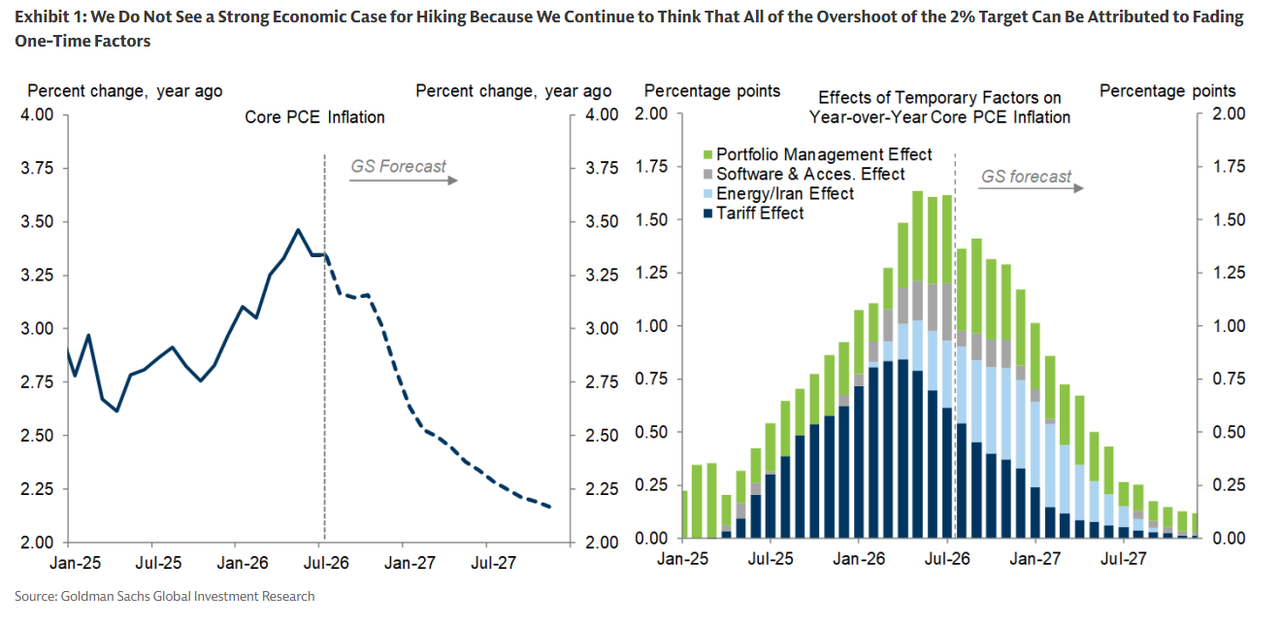
Since these inflation expectations have remained stable, whether measured by consumer surveys or derived from financial markets, Rabobank thinks that the Fed should have been able to keep the target for the federal funds rate unchanged for the remainder of the year.
Warsh’s credibility test
However, Warsh’s speech at Jackson Hole was a game changer. Perhaps overcompensating for his loss of credibility at the July post-FOMC press conference, the new Fed Chair struck a surprisingly hawkish tone two weeks ago. The immediate market reaction suggested that he had improved his credibility as an inflation fighter, but it was still all talk and no action. If the subsequent labor market data had remained weak and inflation had showed continued progress, Warsh might have been able to get away with it. However, both crucial data sets are calling Warsh’s bluff. With decreased downside risk to the labor market and stalling progress on inflation, Warsh’s tough talk at Jackson Hole may warrant rate action in the coming months. Remaining on hold is becoming increasingly difficult.
And while Rabobank – like Goldman – still thinks that the Fed should look through the current episode of inflation, Warsh seems to have painted himself into a corner with his hawkish speech at Jackson Hole. Since the labor market and inflation data have not come to his rescue, we now add a rate hike to our Fed forecasts for 2026, which previously assumed that Warsh was able to navigate through the year without hiking.
This also shows that looking through inflation could benefit from forward guidance. Markets are now translating all inflation pressures into expectations of a higher policy rate path.
If we look at Friday’s market reaction to the CPI report, it is clear that a September hike is largely priced in. With only one day left before the FOMC meeting, and the Fed in a blackout period, this is not likely to change. Consequently, not hiking on Wednesday would come as a big surprise to the markets. In fact, with markets now pricing in 3-4 hikes in total before the end of next year, it would be a real mind-bender. Failing to raise rates now will fundamentally fracture the Fed’s relationship with the markets and cause considerable volatility in the coming months. Therefore, Rabobank – like Goldman and many other banks – put its forecast for a hike in September, rather than October or December.
September or October?
However, although markets are now convinced that the Fed is going to hike in September, Rabo’s Fed watcher still has some lingering doubts. First, the 0.1 ppt overshoot in core inflation month-on-month seems to have been caused to a large extent by an extreme 5.9% (this is month-on-month!) increase in the price of wireless telephone services.
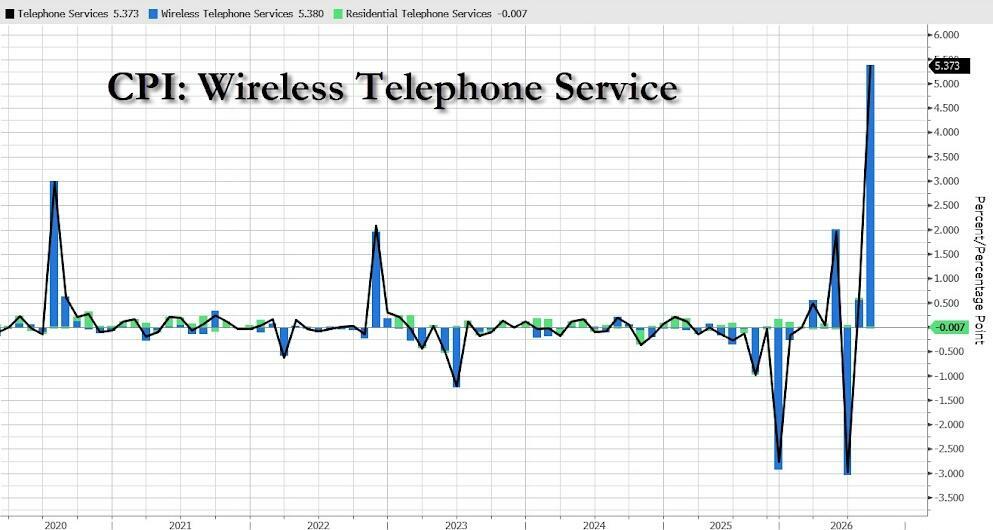
Otherwise, core inflation would have been in line with the 0.2% consensus expectation and low enough for the doves to stick to their guns. In fact, they may point to the random nature of this overshoot as an argument for remaining on hold in September.
Second, the 2.4% year-on-year core CPI figure is the lowest since March 2021! Consequently, a September hike could still meet with opposition from the doves and this could delay the final decision to the next meeting in October. That would increase the likelihood of a more unanimous decision.
Therefore, although Rabobank puts its hike forecast in September, the bank still think there is a risk that the hike gets delayed until October. In fact, Warsh may still try to delay the hike beyond the midterms, but then he runs the risk of being outvoted by the FOMC. This would mean a loss of credibility within the Committee. He will have to balance credibility with the financial markets and the FOMC with his relationship with the White House. There no longer seems a path to a painless solution, so he will have to appease and alienate both sides at different times. A rate hike would satisfy the markets and the hawks, but annoy the White House. By avoiding further hikes, he will alienate the former and improve his standing with the latter, especially if he steers towards rate cuts in 2027. In the end, if a hike is unavoidable then from a purely electoral perspective September may be more attractive than October, because that meeting is less than a week before Election Day.
One and Done
More importantly, although markets are now pricing in 3-4 hikes before the end of 2027, Rabobank like Goldman is convinced that the supply side nature of the shocks that are driving this spell of inflation does not warrant a new hiking cycle. One should suffice to keep inflation expectations anchored, two at most. Therefore, market pricing is likely overdone and Rabo puts only one rate hike in its Fed forecasts for 2026.
Of course, it could be argued that the AI boom is causing a demand shock that could add to inflation pressures and therefore warrant additional hikes (especially for memory prices). However, many doubt the Fed would tackle the AI boom to ease inflation. After all, the promise of AI is that it is going to increase productivity down the road, which would ease inflation pressures long term and make it easier for the Fed to reach its 2% inflation target (even if it sends inflation sharply higher in the near-term). And then we are not even talking about the geopolitical implications of sabotaging the home team in the AI race with China.
Tyler Durden
Tue, 09/15/2026 – 13:00

