

Geothermal Just Undercut Solar-Plus-Storage In Sunny Nevada
Geothermal has long been the clean, firm power source that was always a few breakthroughs away from being cheap enough to matter. Numbers buried in a Nevada utility filing suggest that day may have arrived.
Joel Edwards, co-founder and CTO of geothermal developer Zanskar, put it bluntly earlier this month: “to all the geothermal believers out there, the flippening has come.”
to all the geothermal believers out there, the flippening has come in NV Energy’s 2026 filing, 3 geothermal offers came in at $105–107/MWh, below the ~$114/MWh capacity-weighted average for 11 solar + bess offers in Nevada, of all the sunny places the 3 solar + bess projects NV Energy put forward in 2024 averaged ~$94/MWh, but this 2026 slate is pricier, e.g., Boulder Solar III’s levelized price jumped from ~$85/MWh to ~$125/MWh after permitting delays, land carrying costs, higher financing costs, and, of course, big, bad tariffs. could geothermal pull off a solar + wind circa 2010 move and scale faster to come down the cost curve? it now has a much longer tax-credit runway than new solar + wind projects (oh how the tables have turned), plus firm output and higher energy density (all true for nuclear too) and for the 24/7 solar crowd: the ~$114/MWh average covers solar paired mostly with 4-hour batteries, and we all know 12+ hours of storage would cost more and still wouldn’t cover multi-day gaps it might be time for more geothermal, people
— Joel Edwards (@joelhedwards) October 7, 2026
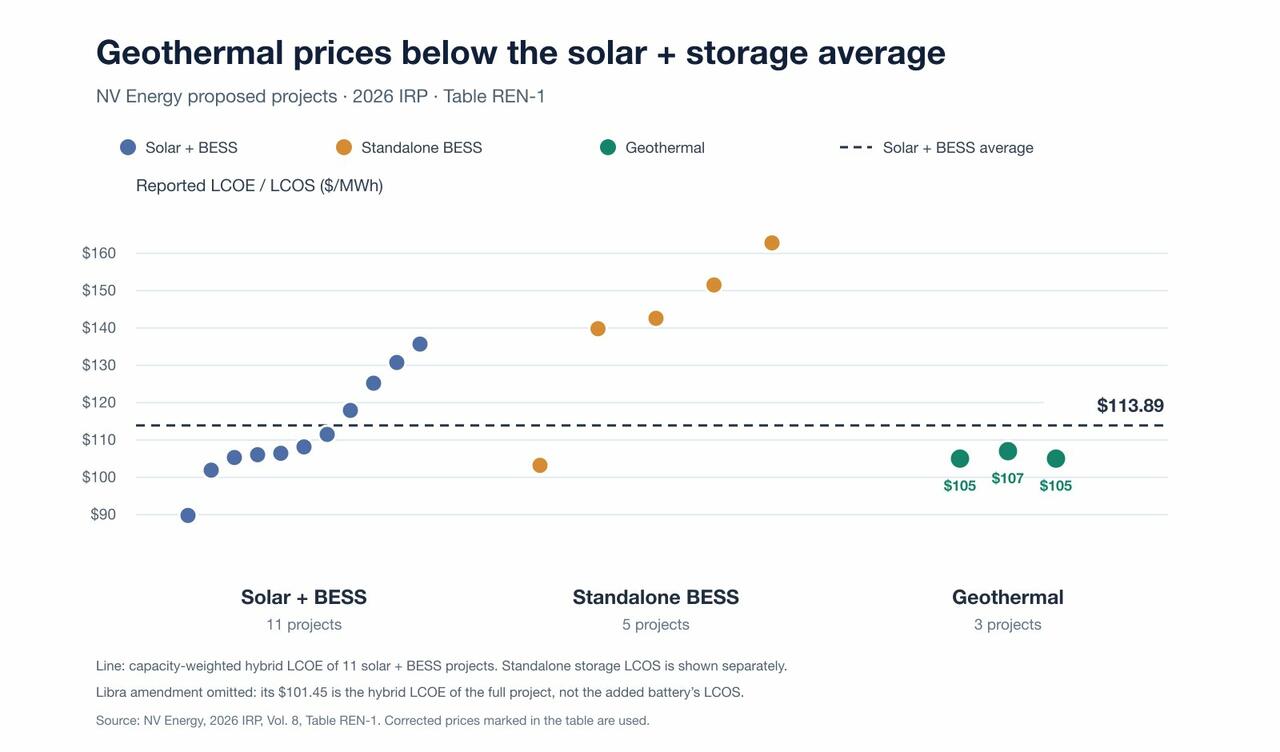
In NV Energy’s 2026 resource plan, three geothermal offers came in at $105 to $107 per megawatt-hour. That’s below the roughly $114/MWh capacity-weighted average for the 11 solar+battery projects in the same filing.
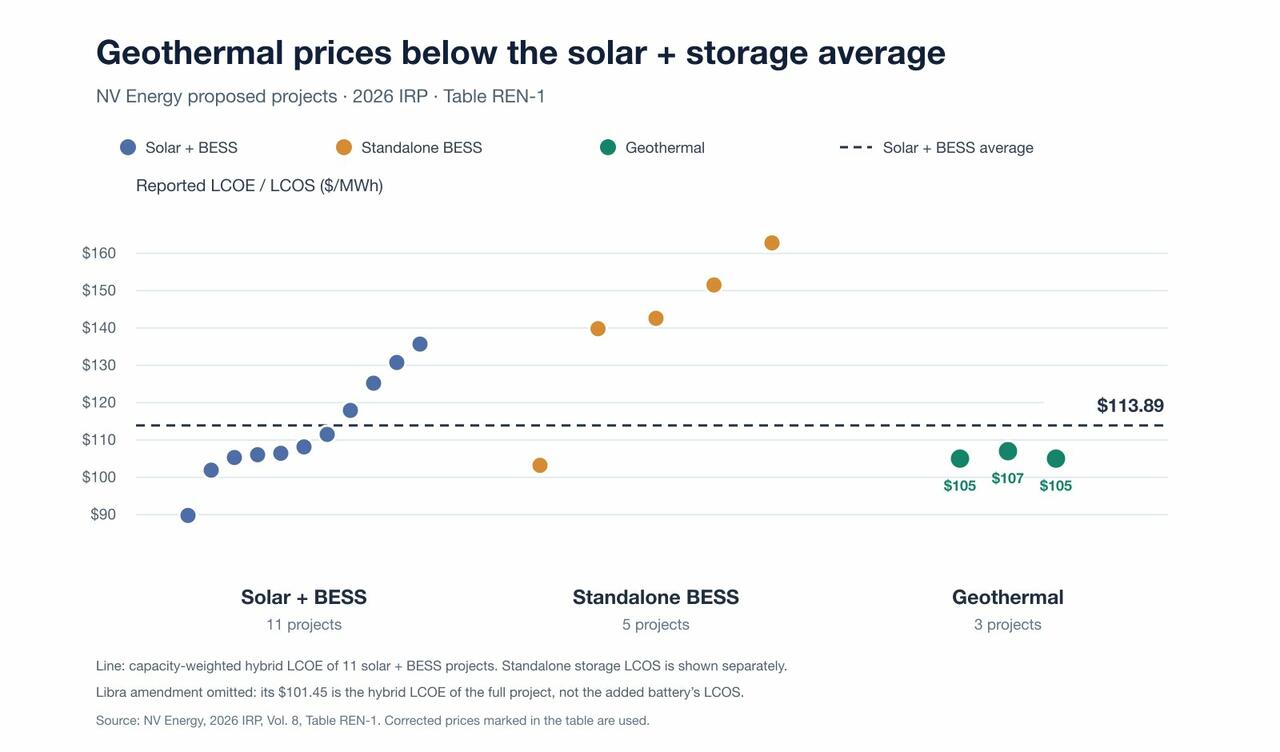
Using the filing’s corrected prices, the three geothermal deals total 180 MW at a weighted $105.56/MWh, versus 4,370 MW of solar-plus-storage at $113.89/MWh.
Geothermal just barely comes in about 7% cheaper.
Part of the story is solar getting pricier. Edwards notes the three solar-plus-storage projects NV Energy put forward in 2024 averaged about $94/MWh.
This time, Boulder Solar III’s levelized price jumped from about $85/MWh to $125/MWh after “permitting delays, land carrying costs, higher financing costs, and, of course, big, bad tariffs.”
The bigger point is what each megawatt-hour buys. A geothermal plant pulls heat from underground and runs day and night, whatever the weather. We said the same thing back in April, that it’s “firm 24/7 power that intermittent renewables struggle to match.”
The solar average, meanwhile, “covers solar paired mostly with 4-hour batteries,” Edwards wrote, “and we all know 12+ hours of storage would cost more and still wouldn’t cover multi-day gaps.”
That’s why data centers are signing up for geothermal. Google is backing up to 150 MW of new Ormat geothermal through NV Energy, and Amazon is backing 100 MW from Zanskar.
To be fair, geothermal beat the average, not every bid. Sleepy Orange came in at $89.80/MWh and White Pine Solar at $101.92. Two of the three geothermal deals (and two of the solar ones) are also “sleeved” contracts tied to specific big customers rather than open bids.
A longer runway
Edwards asks whether geothermal could “pull off a solar + wind circa 2010 move and scale faster to come down the cost curve.”
Under last year’s One Big Beautiful Bill, wind and solar projects that didn’t begin construction by July 4 of this year must be in service by the end of 2027 to claim federal tax credits. But geothermal, like battery storage, keeps the full credit for projects that start construction through 2033.
The drilling learning curve is already compounding. In July, we noted that Fervo’s third-generation well design boosted drilling rates 143%, with its latest Cape Station well finished in 21 days. Last month, Big Oil backed Mazama’s $135 million bet on superhot geothermal, whose second well hit 10,350 feet about 80% faster than its first. And as we noted in August, the Trump administration increasingly sees geothermal as an AI power source.
DOE’s “Enhanced Geothermal Shot” aims to bring next-generation geothermal down to $45/MWh by 2035, well under half of what Nevada was just offered.
Public geothermal is getting crushed
Ormat (ORA), one of the only pure-play publicly traded geothermal companies, is down 19% year to date. Fervo (FRVO), which priced its IPO at $27 in May and closed its first day at $36, finished Friday at just over $9, a record closing low and 64% below its IPO price.
Fervo warned in August of transmission curtailment at Cape Station, and on Oct. 6 short seller Morpheus Research alleged thermal decline, water loss and seismicity problems at its sites.
All this came days after Cape Station’s first 33 MW block began commercial operation a day ahead of schedule.
Meanwhile, the market is still up over 10% this year, and the energy ETF XLE has soared 51% as the US-Iran war drags on.
Tyler Durden
Mon, 10/19/2026 – 15:25

